Murchison Falls National Park: Uganda's thunderous heart of the north
Uganda Tourism
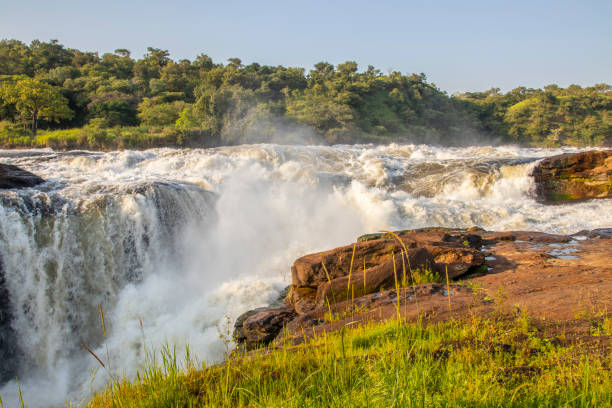
For hundreds of kilometres the White Nile drifts through Uganda with the unhurried grace of a river that has nowhere to be. Then, at a crack in the Rift Valley escarpment, it is squeezed into a gap barely seven metres wide and flung down a drop of some 43 metres. The sound arrives before the sight: a deep, bodily roar, and a mist that rises in the afternoon light and hangs there, trembling, with a rainbow caught inside it. This is Murchison Falls, and the park built around it is the largest and, for many visitors, the most complete safari Uganda has to offer.
A park shaped by a river
Murchison Falls National Park lies in north-western Uganda, spreading across the districts of Buliisa, Nwoya, Masindi and Kiryandongo, and forms the core of the wider Murchison Falls Conservation Area together with the neighbouring Bugungu and Karuma wildlife reserves. It is Uganda's biggest national park, and the Victoria Nile slices it in two, flowing west from the falls toward Lake Albert. The northern bank is open savannah, studded with borassus palms and acacia; the southern bank is a mosaic of woodland and the tangled Budongo forest edge, home to chimpanzees.
The falls were named by the explorer Samuel Baker in 1864, in honour of Sir Roderick Murchison, then president of the Royal Geographical Society. The area later became a protected game reserve, and the park as we know it took shape in the 1950s. Its reputation as one of Africa's great wildlife destinations was battered during the decades of poaching and unrest that followed independence, when elephant, buffalo and giraffe numbers collapsed. Conservation groups and the Uganda Wildlife Authority (UWA) have spent years bringing the park back, and populations of elephants, Rothschild's giraffes, buffalo, lions, hartebeest and Uganda kob have recovered steadily.
What to do when you get there
The classic Murchison day begins with a morning game drive across the northern plains, where a good guide will find giraffes loping across the horizon, elephants coming down to the water, and, with luck, a lion pride dozing in the grass. Leopards are rarer but seen. By midday most travellers head to the water, because the signature experience here is the launch cruise from Paraa. The boat noses upstream through channels thick with hippos and Nile crocodiles, past buffalo wallowing at the shore and clouds of waterbirds, ending at the base of the falls, where the whole river is shouting at you from above. The shoebill, that prehistoric, improbably serious bird, is a prized sighting on the delta near Lake Albert, and birders regularly tick off more than a hundred species in a few days.
The other great perspective is from the top. A steep hike up the escarpment leads to a viewpoint where the Nile funnels through the narrow gorge, and the force of it can be felt through the soles of your boots. Beyond the headline sights, the park offers night drives, nature walks, sport fishing for Nile perch, and cultural visits to nearby communities. Chimpanzee tracking is available in the neighbouring Budongo Forest, with the Kaniyo Pabidi area a popular add-on.

Planning your visit
Murchison is open year-round, but the dry seasons, roughly December to February and June to September, are the easiest for game viewing, with animals concentrated near water and roads in better shape. The wet months bring lush scenery, fewer vehicles and excellent birding, though some tracks turn slick. Most visitors drive from Kampala in about five to six hours via Masindi, enter at the southern gate, and cross the river at Paraa by ferry. Others fly into the Pakuba or Bugungu airstrips from Entebbe or Kajjansi, which saves a day of road travel. Accommodation runs from budget campsites to high-end lodges perched above the river.
On fees, published UWA figures commonly cited by operators put the foreign non-resident entry at about US$45 per adult and US$25 per child, with a launch cruise to the base of the falls around US$30, the hike to the top of the falls around US$15, and a day game drive guide around US$25. These figures come from the 2024 to 2026 tariff, which has now run its course, and UWA notes that fees can change without notice, so travellers should confirm current rates with UWA or a licensed operator before booking.
The challenge beneath the beauty
Murchison's recovery is real but not guaranteed. The Murchison Falls area has long sat at the intersection of conservation, oil development and energy planning, and conservation groups have repeatedly warned that any infrastructure touching the river or the falls themselves would damage the core of what visitors come to see. Closer to the ground, human-wildlife conflict remains a daily reality for farming communities along the boundary, which is why UWA began installing electric fencing around the park in 2022. That fencing is now in the news for the wrong reason, as described below.
This Week in Ugandan Tourism
28 October: fence cut near Murchison — Pulse Uganda reported that suspected poachers cut roughly five kilometres of the electric fence around Murchison Falls National Park in Oyam District. A UWA law-enforcement warden said investigations are under way and that staff are inspecting the fence daily. The fence is part of a 126-kilometre project begun in 2022, and UWA says it has reduced human-wildlife conflict.
28 October: gorilla permits cut to US$600 — Reports say UWA has lowered the mountain gorilla tracking permit for international visitors from US$800 to US$600, with Ugandans and East Africans paying UGX 300,000. New Vision reports the reduced rates apply around the first Mountain Gorilla Festival, to be held in Kisoro from 19 to 22 November 2026 under the theme "Protecting Gorillas, Empowering Communities." Reports differ on whether the cut extends beyond the festival weekend, so travellers should check with UWA.
30 October: CAF and UTB sign destination deal — The Uganda Tourism Board and the Confederation of African Football launched a partnership in Kampala making Uganda an official destination sponsor of the TotalEnergies CAF AFCON PAMOJA 2027, which Uganda co-hosts with Kenya and Tanzania from 19 June to 17 July 2027. The "Explore Uganda: The Pearl of Africa" brand will feature in broadcasts, stadiums and ticketing.
3 November: tourism through football in Berlin — Uganda's embassy in Berlin signed a three-year agreement with the Berlin club VfB Einheit zu Pankow, placing the "Explore Uganda" brand on the kits of its first men's team and youth side to promote travel to Uganda in Germany.
3 November: arrivals data in focus — Nile Post notes that Uganda received about 1.64 million international visitors in 2025, up 19.7 per cent, with receipts of roughly US$1.62 billion, against a government goal of US$5 billion by 2030. Only around 16 per cent of arrivals were leisure visitors, which is the gap that safari destinations like Murchison hope AFCON-linked marketing can help close.
The last word
There are louder waterfalls in the world and bigger parks, but few places combine them so neatly. At Murchison you can watch a giraffe at dawn, a hippo at noon and the full weight of the Nile hammering through a stone doorway by evening, all within a single day's reach. The challenge now is to keep it that way: fenced where it needs to be, funded fairly, and left unmolested at the one spot where the river does its most dramatic work.
Published By | Features Editor