Written By |
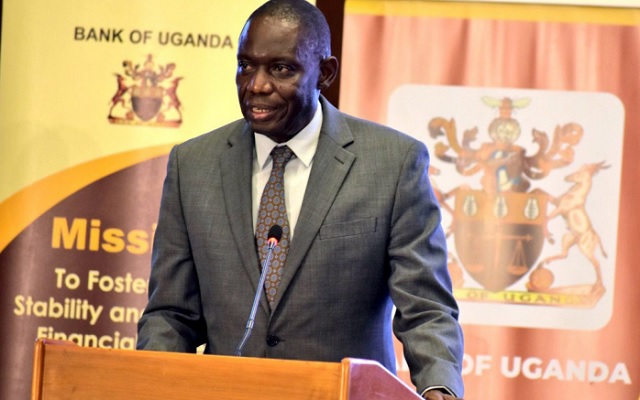
BOU Deputy Governor Michael Atingi-Ego
The Ugandan economy has bounced back strongly, posting robust economic growth rates with projections of between 6% and 6.5% in the current financial year (2024/25) and 7% in subsequent years. The growth will be driven by investment in the extractives industry and government programs, according to the Bank of Uganda (BOU) state of the economy report released last week. The monthly report for June this year was signed by BOU deputy governor Michael Atingi-Ego.
Over the next 25 or more years, oil and gas revenue is expected to fetch $8.6 billion (sh31.7 trillion) annually into Uganda’s economy as production from the Tilenga and Kingfisher oil fields are expected to produce 190,000 and 40,000 barrels of crude oil per day, respectively, at peak production. According to estimates by the Uganda Bureau of Statistics, the economy expanded by 6% in the 2023/24 financial year, up from an average of 4.1% between 2019/20 and 2022/23.
“The economy withstood several shocks, including the lingering effects of COVID-19, geopolitical conflicts, rising international commodity prices, rising global inflation, and tight global and domestic financial conditions,” reads part of the report. The report says the rebound in growth was driven by improvements in household spending, public investment, and net exports.
“On the production side, service and industry sectors were the major drivers of the rebound of growth. The industrial and service sectors grew by 5.8% and 6.6%, respectively, relative to 4% and 5.9%,” it further says. The industrial sector growth accelerated, thanks to the good performance of the manufacturing and construction sub-sectors that have held steady on the recovery path. “The agriculture sector also posted notable performance, growing at 5.1% backed mainly by the cash crop sub-sector. On the demand side of the economy, growth was driven by the acceleration of household consumption, net exports, and a push from public investments,” says the report.
BOU attributed the growth in household consumption at 8.2% to a significant recovery from the 3.6% observed in the inflation-stricken 2022/23 fiscal year. It says that consumer price inflation significantly eased in 2023/24, increasing households’ real incomes to afford more consumption. Also, consumer pessimism reduced during the period, with the consumer confidence index recovering from an average reading of 37.6% in 2022/23 to an average of 42.1%.
Growth Drivers
According to BOU, economic growth has primarily been driven by a resilient global economy that prevailed over tight financial conditions and geopolitical tensions. This, the report says, has kept external demand for Uganda's goods and services strong. “As a result, the contribution to growth from net export of goods and services substantially edged up in 2023/24, as a 35.5% volume increase in the export of goods and services was a major rebound and overwhelmed the meagre 7% growth of real import of goods and services,” the report states.
Additionally, the investment demand from the public sector was a major contributor to growth in 2023/24. Public investments, mainly in buildings and other structures, grew by 30% in 2023/24, thereby reversing the negative and no growth observed in previous years. Inflation, which remained muted at below 5%, a target set since May 2023, was another driver of growth. “This was due to tight monetary conditions, favorable domestic food supplies, and declining imported inflation, which is benefiting from lower global commodity prices coupled with the relative stability of the shilling against the dollar,” says the BOU report.
The inflation forecasts have been revised downwards, with headline and core inflation projected to be at 5.4% and 5.7%, respectively, in 2024/25, which is a 0.7% reduction mainly due to a less depreciated exchange rate. The vibrant shilling, which has broadly maintained relative stability, has registered an extended period of appreciation since late March 2023, following the two successive increases in the central bank rate, which lured back offshore investors who were seeking higher returns. The shilling gained against the dollar, appreciating by 2.7% between March and May 2024, extending the gains in June 2024. As of yesterday, the shilling was trading at 3,690/3,715 against the dollar for buying and selling, respectively.
Another driver of economic growth, according to BOU, has been government expenditure and revenue collection for the first 10 months of the 2023/24 financial year. Data indicates that the total revenue, including grants, was 12% higher relative to the same period last financial year. In the first 10 months of the financial year, relative to the Uganda Revenue Authority (URA) targets, the cumulative outturns for total net tax and non-tax revenue collections amounted to sh21.8 trillion, of which the net URA tax revenue amounted to sh20.3 trillion, and non-tax revenue amounted to sh1.52 trillion.
BOU also attributed other drivers to prices other than fuel, which also increased by 5.5%, supported by a spectacular rise in prices of beverages following a persistent upsurge in prices of cocoa and Robusta coffee. Cocoa prices almost tripled between October 2023 and April 2024 to reach an all-time peak of $9.74 (sh35,940) per kilogram in April 2024 before retreating to $7.54 (sh27,822) per kilogram in May 2024. Similarly, Robusta coffee prices almost doubled in the same period to reach a high of $4.23 (sh15,608) per kilogram, a level last seen during the 1970s. Prices of metals and minerals, which stayed on an upward trajectory, also helped shore up Uganda’s economy. Gold maintained a three-year rise amid haven flows and central banks buying, registering a 12.4% increase in the three months (March – May 2024) to reach an average of $2,351.1 (sh8.6m) per troy ounce in May this year. Uganda’s gold exports more than quadrupled last financial year, leading to a net gold export of $139m (about sh513b) after the tax disputes on gold exports that had led to the halting of gold trade were resolved. 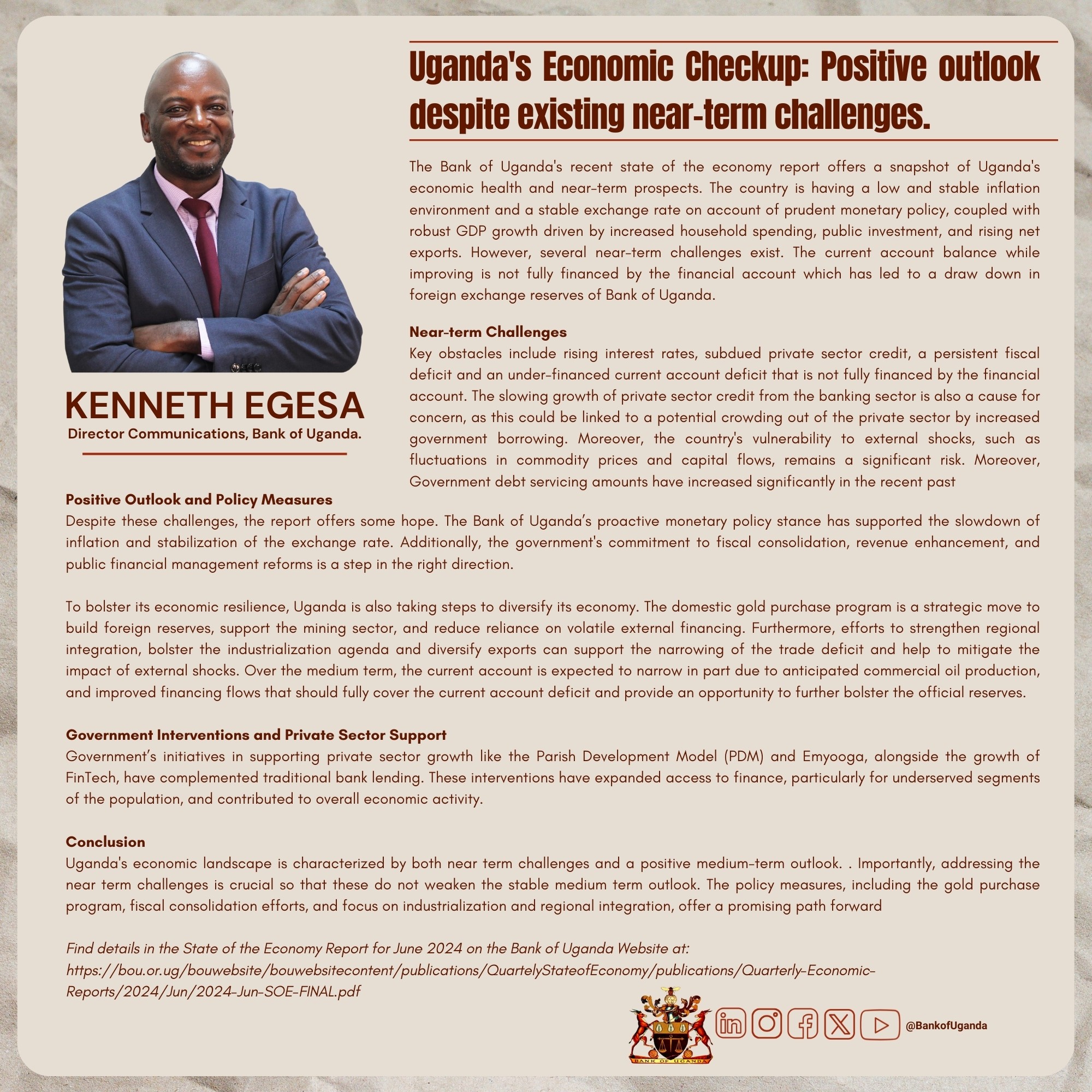 Report shared by Bank Of Uganda
Projections
According to the finance ministry, Uganda’s national resource envelope is projected at sh72.13 trillion in the next financial year, a significant increase from sh52.74 trillion in the 2023/24 fiscal year. Of this amount, the Government expects to generate sh31.9 trillion in domestic revenues, comprising tax and non-tax receipts, excluding grants. In the 2023/2024 financial year, the revenue collection target was sh29.6 trillion.
While the increased budget presents an opportunity for economic growth, the failure to generate matching domestic revenues raises concerns about Uganda’s ability to fund its own development. The theme for the 2024/25 budget is: “Full Monetization of Uganda’s Economy Through: Commercial Agriculture, Industrialization, Expanding and Broadening Services, Digital Transformation, and Market Access.”
However, BOU said risks to the growth of Uganda’s economy include uncertainty about the global economic situation and a likely stronger shilling depreciation. “Private sector credit growth could weaken further due to tighter domestic financing conditions, resulting in lower demand. External factors such as a weaker global economy and escalating geopolitical conflicts could further impede growth through supply chain disruptions, higher freight costs, and reduced export demand,” the BOU report states.
For more details follow the Bank of Uganda Report Link here
https://t.co/C0YXaSZOa1
Torch Media Africa



