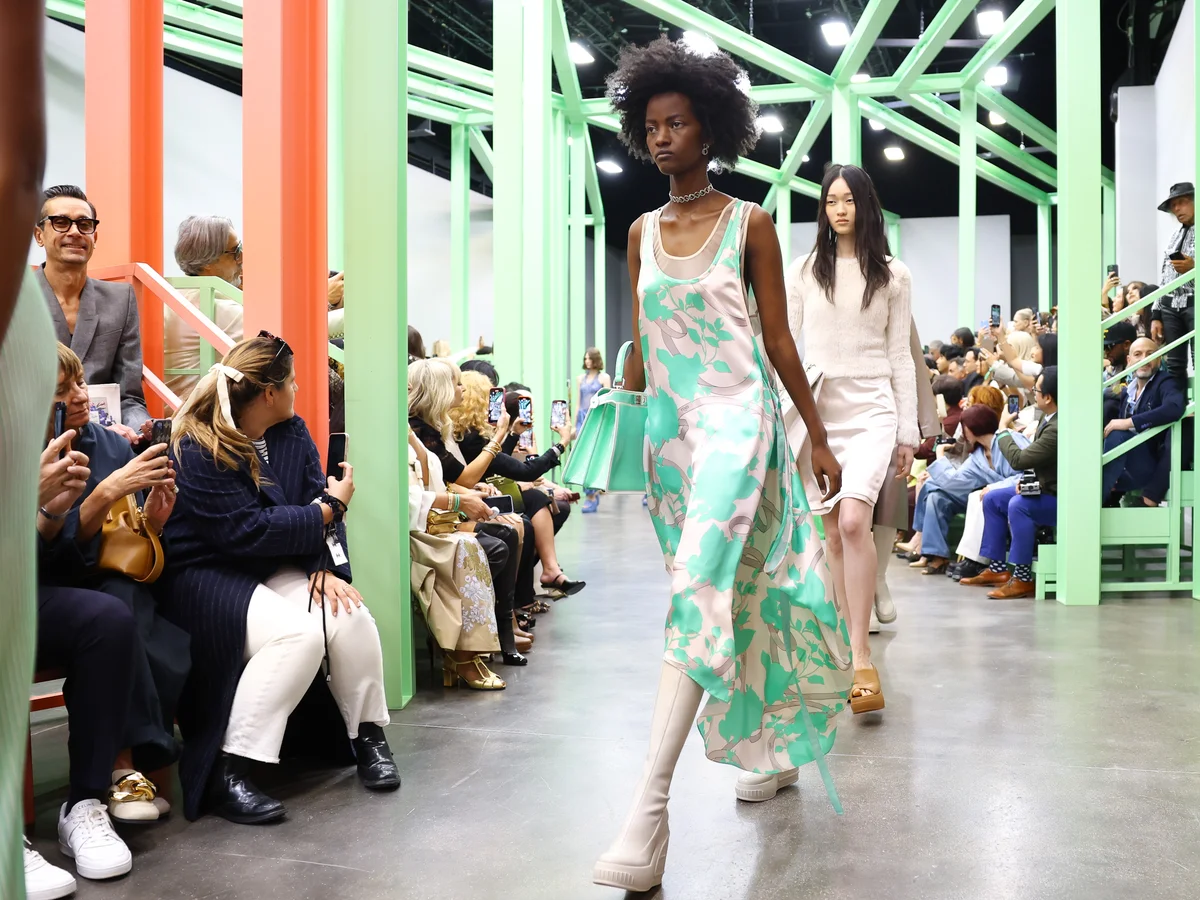
Milan Fashion Week opens today. On Friday at five o'clock, two designers who spent a decade building an independent label out of nothing will show their first collection for the house that turned surrealism into a business model. It is the week's real test.
MILAN
Milan begins this afternoon, and it begins out of order.
Prada takes the 2 p.m. slot today, opening the Spring/Summer 2027 womenswear season — a move up from the house's traditional Thursday position and a signal that the Camera Nazionale della Moda Italiana intends this week to start with force rather than build to it. Diesel, Dhruv Kapoor and J.Salinas follow on the same day. That evening Prada hosts a cocktail for Prada Galleria, the multifloor reimagining of its historic store inside the Galleria Vittorio Emanuele II.
It is an enormous week: roughly 218 appointments across physical and digital shows, presentations and events, including around 60 runway shows, some 54 of them staged in person.
But the appointment that will tell you most about where Italian fashion is going is not today's. It is Friday's, at five o'clock.
Two Names, One House
Loris Messina and Simone Rizzo were named creative directors of Moschino in June, effective immediately, with their debut collection set for this season. They arrive from Sunnei, the Milanese label they founded together in 2014 and ran until September 2025.
If you do not follow the independent end of the Italian market, that sentence undersells them considerably. Sunnei was not a small brand with a nice aesthetic. It was one of the most distinctive things happening in Milan for a decade — a label that treated fashion simultaneously as product, as platform and as ongoing cultural experiment, and that built a genuine community around itself at a moment when most of the industry was outsourcing community to social media agencies.
Their shows were performances. Their commercial thinking was unusually sharp for a brand of that scale. Their instinct ran consistently toward irreverence.
Executives at Aeffe, Moschino's parent, described the pair as bringing "a contemporary creative vision, a deep cultural sensibility and the ability to develop relevant and distinctive creative languages." Corporate language, but the specifics in it are not accidental: cultural sensibility and distinctive languages are precisely what Moschino has spent a decade struggling to re-establish.

The Hardest Job in Milan
Moschino is a peculiar inheritance.
Franco Moschino founded the house in 1983 and spent eleven years making clothes that mocked the fashion industry while selling inside it — the question mark as a motif, slogans stitched onto couture, a sustained and genuinely funny argument that the whole apparatus was ridiculous. He died in 1994, at 44, having established something almost no other Italian house has: a brand identity built on irony rather than craft, heritage or sex.
That is an extraordinarily difficult thing to hand to a successor. Craft can be taught. Irony curdles.
Jeremy Scott's decade at the house, which ended in 2023, resolved the problem by going maximal — fast food, cartoons, spectacle, a version of Moschino that translated perfectly to the internet and generated more image than product. Since his departure the house has cycled through creative leadership without finding a stable answer, including a tenure that ended in tragedy before a single collection was shown.
So Friday's show is not a debut in the ordinary sense. It is an attempted diagnosis.
What to Actually Watch For
The temptation for any designer taking over Moschino is to reach for the archive's greatest hits: the question marks, the trompe l'oeil, the gags. That path is available and it is safe and it produces a collection that photographs well and means nothing.
The more interesting possibility is that Messina and Rizzo do at Moschino what they did at Sunnei — treat the house as a system rather than a mood board. Their Sunnei work was consistently more interested in how a garment is made, priced, distributed and talked about than in how it looks in a single frame. Applied to Moschino, that would mean asking what Franco Moschino's satire is actually about in 2026, when the fashion industry's absurdities are different ones.
Watch, specifically, for whether the clothes are funny or whether they are about funniness. It is a narrow distinction and it is the whole job.
The Wider Reshuffle
The Moschino appointment is one move in what has been an unusually volatile year for creative leadership across the industry. Emporio Armani now has Dario Vitale in the creative director role. On the high street, Primark has brought in Keiron Birch, formerly of Calvin Klein and Tommy Hilfiger, to run womenswear design. Nearly every major European house has either changed hands recently or is widely expected to.
There is a pattern in these appointments worth noticing: houses are increasingly reaching for designers who built something independently rather than for those who rose through the conglomerate system. Messina and Rizzo are the clearest example. Their qualification is not a decade of apprenticeship inside a luxury group. It is having run a business where every decision had consequences and there was no parent company to absorb them.

What This Means for What You Will Buy
Creative director news can feel hermetic — an industry talking to itself about itself. The practical translation is simpler than it looks.
A designer's first collection at a house sets pricing architecture, category priorities and, crucially, the brand's entry point. Designers who come from independent labels tend to think harder about the accessible end of the range, because at their own brands that is where the volume lived. Sunnei's business was built on that logic.
If Friday goes the way it might, expect Moschino to become a more coherent proposition at the level most people actually shop — knitwear, denim, accessories — rather than a house whose identity lives entirely in runway spectacle and licensed fragrance.
The other reader-level consequence: this week is the last full season before a great many of these new creative directors have shown twice. By next spring we will know which of the current appointments were correct. Right now, everybody is still guessing.
Milan has spent several seasons being described as the fashion capital with the most to prove — less commercially dominant than Paris, and burdened with the loss of the generation that built it.
Two hundred and eighteen appointments in seven days is one answer. Handing a house founded on irony to two people who built their reputation on it is a better one. Friday, five o'clock.
Published By | Features Editor