Written By | Fashion and Design Desk
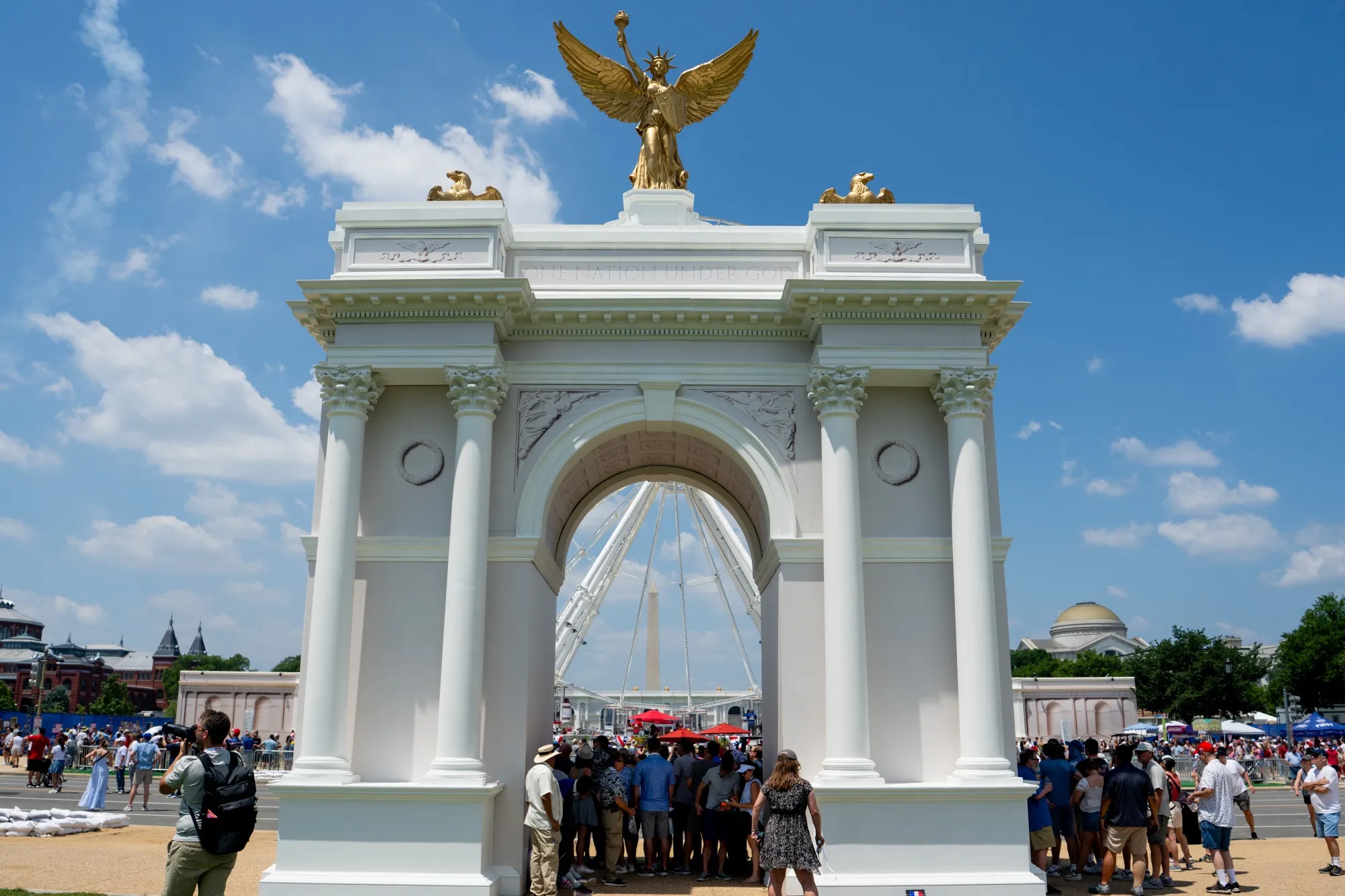
Designed as a neoclassical landmark with a public viewing deck, President Trump's planned triumphal arch will now, he says, house drones, snipers and ammunition
WASHINGTON, D.C.
For most of its short, disputed life on paper, the proposed arch at the edge of the Potomac has been described in the language of civic architecture: neoclassical proportions, gilded ornament, interior galleries and a public viewpoint looking across to the Lincoln Memorial. Over the weekend, that description changed.
In a Truth Social post on Sunday, President Donald Trump said that "at the strong request of the United States military, and for national security purposes," he had agreed to convert the planned monument "into a top grade Military Complex/Triumphal Arch." It would, he wrote, "house, store, and have the rapid ability to use large numbers of drones, plus Snipers, on both the roof and plaza areas, and additionally have and hold large quantities of sniper ammunition in storage."
Taller than the Arc de Triomphe
The arch, designed by Atlanta-based Harrison Design, would rise 250 feet (76 metres) on a traffic circle next to Arlington Memorial Bridge, on the south bank of the Potomac between the Lincoln Memorial and Arlington National Cemetery. That is almost 100 feet taller than Paris's Arc de Triomphe, the obvious model. Plans were first revealed in October 2025. The U.S. Commission of Fine Arts, whose members were all appointed by the president, approved the design in May, and the National Capital Planning Commission approved the site and preliminary plans in July.
Earlier this month, Interior Secretary Doug Burgum said construction would start within about two weeks. As of the weekend, the Associated Press reported that the project still lacked final approval from the planning commission, which is expected to consider it again this fall.
The location matters to planners. Memorial Circle sits on a symbolic axis running from the Lincoln Memorial across the river to Arlington House and the national cemetery. It is one of the most carefully protected views in American urban design. The National Park Service has backed the arch while acknowledging its impact on key Washington sightlines, according to the AP, and a retired general has called the project a "sacrilege" because of its closeness to Arlington.
A design brief rewritten after approval
For architects, the most notable part of the announcement is its timing. Monuments go through review on the basis of what they are for. Dezeen noted that the drawings released so far show no military facilities. They show visitor spaces, exhibition galleries and a public observation level at the top. "It is unclear how these spaces will be impacted by the plans to use the structure for military purposes," the magazine wrote, "or how the plans will impact the arch's planning approvals."
The Pentagon has not added any detail. A spokesperson told reporters the department had "nothing additional to provide beyond the post." NPR reported on Tuesday that the change raises new questions about approvals, public access and how the site would be secured.
There is a recent precedent. The president has also described the new White House ballroom, now being built over an underground military complex, as a national security project. Earlier this month the U.S. Supreme Court allowed ballroom construction to continue despite several legal challenges.
Critics call it a legal strategy
Opponents say the timing is the point. A group of three veterans and an architectural historian has sued, arguing that a memorial on this federal land requires approval from Congress. "The President's belated efforts to manufacture a national security justification for this project do nothing to cure its fundamental illegality," said Nicolas Sansone of Public Citizen Litigation Group, who represents the plaintiffs. "Congress has not authorized the arch and unless and until Congress does so, the project should not be permitted to move forward."
Rep. Don Beyer, a Virginia Democrat whose district is across the river, pointed to aviation. The site sits under the approach to Ronald Reagan Washington National Airport. "Putting a drone launching site directly in the landing path for DCA is a stupid, dangerous, and unworkable idea," he wrote on X, arguing the change was a pretext to strengthen the administration's position in court.
Supporters of the president see it differently. They say the capital's security needs are real and changing, and that a structure placed at a key river crossing can be both ceremonial and practical. Monumental architecture has often served both purposes. City walls, triumphal gates and fortified bridges were built to impress and to defend.

What this means for you
If you visit Washington, the most immediate question is access. The arch was promoted as a public attraction with a viewing deck that could have offered one of the best views in the city, across the river to the National Mall. If the roof becomes a secured military area, that public role may shrink or disappear. There are traffic questions too: Memorial Circle is one of the few busy links between the capital and Northern Virginia, and construction there would affect commuters.
There is also a broader design question. Whatever you think of the arch itself, the episode shows how the purpose of a public building can change after approval, and that the public review process depends on knowing what a structure is for. Planning commission meetings are public, and the next review is expected this fall.
The unfinished monument
Triumphal arches have traditionally marked victories that were already won. This one has not been built yet, and its purpose has already changed. Whether it becomes a landmark, a military installation or stays a plan will likely be decided in the courts and at the planning commission this fall.



