Written By | International News Agencies
The AfD wins Mecklenburg-Vorpommern, Die Linke wins Berlin, and the Christian Democrats finish fifth in a state they once led. Monday, 21 September 2026
Background
Friedrich Merz has been Chancellor of Germany for sixteen months, and for the last three of them his own party has been openly discussing how to replace him. He took office on 6 May 2025 at the head of a Christian Democratic-Social Democratic grand coalition holding 328 of the Bundestag's 630 seats, after becoming the first chancellor-designate in the republic's history to lose a first-round investiture vote. He promised a Wirtschaftswende, an economic turnaround, and said explicitly that one of his aims was to shrink support for the far-right Alternative for Germany. Sixteen months later the AfD leads national polling at around 28 to 29 per cent, the Union parties sit near 20, and an INSA survey for Bild in mid-September found that 14 per cent of Germans considered Merz the right chancellor while 78 per cent did not - a majority of Union voters among them.
The trouble became acute in July, when Bild reported that Jens Spahn, the Union's parliamentary leader and a long-standing opponent of commercial surrogacy, had become a parent through a surrogate in the United States. Spahn resigned on 18 July. The reshuffle Merz built around the vacancy was handled so badly - a transport minister told of his dismissal while on holiday, a designated successor who accepted and then withdrew, a state secretary who learned of his own removal from the press - that Politico described the combined affair as the gravest crisis of the chancellorship to that point, and reported that replacing Merz was no longer a taboo subject among Union legislators. Most of them agreed to wait until the September state elections.
The first of those, in Saxony-Anhalt on 6 September, was worse than the pessimists had feared. The AfD took 43.8 per cent of the party-list vote and 39 of 83 seats, three short of an absolute majority, and won 38 of the state's 41 constituencies. The CDU, which had led every Saxony-Anhalt government since 2002 and had won 40 constituencies in 2021, won none, and fell to 17.2 per cent. Turnout jumped from 60.3 per cent to 77.8. German newspapers began writing about a Kanzlerdaemmerung - a chancellor's twilight - and about an internal operation to remove him. Merz called it the worst defeat the CDU had suffered in years or decades and said giving up was not an option. On 11 September his deputy general secretary, Christina Stumpp, agreed after several days of public resistance to leave office on 21 September: the day after the next two elections.
Key Developments
Berlin and Mecklenburg-Vorpommern voted on Sunday, 20 September. Both are traditionally left-leaning; neither was expected to be kind to the CDU. Neither turned out to be the point. In Mecklenburg-Vorpommern, a coastal state of about 1.3 million voters that the Social Democrats have led since 1998, the AfD finished first with 38.3 per cent of the list vote and 32 of 71 seats, a gain of 18. Manuela Schwesig's SPD held second place with 35.5 per cent and 29 seats, losing five. The Left took 6.6 per cent and five seats; the Greens scraped over the threshold at 5.7 per cent and held their five. Turnout was 76.5 per cent, up sharply from 2021.
The CDU took 4.9 per cent and no seats at all. It had held twelve. Party officials and historians spent Sunday night searching for a precedent and found only one comparable single-digit result, in Bremen in 1951. It is the first time since the founding of the Federal Republic that the Christian Democrats have been voted out of a state parliament outright. The AfD's lead candidate, the former radio presenter Leif-Erik Holm, won 22 of the 36 constituencies; the SPD won the remaining 14 and the CDU none. The Sahra Wagenknecht Alliance, which had cleared the threshold in Saxony-Anhalt two weeks earlier, missed here at 4.8 per cent, and the Free Democrats collapsed to 1 per cent.
Readers comparing coverage will find the numbers moving through the evening, and it is worth noting why. The ARD exit poll published at 6pm put the AfD at 37 and the SPD at 36; an Infratest dimap projection had 37.3 against 35.5; the CDU appeared at 5.0, then 5.3, then 4.9 as constituency returns came in. The figures above are the state returning officer's count at 99.7 per cent reporting, and remain preliminary until certification.
Berlin produced a mirror image. Die Linke finished first with 25.7 per cent and 38 of 130 seats, a gain of 16 and the party's best result anywhere outside Thuringia. The CDU fell to 18.8 per cent and 28 seats, down 24. The AfD came third on 16.3 per cent and 24 seats, nearly doubling its 2023 share in a city that has long been among its worst markets. The Greens took 14.3 per cent and the SPD 12.1 per cent - the Social Democrats' worst showing in the capital in over a century, and the second time in three years they have broken that record. The BSW narrowly missed the threshold at 4.7 per cent.
Both governing parties in Berlin arrived at the election damaged. Kai Wegner, the CDU governing mayor, had stood down as lead candidate on 10 July over his handling of the 3 January arson attack on the city's power grid, after Der Tagesspiegel reported that he made no official calls about the blackout until nearly seven hours after it began, having spent part of the morning playing tennis. Finance Senator Stefan Evers replaced him at a day's notice. The SPD's lead candidate, Steffen Krach, was the subject of three criminal investigations opened by Hanover prosecutors on 3 September, two for acceptance of benefits and one relating to anti-competitive agreements; his apartment and party offices were searched on 9 September. Krach denies wrongdoing and says the donation at the centre of the case was returned. His party's executive publicly backed him and he campaigned to the end.
Reactions
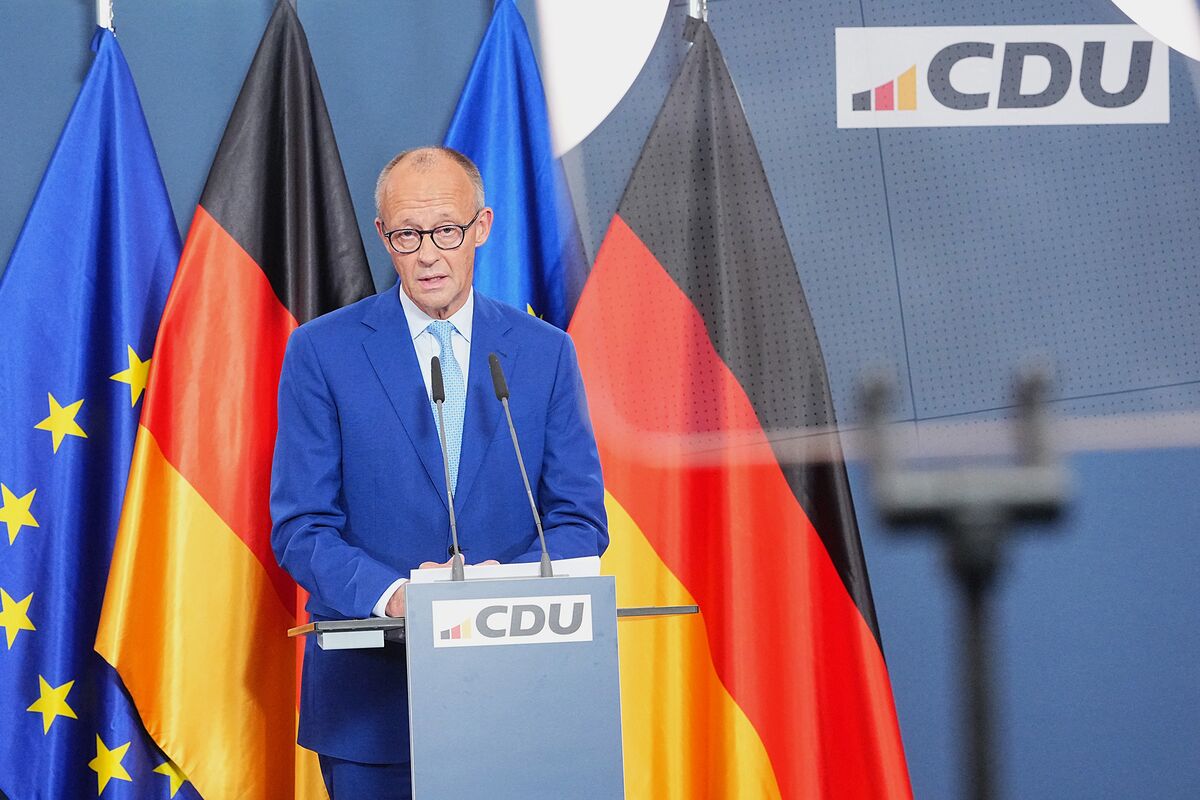
Merz went before the cameras at CDU headquarters on Sunday evening and used the word that dominated Monday's front pages. "It is a disaster," he said. "The CDU fought hard, but in the end it was the CDU that got crushed in the polarisation between the SPD and the AfD." He added that the result could not be talked up, and then refused to draw the conclusion his critics wanted: "What needs to be done now requires backbone, steadfastness and patience. The reforms have to come. I am taking on this responsibility because I want to move our country forward." German outlets including Stern reported heated exchanges at the party presidium and said Merz had indirectly raised the possibility of standing down as CDU chairman, a suggestion that was discussed and swiftly rejected; other reporting described a leadership meeting held without him. None of this has been confirmed on the record.
Tino Chrupalla, the AfD's national co-leader, told ZDF that "the chancellor's statement today really was more than feeble - he announced that he'd carry on as before, instead of finally drawing the consequences and resigning." Holm struck a different note, calling on the other parties to talk: "We expect a willingness to talk, in order to install a government that brings change."
Schwesig ruled that out before he finished. The AfD, she said, would not be able to form a government; the majority had voted for democratic parties, and she was ready to build a stable one. Lars Klingbeil, the SPD leader and vice-chancellor, expressed "huge respect" for her campaign, which the party ran on her personal standing rather than on Berlin's record. Bavaria's Markus Soeder, whose support for Merz has been read all month as conditional, said he expected the SPD to behave responsibly and stay in government.
In Berlin, Die Linke's Elif Eralp - a Berlin-born daughter of Turkish immigrants, now plausibly the next governing mayor - told supporters: "In our city, love and justice have triumphed over hatred." Al Jazeera's Dominic Kane, reporting from Schwerin, offered the counterpoint that the CDU's own strategists have been making privately: 20 per cent in Berlin is not a catastrophe, and the AfD's dominance is concentrated in the former East, not in the western states where most Germans live and where the next federal election will be decided. Florian Hartleb of Modul University Vienna put the broader case that containment has failed: the other parties have tried "everything" against the AfD, he said, "but it didn't work out."
What's Next
The arithmetic in both states keeps the AfD out of office despite its first-place finish in one of them. In Schwerin, Schwesig's SPD, the Left and the Greens together hold 39 of 71 seats against the 36 needed, enough for the three-party coalition she spent the campaign preparing the ground for. In Berlin, the Left, Greens and SPD hold 78 of 130 - a comfortable majority, and the same combination that governed the city from 2016 to 2023, though under SPD rather than Left leadership. The obstacle there is not numbers but Eralp's stated red line: that any coalition she joins must begin expropriating large corporate landlords under Article 15 of the Basic Law, a provision never yet used, in line with the 2021 referendum Berliners passed and the city's government ignored. Krach has refused. A CDU-led alternative is blocked by the federal party's standing resolution against cooperating with the Left, and by the Greens' refusal to sit with the CDU.
Merz's own position is harder to resolve, because the mechanisms for removing him are all unattractive to the people who would have to use them. A constructive vote of no confidence under Article 67 would require SPD votes for a CDU successor. A confidence vote under Article 68 could open the way to a snap election that every poll suggests would strengthen the AfD, and President Steinmeier has shown little appetite for dissolving a Bundestag elected in 2025. That leaves the Kanzlertausch - a voluntary resignation and an internal handover, most often to North Rhine-Westphalia's Hendrik Wuest or to Soeder - which requires a successor willing to take the job on these terms. Die Zeit's Bernd Ulrich has made the sardonic observation that the crisis has begun to stabilise Merz precisely because nobody else wants it.
What is not in dispute is the direction. Three state elections in three weeks have produced the AfD's best result in Saxony-Anhalt since reunification, its first outright state victory in Mecklenburg-Vorpommern, and a near-doubling of its Berlin vote. The party treats these as staging posts towards the federal election due in 2029. The firewall that keeps it from power has held at every level, and has now produced the spectacle of a party winning an election and being excluded from government - the argument the AfD has spent a decade wanting to be handed. Merz's answer, repeated on Sunday night, is that the pension, health and tax package agreed in July must pass by the end of the year. The SPD is demanding that parts of it be reopened. Both things cannot happen.



