Written By | Business Experts
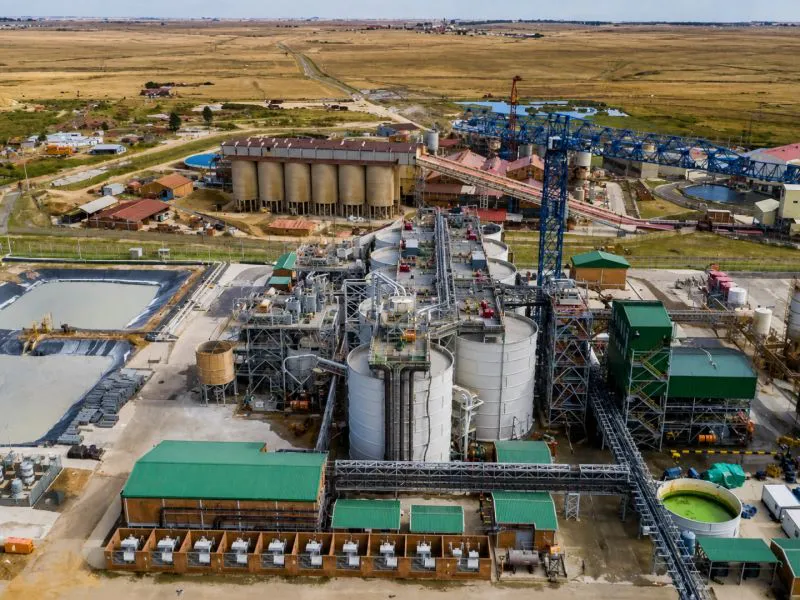
Guinea's Kiniero Gold Mine becomes a rising force in Africa's gold industry
Guinea has quietly become the fastest-growing economy on the African continent, and the numbers are striking enough to stop economists mid-sentence. The World Bank's June 2026 Global Economic Prospects report puts Guinea's 2026 growth at 8.8 percent — the highest of any African economy — with growth forecast to accelerate further to 11.6 percent in 2027. The African Development Bank's own projections, while calculated slightly differently, tell the same story: growth rebounded to 6.9 percent in 2025 from 5.4 percent in 2024, and the Bank expects Guinea to expand by 9.3 percent in 2026 and 9.8 percent in 2027. Averaged out, the World Bank projects growth of 10.3 percent a year over 2026-28, with the mining sector itself expanding by an average of 23.3 percent annually as new iron ore exports ramp up. Few economies anywhere in the world are growing at this pace, and almost all of the explanation lies underground.
The Simandou Ramp-Up
At the center of the boom is Simandou, the vast iron ore deposit in Guinea's forested southeast that the International Monetary Fund has described as a potential candidate to become the largest iron mine on Earth, with eventual output as high as 120 million metric tons a year. After decades of false starts, legal disputes and stalled financing, the project's Simfer consortium — anchored by Rio Tinto and Chinalco alongside Guinean state participation — shipped its first commercial cargo in December 2025: 200,000 tonnes of ore that reached Chinese ports in January 2026. The ramp-up since then has been rapid. Monthly shipments stayed below 0.6 million tons in each of the first three months of 2026, but volumes leaving the project's Morébaya port hit a record 1.3 million tons in April and then 2.2 million tons in May — a 69 percent month-on-month jump. Simfer expects to produce between 5 and 10 million metric tons in 2026 as a whole, with output climbing toward 60 million tons a year once further infrastructure is completed. Rio Tinto's own guidance points to full capacity being reached within roughly 30 months of first production. Underpinning the flow of ore is the newly built 650-kilometer Transguinean railway, financed entirely by the mining operators, which carries the ore from the interior to Morébaya port on the Atlantic coast.
Bauxite: The Existing Cash Cow
While Simandou dominates headlines, Guinea's bauxite sector — already the world's largest exporter of the ore used to make aluminum — remains the backbone of current export earnings. Guinea shipped a record 183 million tonnes of bauxite in 2025, a 25 percent increase on the prior year. China's appetite is central to this story: of the roughly 201 million tonnes of bauxite Beijing imported last year, some 149 million tonnes came from Guinea alone. That concentration illustrates both the scale of the opportunity and a structural vulnerability that runs through the whole economy. Guinea's total trade turnover of about $14.5 billion is heavily tilted outward and eastward: 84.9 percent of it flows outside Africa, and 55.7 percent goes to Asia, with China by itself accounting for roughly $4.5 billion. A boom built this narrowly on two commodities and one overwhelming buyer leaves Guinea exposed to any slowdown in Chinese steel or aluminum demand.
A New Political Settlement
The mining supercycle is unfolding against a consequential political transition. Guinea held a presidential election on December 28, 2025, in which Mamady Doumbouya — the colonel who seized power in a September 2021 coup — won with 86.72 percent of roughly 5.6 million votes cast, under a new constitution his government had pushed through a September 2025 referendum. That charter extended the presidential term from five to seven years, lifted the ban on junta members holding office, and granted amnesty to coup leaders. Doumbouya was inaugurated in January 2026, formally ending four years of military transition and returning Guinea to constitutional rule, at least on paper. Opposition candidates, including Faya Millimono and Yero Balde, alleged systematic fraud, ballot stuffing and restricted access for election observers — concerns echoed by regional monitors who have long criticized the transition's opacity. In March 2026, rating agencies upgraded Guinea's sovereign rating to B+ with a positive outlook, citing improved public financial management and the return to constitutional order — a signal that, fraud allegations aside, markets are pricing in political stability alongside the mining windfall.
Resource Nationalism in Practice
Doumbouya's government has paired the investment boom with an increasingly assertive resource-nationalist agenda. In June 2026 the president banned all raw gold exports outright, mandating that gold be refined domestically before it can be shipped — the latest in a string of measures that also include a bauxite reference-price mechanism designed to capture more revenue from bauxite sales and a new mining code built around local content requirements. The government's stated aim is to force mining companies to process more raw material inside Guinea itself — turning bauxite into alumina, for instance — rather than exporting unrefined ore, while also digitalizing revenue collection to improve transparency. Guinea's local content law is explicitly framed by the AfDB as a lever for both fiscal inclusion and economic diversification, an acknowledgment that extraction alone will not automatically translate into broad-based development.
The Diversification Challenge
The African Development Bank's own analysis is candid about the risks this concentration creates. Mining-led foreign direct investment, foreign exchange earnings and public investment tend to appreciate the real exchange rate and make non-mining tradeable sectors — agriculture, light manufacturing, services — less competitive, a textbook case of Dutch disease that could limit the extent to which growth spreads beyond the mining enclave. The Bank's prescription is active industrial policy, investment in non-mining infrastructure, and deliberate skills development that links education systems to productive employment outside the mines. It also flags more immediate operational risks: the need to strengthen storage infrastructure so that ore does not bottleneck at port, and to rationalize energy subsidies that currently strain the budget even as mining revenue surges.
What the Boom Means for Ordinary Guineans
The test of Guinea's mineral supercycle will ultimately be measured not in export tonnage but in whether growth reaches households far from Simandou's rail line or the bauxite terminals of Boke. Guinea remains one of the poorer countries in West Africa by human development indicators, and a mining-driven GDP surge — however historic in scale — does not by itself build schools, clinics or non-mining jobs. The government's emphasis on local content requirements, domestic refining mandates and digitalized, more transparent revenue collection are the policy tools it has chosen to try to convert commodity wealth into durable development gains, following a path that resource-rich but historically underdeveloped economies across the continent have attempted with mixed success. With Simandou's output still expected to multiply several times over the coming decade, and bauxite volumes continuing to climb, Guinea's coming years will offer one of the clearest live tests anywhere in Africa of whether a mineral boom of this magnitude can be managed into inclusive growth rather than an enclave economy detached from the rest of the country.



