World Politics
Background
The Republican National Committee did something this week that no American party committee had done before: it held a full-scale national convention in a midterm year. The two-night gathering in Dallas, staged on 9 and 10 September, was built to the template of a presidential nominating convention — roughly 109 speakers and programming items, six hours of stagecraft each evening, every hour organised around a different plank of the administration's agenda — but with no nominee to crown and no platform to ratify. Its purpose was simpler and more urgent: to mobilise Republican voters eight weeks before an election the party is, by most measures, losing.
The numbers explain the improvisation. As of 9 September, polling averages put Democrats ahead on the generic congressional ballot by roughly six points, around 49.8 per cent to 43.6 per cent; Nate Silver's likely-voter adjustment stretched the margin further, to about seven and a half. The president's approval rating sits near 39 per cent. Democrats need a net gain of only three districts to take the House, which means Republicans can afford to lose no more than two. The Senate map is friendlier to Democrats than usual — of the roughly nine seats rated as battlegrounds, seven are currently held by Republicans. Prediction markets in early September had begun pricing in a Democratic sweep of both chambers.
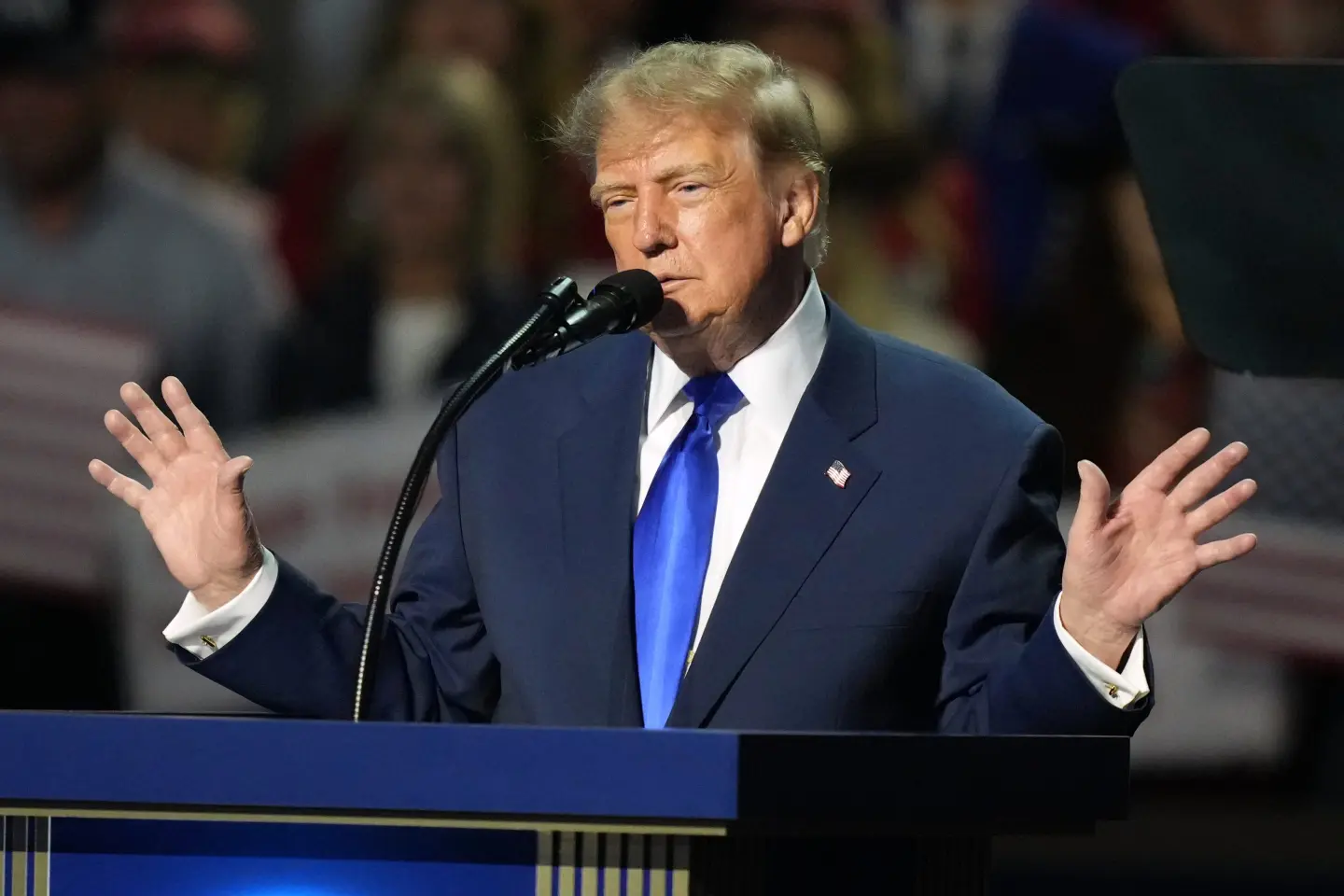
Against that backdrop, the convention's lineup was assembled to project unity and inevitability. Vice President JD Vance delivered a keynote address; Health and Human Services Secretary Robert F. Kennedy Jr. and Treasury Secretary Scott Bessent spoke, as did former White House press secretary Karoline Leavitt and Donald Trump Jr.; Texas Attorney General Ken Paxton and Michigan's Mike Rogers, both Senate nominees, were given prime slots. President Trump closed each night. (Accounts differ slightly on the running order — some outlets described Trump as the opening night's keynote and Vance as the second night's, others the reverse, with Trump closing both.) What no one had been briefed on in advance was the announcement he made from the stage on Wednesday.
Key Developments
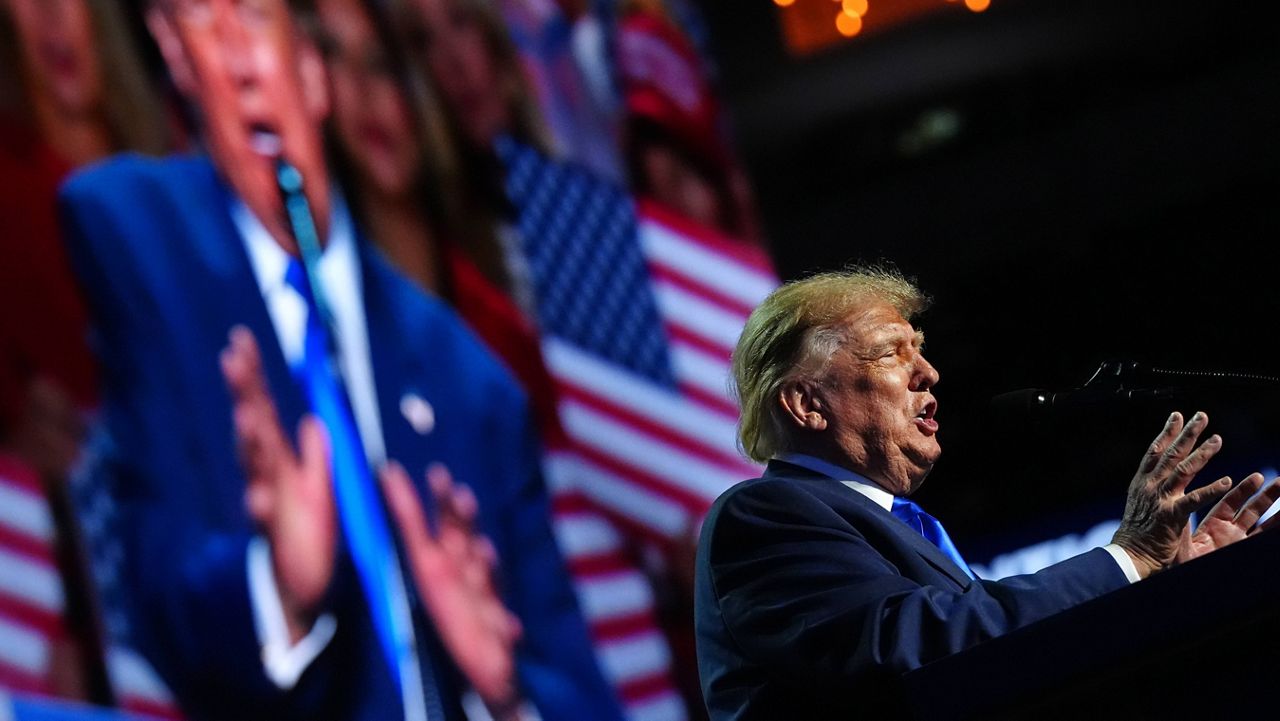
Speaking for close to two hours, Trump promised that every adult American citizen would receive a payment of $5,000 — a "Trump Dividend" — after the midterms, on one condition: that Republicans hold both the House and the Senate. He framed it in corporate terms, comparing the payment to the way "a successful company will do a cash distribution to its shareholders," and said the only string attached was that the money would have to be spent inside the United States. He also pledged to campaign in every state with a Republican running for Congress.
He did not say how the payments would work. He did not say whether he would ask Congress to authorise them, or under what statutory authority they might be issued without it. Asked to account for the cost, the administration offered only the general proposition that the money would come from the "tremendous economic success" of the president's policies, with tariff revenue implicitly doing much of the work.
The arithmetic is not close. There are roughly 245 million adult citizens in the United States. At $5,000 each, the programme would cost somewhere in excess of $1.2 trillion — a figure larger than the entire annual federal deficit, which is running near $1.8 trillion for the fiscal year to date and topped $1.8 trillion last year. Tariff collections, the most frequently cited funding source, brought in about $154.5 billion in the first ten months of fiscal 2026 through July. Even a full year of tariff revenue would cover roughly an eighth of the pledge. There is no plausible reading in which the dividend is self-financing.
It is also not the first cheque of its kind that Trump has promised. Early in his second term he backed a $5,000 "DOGE dividend" to be funded from savings identified by the Department of Government Efficiency; it never materialised. He later proposed a $2,000 "tariff rebate" underwritten by trade revenue, a plan that collapsed after the Supreme Court struck down his tariff regime early this year. Both precedents shared the structure of Wednesday's announcement: a headline number, a funding source described in general terms, and no legislative vehicle. The difference this time is the explicit electoral condition — the money is offered not as policy but as consideration for a result.
Reactions
The most pointed early criticism came from inside the president's own party. Representative Chip Roy of Texas, one of the House's most persistent deficit hawks, told Politico he would "like to know how they would plan to pay for" a programme he estimated on the back of an envelope at well over $1 trillion. Roy has spent the year pushing for a package that reduces rather than expands the deficit, and his objection is not rhetorical: any dividend requiring appropriation would have to pass through a House Republican conference in which fiscal conservatives have repeatedly extracted concessions.
Economists raised a second objection. Direct cash transfers on this scale function as fiscal stimulus, and many economists attribute at least part of the post-pandemic inflation surge to the stimulus programmes of 2020 and 2021. Injecting more than a trillion dollars into household balance sheets at a moment when Brent crude has just broken $100 a barrel — driven by the escalating war with Iran, which Trump also addressed from the same stage — would push in exactly the wrong direction on prices. The president's own message contains the tension: he told the convention that petrol prices would take "a little bit longer than the midterm" to come down, while simultaneously promising a payment that would add demand to an economy already absorbing an energy shock.
The legal question is the least discussed and possibly the most consequential. The Constitution vests the spending power in Congress; money cannot leave the Treasury without an appropriation. Trump has previously argued that rebate payments funded by tariffs could be issued without congressional approval, a claim that was untested before the Supreme Court invalidated the tariff regime underpinning it. Conditioning a federal payment on the outcome of an election raises further questions that have no clean precedent, because no president has previously made the offer in this form. Democrats have characterised the pledge as an attempt to purchase a legislative majority; Republicans on the stage in Dallas received it as the evening's biggest applause line.
Coverage split along familiar lines. Conservative outlets treated the announcement as a bold, first-of-its-kind bid to reset a difficult cycle. Mainstream financial press focused on the cost and the absence of a mechanism. Several outlets noted, without much prompting, that the two previous dividend promises had gone unfulfilled — a comparison that is likely to shape how voters who remember them respond.
What's Next
Three things are worth watching between now and 3 November. The first is whether the pledge acquires any legislative substance. If the White House produces a bill, or even a specified legal authority, the dividend becomes a policy that can be scored, debated and attacked on its merits. If it does not, it remains a campaign promise whose credibility rests entirely on the president's own record of keeping similar ones — a record that, on this specific promise, is nought for two.
The second is whether it moves anything. The generic ballot has been stable and negative for Republicans for months, and the structural conditions — a president at 39 per cent approval, a mid-term electorate, an ongoing war, petrol above the levels voters remember from 2024 — are the sort that usually swamp individual announcements. Cash promises have historically had modest and short-lived polling effects. The RNC's decision to spend on a first-ever midterm convention suggests the party already understood that turnout, not persuasion, is its realistic path.
The third is what happens to the promise if Republicans lose. The condition Trump attached gives him a ready explanation for non-delivery, but it also converts the dividend into an argument Democrats can run against: a president who offered voters money to keep his majority and, having failed, kept the money. Should Republicans hold both chambers, the harder reckoning begins immediately — a trillion-dollar commitment made without a funding source, in front of a party whose fiscal wing has already objected, in an economy where the inflation risk is not theoretical. Either way, the cheque announced in Dallas on Wednesday night is now part of the November argument, and it will be cashed politically long before it is cashed literally.
Published By | News Editor