Written By | Agencies
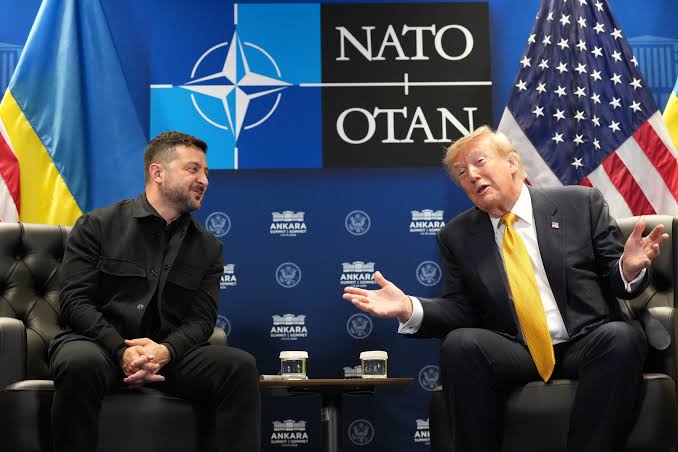
NATO leaders gathered in Ankara
NATO leaders gathered in Ankara, Turkey on July 7 and 8 for the alliance's 36th summit — only the second ever hosted by Turkey — under conditions that exposed both the alliance's growing military ambitions and the deep strains running through the U.S.-European relationship. President Donald Trump used the summit to renew pressure on allies over defense spending, revive his long-standing demand for U.S. control of Greenland, and hold a closely watched bilateral meeting with Ukrainian President Volodymyr Zelenskyy, who arrived seeking an urgent infusion of American Patriot missile interceptors as Russian strikes on Ukrainian cities intensify.
Background
The Ankara summit follows a pivotal gathering in The Hague roughly a year earlier, where NATO members agreed to a sharply higher defense-spending target: 5 percent of GDP by 2035, split between 3.5 percent on core military spending and 1.5 percent on broader security needs, up from the alliance's longstanding 2 percent benchmark. That pledge was widely seen as a concession to sustained pressure from Trump. Heading into Ankara, however, only about five of NATO's 32 members were on track to meet the 3.5 percent core target in 2026, underscoring the gap between rhetoric and budgetary reality.
The summit also unfolded against the backdrop of an intensifying war in Ukraine. On July 6, Russia launched a massive bombardment of Kyiv and other cities, firing dozens of missiles and hundreds of strike drones; Ukrainian air defenses failed to intercept all 29 incoming ballistic missiles, in part because of a well-documented shortage of Patriot interceptors. NATO Secretary General Mark Rutte had outlined three priorities: sustaining defense-investment pledges, strengthening transatlantic defense-industrial production, and continuing support for Ukraine — an agenda that put Ukraine's battlefield needs squarely on the table.
Key Developments
Zelenskyy attended the summit alongside South Korean President Lee Jae-myung and was scheduled for a bilateral meeting with Trump. Ahead of the meeting, Zelenskyy said his central message would be the urgent need to obtain "as soon as possible and as many as possible" interceptor missiles for Ukraine's Patriot batteries, framing the request around the gaps exposed by the July 6 attack on Kyiv.
Trump used the summit's opening day to publicly criticize the alliance, saying he was "very disappointed with NATO," and reopened one of his signature grievances by declaring that Greenland "should be controlled by the United States, not by Denmark." He suggested the U.S. could withdraw its troops from Europe altogether if allies continued to resist, citing the money Washington spends helping defend the continent. Danish Prime Minister Mette Frederiksen said flatly that a U.S. takeover "is not going to happen," while Greenland's foreign minister said the territory's future was a matter for its people alone. Finnish President Alexander Stubb noted NATO already includes seven Arctic nations and suggested the alliance could address Arctic security collectively rather than through annexation.
Despite the friction, NATO unveiled a series of large new arms deals and reaffirmed the elevated defense-spending targets — moves officials described as an effort at "Trump management," a deliberate attempt to keep the American president engaged with the alliance rather than disengaging.
Turkey's hosting of the summit was accompanied by significant domestic friction. Anti-NATO protests took place in Istanbul, Ankara, and Izmir in the two weeks before leaders arrived, organized by groups opposed to rising military budgets and NATO's expansion. Turkish authorities responded with a crackdown that human rights organizations said resulted in the detention of more than 200 people, including activists, lawyers, and journalists.

Reactions
Reactions to Trump's Ankara performance split along familiar transatlantic lines. Allied officials sought to project unity and highlighted new arms-procurement announcements as evidence the alliance was responding seriously to American pressure, while privately acknowledging that much of the summit's choreography was designed around managing Trump's expectations. Nordic and Baltic leaders generally welcomed the renewed emphasis on defense spending even as they pushed back firmly on the Greenland proposal. Denmark's rejection was unambiguous, and Greenlandic officials reiterated that any change in status was solely for its roughly 57,000 residents to decide.
Ukrainian officials described the Patriot missile shortage as an urgent operational problem — a gap that could be partially closed if Trump agreed to accelerate deliveries or authorize European allies to transfer their own Patriot stocks. Commentators noted that the timing of Zelenskyy's appeal, arriving one day after a Russian barrage that overwhelmed Kyiv's defenses, added political urgency.
Analysts framed the Ankara summit as illustrative of a now-familiar pattern: NATO allies making large symbolic gestures — elevated spending pledges, headline-grabbing arms deals — to placate an American president who continues to question the alliance's value even as the United States remains its most powerful member.
What's Next
The most immediate outcome to watch is the Trump-Zelenskyy meeting itself, including whether Trump commits to accelerating Patriot interceptor deliveries or other munitions support, and whether any announcement addresses the shortfall that contributed to the failed intercepts during the July 6 attack.
Beyond the summit, attention will turn to whether NATO members actually close the gap between the 3.5 percent defense-spending pledge and current budget realities. The Greenland dispute is unlikely to be resolved but will likely resurface given Trump's repeated returns to the subject. Turkey's domestic handling of protests and detentions may draw continued scrutiny from international human rights organizations. Finally, the overlapping crisis in the Gulf — where U.S. strikes on Iran unfolded just as the summit began — will test NATO's bandwidth for managing simultaneous security challenges on two fronts.



