MOGADISHU, Somalia
Somalia's House of the People elected a new speaker of parliament this week in a vote that half the country's federal member states refused to join, capping months of escalating tension between Mogadishu and its regional governments and raising fresh questions about who actually controls the institutions meant to oversee the federal government's foreign and security agreements.
Abdulkadir Mohamed Nur Jaamac, a former defense minister, justice minister and minister of ports and maritime transport, was confirmed as speaker on Aug. 11 after winning 142 votes against 30 for his rival, lawmaker Abdulqadir Omar Maalin. Lawmakers representing Puntland and Jubaland, two of Somalia's five federal member states, boycotted the session entirely, arguing that the parliament's mandate had constitutionally expired on April 14, 2026, and that the chamber had no legal authority to elect a new speaker — let alone extend its own life — without a fresh mandate from the country's regions. The opposition Somali Future Council formally rejected the outcome on those grounds, while a separate government critic, the U.S. State Department, had earlier voiced frustration over Jubaland's and Puntland's continued absence from national election talks.
The dispute over the speakership is, on its surface, a procedural fight over parliamentary rules. But it sits atop a deeper and more consequential struggle over the shape of the Somali state itself — one that has combined disputed regional elections, a rewritten constitution, a Jubaland administration that has moved toward outright secession, and, most strikingly, a military operation earlier this year that cleared the path for Jaamac's own path into parliament.
How the seat was won
On March 30, 2026, armored personnel carriers rolled into Baidoa, the capital of Southwest State, one of Somalia's federal member states. By nightfall, Southwest State President Abdiaziz Laftagareen had fled the city and announced his resignation on Facebook after federal troops entered and dismantled a regional administration that had governed for seven years. Ten days later, a lawmaker whose seat had been held by an MP with close ties to the ousted Laftagareen administration was replaced, and Jaamac — President Hassan Sheikh Mohamud's preferred candidate, who had been blocked from winning a parliamentary seat in Southwest State during the 2021-2022 election cycle by Laftagareen's political machine — was sworn in without a competitive vote. Regional outlets including WardheerNews and Garowe Online reported that Jaamac secured the seat "without competition or proper procedures" and that opposition figures accused him of "taking the seat from the previous lawmaker through force and outside the legal process."
Somali political observers have noted that the maneuver echoes a nearly identical episode in December 2018, when then-President Mohamed Abdullahi "Farmaajo" needed a loyal Southwest State parliamentary delegation ahead of his own reelection bid. Then, the sitting regional president was reportedly paid to resign, his most popular potential successor was arrested by allied African Union troops days before a regional vote, and security forces killed at least 15 people, including a lawmaker, when they fired on protesters. The candidate who prevailed in that 2018 process, Laftagareen, is the same man whose government was toppled by federal troops this March — a reversal that analysts say illustrates how thoroughly control of Baidoa's political machinery has become a recurring instrument of federal presidential power in Mogadishu, evolving in this instance from financial inducement in 2018 to direct military force in 2026.
The foreign-policy stakes of the speakership
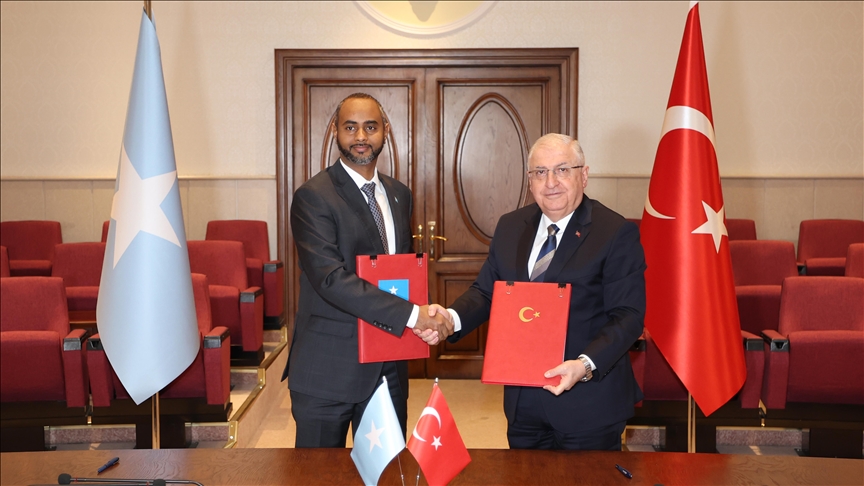
What distinguishes this episode from a routine internal power struggle is the position's direct bearing on Somalia's relationship with Turkey, one of the country's most important — and most consequential — foreign partners. Jaamac was educated in Ankara on a Turkish government scholarship, graduating from Ankara University's Faculty of Political Science, and served as a diplomat at Somalia's embassy in Turkey for roughly seven years, from 2009 to 2016. As defense minister, he personally signed a defense and economic cooperation framework agreement with his Turkish counterpart, Yaşar Güler, in Ankara in February 2024 — described by regional media as the most significant military cooperation agreement between the two countries to date. He has called Turkey his "second home" in on-the-record remarks to Anadolu Agency, and Turkey's state broadcaster, TRT Afrika, has held him up as an emblem of Ankara's scholarship diplomacy in Somalia.
The significance is structural, not merely biographical. As speaker, Jaamac now controls which legislation reaches the parliamentary floor and which committees review which international agreements — including any future security, port or resource deals between Mogadishu and Ankara. Somalia's naval basing agreement with Turkey, one of the most consequential foreign arrangements concluded in the Horn of Africa in recent years, was signed without what regional commentators described as adequate parliamentary scrutiny. Analysts at the Somali outlet Axadle argued before the speaker's race concluded that future agreements of this kind require independent legislative review, and that the contest itself had raised concerns about executive influence over parliamentary oversight. With a speaker who spent years as Somalia's own diplomatic representative in Ankara now presiding over that oversight function, critics argue the chamber's independence from the executive — and from Turkish influence specifically — has been further narrowed rather than strengthened.
A government pushing back against its partners — and its own regions
The speaker's election came just a day before Prime Minister Hamza Abdi Barre used a public address in Mogadishu to deliver pointed criticism of the international organizations operating in Somalia. Speaking on Aug. 12, Barre called on United Nations agencies, donor governments and international organizations to fundamentally change how they engage with the country, arguing that Somalia should no longer be treated as a transitional state. He specifically criticized what he characterized as outdated practices in which some international organizations continue to manage significant aspects of their Somalia operations from outside the country, particularly from neighboring Kenya, and pointed to the government's National Transition Plan as evidence that Somalia has built functioning institutions and a legal framework that warrant a different, more sovereignty-respecting relationship with its foreign partners.
The comments reflect a government eager to project institutional maturity to the outside world even as it faces open defiance from within its own federal structure. Jubaland, under President Ahmed Madobe, has moved further from Mogadishu's authority over the past two years, with reports describing the state's effective withdrawal from aspects of the federal system and its own disputed 2024 presidential election, which the federal government itself characterized as illegal. Puntland has similarly kept its distance from national-level negotiations over Somalia's future electoral model, prompting the United States to publicly register frustration over both regions' absence from the talks meant to resolve the country's long-delayed transition to one-person-one-vote elections. Meanwhile, security conditions remain precarious nationwide: more than a dozen Somali army personnel were killed this week when a military truck carrying troops was struck in an attack, a reminder that the political jockeying in Mogadishu is unfolding against the backdrop of an active insurgency that continues to contest large parts of the country's territory.

Analysis: an institution captured, not strengthened
Taken together, the speaker's election, the Baidoa military intervention that preceded it, and the prime minister's public break with international partners paint a picture of a federal government in Mogadishu consolidating power through methods that bypass, rather than build, the country's fragile institutional consensus. Somalia's constitution envisions a negotiated federalism in which Mogadishu and the federal member states share authority over security, resource revenue and eventually direct elections. Instead, the events of the past several months — a state government toppled by federal troops, a parliamentary seat reassigned without a vote, a speaker's election boycotted by two of five federal states, and a chamber whose own constitutional mandate lapsed four months ago — suggest that federalism is being resolved through the assertion of central force rather than negotiation.
That matters beyond Somalia's internal politics because of what the speakership controls. Turkey's expanding security and economic footprint in Somalia — encompassing military training, a naval basing arrangement, and broader economic cooperation — now moves through a parliamentary oversight process led by a speaker with unusually deep personal and professional ties to Ankara, installed through a process that a majority of Somalia's federal states either boycotted or rejected as illegitimate. For a country that has struggled for more than three decades to build durable central institutions capable of surviving a change in leadership, the manner of this transition — replicating, almost exactly, a 2018 playbook but with tanks in place of cash — raises the question of whether Somalia's parliament is functioning as a check on executive power or as an extension of it.
What to watch next
The most immediate flashpoint will be whether Puntland and Jubaland escalate their boycott into a more formal rupture with the federal government, potentially by refusing to recognize legislation or international agreements the new parliament approves. Also worth watching is whether the Somali Future Council or other opposition figures pursue a legal or political challenge to the parliament's expired mandate, and whether donor governments — already the target of Barre's public criticism — adjust their engagement with Mogadishu in response. Finally, any movement on Turkish-Somali agreements that come before the new speaker's parliament, particularly around the naval basing arrangement, will offer an early test of whether the concerns raised about executive and foreign influence over the chamber's oversight function were warranted.
Published By | News Editor