DATELINE: WASHINGTON, D.C.
For the 6.5 million Americans living with heart failure, there is a particular kind of dread that comes with a certain feeling: the tightness in the chest, the swelling in the ankles, the sudden ten pounds of water weight that shows up overnight. It means the fluid is coming back. And for decades, it has meant one of two miserable choices — rush to the emergency room and get plugged into an IV drip, or sit at home for up to five hours hooked to an on-body infusor, watching a slow drip of diuretic medication crawl into your bloodstream.
As of today, there is a third option. And it takes less time than it takes to read this sentence out loud.
The U.S. Food and Drug Administration has approved Furoscix ReadyFlow, a first-of-its-kind autoinjector that delivers a full, IV-equivalent dose of the diuretic furosemide under the skin in under 10 seconds. The approval, announced by MannKind Corporation on the drug's PDUFA target action date of July 26, 2026, transforms a treatment that once required a bulky wearable pump and hours of patience into something closer to an EpiPen — a fast, self-administered shot patients can give themselves at home, at the first sign of trouble, before the fluid buildup spirals into a hospital admission.
"The approval of Furoscix ReadyFlow marks an important milestone for patients living with heart failure or chronic kidney disease who experience fluid overload," said MannKind CEO Michael Castagna in a statement announcing the decision. "By combining IV-equivalent diuretic performance with the simplicity of an autoinjector, Furoscix ReadyFlow has the potential to advance how fluid overload is managed outside traditional care settings and reach appropriate patients at different intervention points."
Translation, for the millions of people who live in fear of their next swelling episode: help might now be sitting in your refrigerator instead of five hours and a hospital co-pay away.
Why This Drug Exists — And Why the Old Way Was So Brutal
Furosemide itself is nothing new. It's one of the most widely prescribed drugs in American medicine, a "loop diuretic" that has been flushing excess fluid out of failing hearts and struggling kidneys since the 1960s. Doctors call it a workhorse. Patients often call it something less polite, mostly because of how it's been forced into their bodies.
Taken as a pill, furosemide is unreliable when someone is in the middle of an acute flare — the drug's absorption through an inflamed, congested gut is "low, highly variable," according to clinical literature on the subject, especially exactly when patients need it most. That's why the gold standard has always been intravenous furosemide, delivered directly into a vein, typically in a hospital or emergency room.
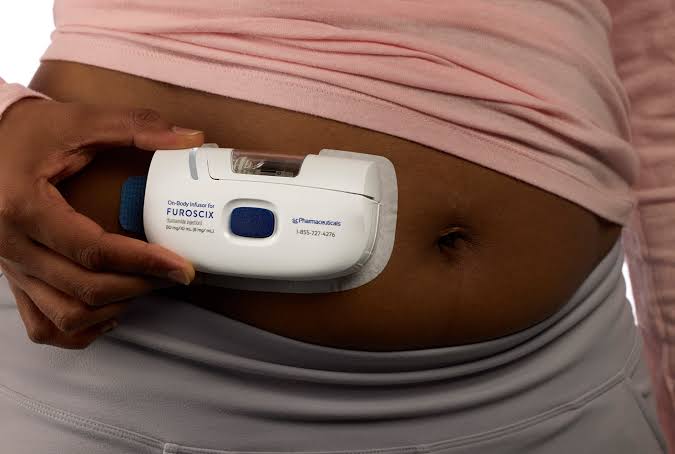
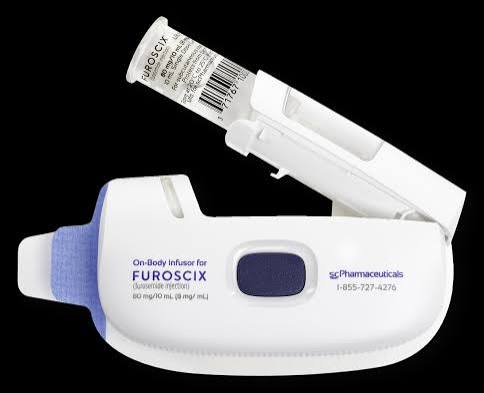
In 2022, the FDA approved a subcutaneous alternative: Furoscix, delivered through an on-body infusor — essentially a small pump patients would strap on and wear for roughly five hours while it slowly pushed the drug in. It was a genuine advance, letting people avoid some emergency room visits and manage congestion from their couch instead of a hospital bed. But five hours is still five hours. It's a workday. It's a missed family dinner, a canceled outing, an afternoon spent tethered to a device stuck to your stomach.
The ReadyFlow autoinjector, known in clinical trials as SCP-111, was built to solve exactly that problem. In pharmacokinetic studies, the autoinjector delivered furosemide with a bioavailability of 107.3% compared to intravenous dosing — comfortably within the FDA's window for demonstrating equivalence — and produced matching urine output, sodium excretion and potassium excretion at the six, eight and twelve-hour marks compared to standard IV treatment. In plain English: the fast shot works just as well as the slow pump, and just as well as a hospital IV line.
The only difference is that instead of a five-hour ordeal, it's over before you've finished reading the instructions.
The Stakes: Why Fluid Buildup Is Such a Killer
To understand why this approval matters so much, you have to understand just how relentless heart failure has become in the United States. Roughly 6.5 million American adults currently live with the condition, a number researchers expect to climb past 8 million by 2030 as the population ages and survival rates for heart attacks improve — meaning more people are living long enough to develop heart failure as a downstream consequence.
Heart failure is now the leading cause of hospitalization among Americans 65 and older, driving somewhere between 1 and 2 million hospital stays and roughly 700,000 emergency room visits every single year. And the reason for the overwhelming majority of those hospitalizations isn't a dramatic cardiac event — it's congestion. Fluid overload. The body retaining sodium and water because the heart can no longer pump efficiently enough to keep up. Clinicians estimate that roughly 60% of heart failure hospital admissions trace back to this same mechanism: fluid piling up faster than the body — or an oral pill — can clear it.
Once a patient is admitted, the math gets worse. Between 25% and 30% of people hospitalized for heart failure end up readmitted within just 30 days, a statistic that has haunted hospital administrators and cardiologists alike for years, prompting Medicare penalties for high-readmission hospitals and a two-decade hunt for anything that might break the cycle. Every day that a symptom of congestion goes untreated, or gets treated too slowly, raises the odds of an ambulance ride. Time-to-treatment studies of hospitalized heart failure patients have found that faster administration of IV furosemide is associated with better outcomes, including mortality — every hour matters.
That is precisely the gap Furoscix ReadyFlow is designed to close: giving patients and caregivers a tool to intervene at the very first sign of swelling, at home, within seconds, rather than waiting for symptoms to worsen into a 2 a.m. trip to the ER.

From the Doctor's Chair: What Clinicians Are Saying
Cardiologists who treat heart failure patients day in and day out have long complained that the biggest barrier to good outpatient management isn't a lack of good drugs — it's the practical friction of actually getting those drugs into patients before a crisis hits. An oral pill that doesn't absorb reliably during a flare. An infusion pump that eats up an entire afternoon. A hospital visit that costs thousands of dollars and exposes an already vulnerable patient to infection risk and the general chaos of an ER.
Physician commentary published alongside the drug's FDA review process has repeatedly emphasized the same theme: reducing the "time to therapy" and the burden of administration are seen as key levers for keeping patients with chronic heart failure and chronic kidney disease out of the hospital altogether. A treatment that collapses the administration time from roughly five hours to under 10 seconds doesn't just save time — clinicians argue it fundamentally changes who is willing and able to use the drug in the first place. Elderly patients, caregivers managing a loved one's condition, rural patients with long drives to the nearest infusion center — all of them stand to benefit from a device that can be kept on hand and used the moment symptoms appear.
What This Means for You
If you or someone you love lives with chronic heart failure or chronic kidney disease and battles recurring fluid overload, this approval is worth flagging for your next cardiology or nephrology appointment. MannKind says Furoscix ReadyFlow is expected to launch commercially in the U.S. during the third quarter of 2026, meaning it could be available at pharmacies within weeks of this approval.
A few things to know: The autoinjector delivers the same 80 mg/mL dose of furosemide used in the existing on-body infusor version of Furoscix, just through a different, faster delivery mechanism — it is not a new drug, but a new, dramatically more convenient way of administering one that is already FDA-approved and widely used.
It is intended for adults with chronic heart failure or chronic kidney disease experiencing edema, not as a replacement for emergency care in a severe crisis. Anyone experiencing serious shortness of breath, chest pain, or a rapid, dangerous weight gain should still seek immediate medical attention.
As with any furosemide-based treatment, patients should expect their care team to monitor kidney function and electrolyte levels, since aggressive diuresis can affect sodium and potassium balance.
Cost and insurance coverage details had not been finalized as of the approval announcement; patients should ask their prescriber and insurer about co-pay assistance programs, which MannKind has offered for the existing Furoscix on-body infusor.

The Bigger Picture
This approval lands at a moment when the entire pharmaceutical industry is racing toward one common goal: turning hospital-only treatments into things patients can do themselves, at home, on their own schedule. From insulin pens to biologic autoinjectors for autoimmune disease, the last two decades of drug development have been defined by this same shift — take a therapy that once required a clinical setting and shrink it down to something that fits in a purse or a kitchen drawer.
Furoscix ReadyFlow is the latest, and in some ways one of the most dramatic, examples of that trend. Going from a five-hour infusion to a 10-second injection isn't an incremental tweak — it's the kind of leap that changes behavior. Patients who might have skipped or delayed treatment because of the time commitment now have a tool that fits into the two minutes before they leave for work.
MannKind's Castagna called the approval the company's third FDA action of 2026, following a dosing update for its inhaled insulin product Afrezza earlier in the year and a pediatric approval for the original Furoscix on-body infusor in the second quarter. The company also announced a $50 million private placement financing, led by Frazier Life Sciences, timed to the approval — funding that will help cover a $45 million contingent payment triggered by the FDA's green light and support the drug's commercial launch this fall.
For the millions of Americans who live one bad swelling episode away from another hospital stay, the real headline isn't the financing or the regulatory milestone. It's simpler than that: the shot that used to take an afternoon now takes less time than boiling an egg. And for a disease where every hour of delay can mean the difference between managing symptoms at home and ending up in an ambulance, that difference could end up saving lives — and a great many trips to the emergency room.
Published By | Features Editor