Written By |
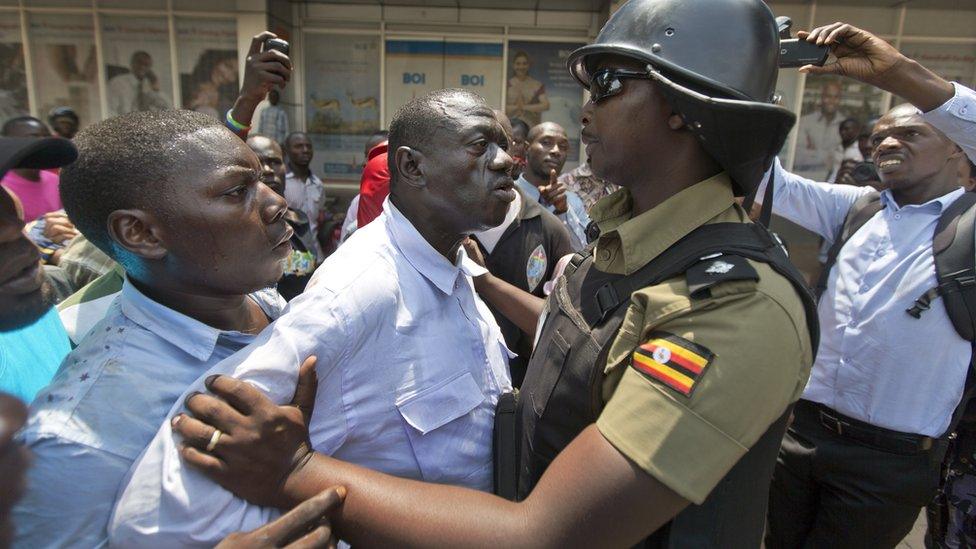
Besigye has been arrested many times to deter him from standing against President Museveni
By Evan Sande Ndahura
Fear is political fuel. From the parent who shouts to make a child obey, to party bosses who bully MPs, to dictators who station soldiers in parliamentary galleries — fear short-circuits normal politics, substitutes coercion for consent, and helps leaders stay in power long after popular legitimacy evaporates. It is elegant, primitive and stable. It requires no persuasion, no vision, no public service, no policy competence. You don’t need to be loved. You don’t need to be intellectually impressive. You just need to make the cost of saying “no” higher than the cost of obedience. That is why fear is the most portable political technology in human history. It is infinitely scalable — a small technique in the household becomes a system architecture of authoritarian power in the state.
This is not metaphorical. Political scientists, psychologists, and historians have repeatedly shown that the same behavioral logic underlying coercive households — threat + surveillance + humiliation + punishment — is the same operating system that undergirds authoritarian control of institutions and societies. Individuals act to avoid expected costs. When many individuals act in similar directions to avoid sanction, resistance becomes individually irrational and collectively hard to coordinate. Fear solves the dictator’s most fundamental governance dilemma — how to rule without consent.
And when fear becomes infrastructure, politics ceases to be negotiation between equal citizens. It becomes management of obedience.
The micro → macro chain of fear
Inside homes children experience fear first as instrumental: punishment produces compliance. Those are formative political experiences. They normalize coercion. They teach hierarchy is enforced not by legitimacy, but by the threat of retaliation. Schools and workplaces scale that lesson. Headteachers, managers, and supervisors reward docility and punish dissent. Expulsion, dismissal, public humiliation become common governance tools. Many corporate and bureaucratic environments — especially in post-colonial states — retain colonial command culture: fear is operational efficiency.
Political parties and state bureaucracies industrialize this logic. Promotion is given to loyalists — not talented reformers. Lateral peer-surveillance forms inside middle cadres because careers become dependent on proving obedience. Bureaucracies become fearful ecosystems. At full macro scale the state uses professional fear architecture: intelligence services, legal persecution, security violence, media capture. Courtrooms become theatre. Electoral commissions become paper legitimacy machines. Parliaments become risk zones.
Fear ceases to be a reaction. It becomes an environment. And when it becomes environment — it becomes invisible. People adjust their lives around it the way people adjust their movement around landmines they no longer openly speak about.
Historical clarity: this is not new
Nazi Germany’s Enabling Act in 1933 is the classical demonstration of legislative coercion under fear. After the Reichstag fire and mass arrests of Communists and Social Democrats, SA and SS men physically lined the chamber and prevented some deputies from entering. Hitler then passed a constitutional legal amendment that made parliamentary oversight irrelevant. It is the perfect example of fear inside a legislative process — not outside it. Mussolini’s March on Rome in 1922 used paramilitary violence (the Blackshirts) not only to threaten politicians but to socially intimidate Italian society into pre-emptive compromise. Fascism did not need majority support; it needed to impose higher costs on resistance than on endorsement.
Idi Amin’s Uganda, Gaddafi’s Libya, Hosni Mubarak’s Egypt, Sani Abacha’s Nigeria — these regimes did not merely use fear. They engineered it structurally. Fear was a resource for rule. It was a deliberate policy design choice. Uganda’s age limit removal in 2017–2018 follows the modern playbook documented by Steven Levitsky & Daniel Ziblatt in How Democracies Die: the electoral route to authoritarian consolidation works through legal subversion combined with intimidation. It is not classical coup. It is weaponization of procedure under duress.
Why do citizens and officials not fight back earlier?
Because fear is rational. Dissenters are imprisoned. Tortured. Bank accounts frozen. Jobs lost. Family targeted. Professional reputations smeared. Once a regime makes a few public examples — even secretly — the message is internalized. Fear does not require daily violence. It only requires the credible expectation of violence.
Then the collective action problem locks in. Each individual waits for “others” to risk first. Silence becomes rational strategy. The dictator wins not because he inspires loyalty, but because he imposes personal cost asymmetry.
Hannah Arendt saw this clearly: terror restructures reality. When people no longer know what is true, when fear makes every direction dangerous, neutrality itself becomes survival. This is how authoritarianism becomes psychologically stable even with thin social legitimacy.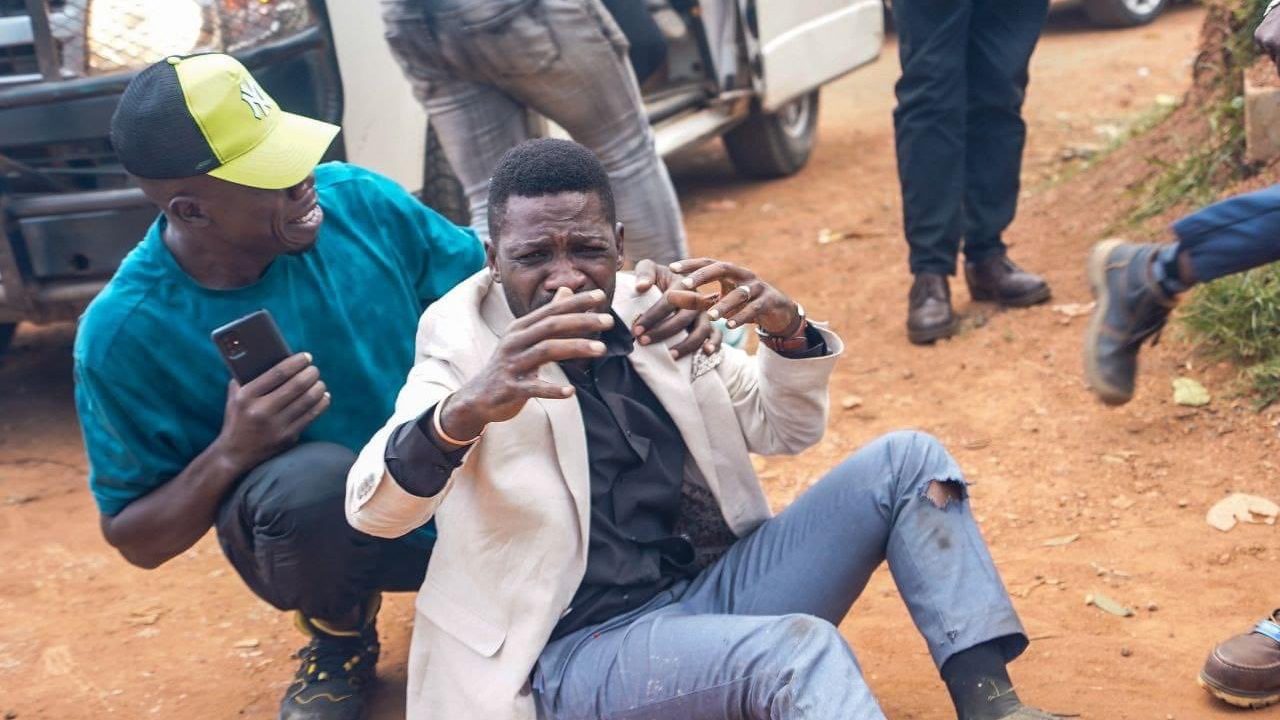
Bobi Wine teargassed as he campaigns: The dictator wins not because he inspires loyalty, but because he imposes personal cost asymmetry
Consequences: Fear is catastrophic for democracy
When fear governs, the rule of law decays. Courts defer to the executive to avoid retaliation or removal. Parliaments become rubber stamps — or become militarized spaces where the presence of security forces influences votes. Media shrinks. Investigative journalists disappear or self-censor. Civil society collapses into NGO performance theatre. Economies under fear also degrade. Investment collapses because rational investors do not place capital in jurisdictions where power is arbitrary. Elite networks capture contracts. Merit dies. Innovation suffocates. Corruption becomes rational strategy for survival within the system.
Fear corrodes social trust. Citizens learn that the safe social strategy is silence. People stop organizing, stop forming civic associations, stop publicly caring. This social corrosion is not reversible by election alone. It takes generational trust repair. Fear ruins the capacity of society to imagine better futures.
The unmasking: How to defeat political fear
No dictator falls simply because people dislike him. Dictatorships fall when fear stops dominating the system. Gene Sharp’s lifetime body of work on nonviolent strategy shows that the key to defeating fear is not emotional courage alone — it is systematic disruption of the sources of a dictator’s power.
The most successful citizen movements do the following:
Map the pillars of regime support (security, finance, bureaucracy, media).
Fragment those pillars by increasing the relative safety and benefits of defection.
Decentralize leadership — so arrests do not collapse the movement.
Break the narrative monopoly — truth is an existential threat to fear regimes.
Remove fear by making collective resistance simultaneous rather than individual.
And crucial — removing leaders who rule by fear almost always requires elite splits inside the regime itself. Once insiders believe the dictator is too costly to carry, the system collapses rapidly. That is why investigative exposure, financial pressure, targeted sanctions, and international legal threat matter more than symbolic condemnation.
Fear regimes are brittle. They look strong because everyone looks silent. But silence is not consent — it is suppressed preference. Once suppressed preference becomes visible simultaneously across a population or across key elite factions, authoritarian stability evaporates.
The democratic duty of our generation
Fear must not become the primary currency of politics in the 21st century. The colonial curse of post-colonial repression should not be inherited forward as normal governance tradition. We need institutional architecture designed to prevent the substitution of fear for legitimacy.
This includes:
Independent courts.
Electoral commissions insulated from executive manipulation.
Secure tenure for judges, commissioners, auditors.
Police and military whose constitutional loyalty is to law — not individuals.
Constitutional rigidity around term limits and eligibility rules.
Real costs for abusers: asset freezing, ICC jurisdiction, transnational accountability.
Democracy is not self-executing. It requires design that pre-commits the future against our worst impulses.
Fear is cheap power. But its cost to society is enormous. The job of democratic citizens everywhere is to make sure fear never becomes normal — because once fear becomes normal, freedom becomes exceptional.
Torch Media Africa



