Written By |
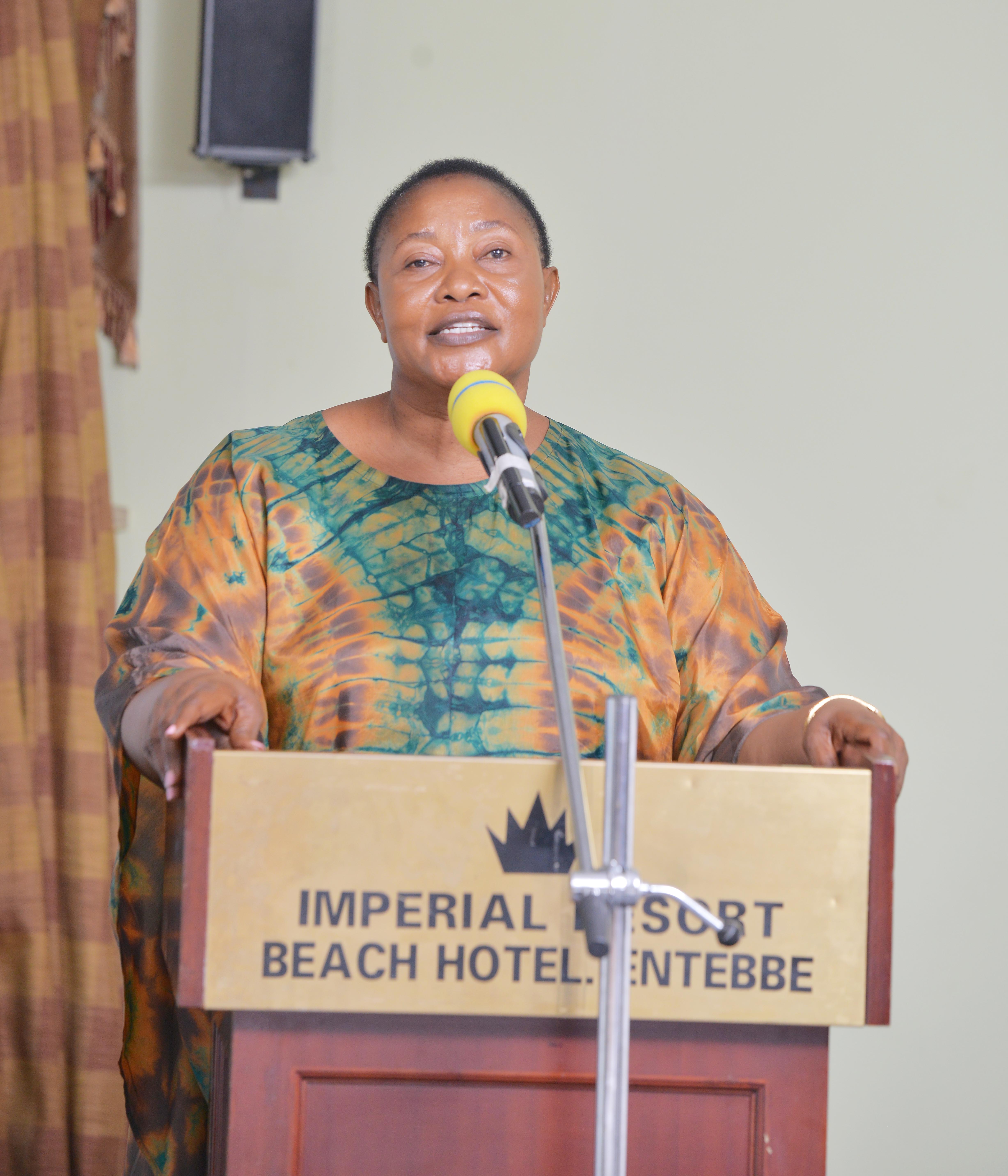
The Minister for the Presidency, Milly Babirye Babalanda urging USPC to shun avenues of corruption for the government to serve people well. (Photo by Milton Niinga)
By Milton Niinga
In a move aimed at reducing expenditure on imported security cards, the government has embarked on constructing a factory for the Uganda Security Printing Company (USPC) in Entebbe. The facility will enhance the country’s capacity to locally print sensitive national security documents.
For years, the government has struggled to develop a comprehensive and interlinked identity management system, integrating vital records such as birth certificates, voter registration cards, driver’s licenses, marriage certificates, national identity cards, and passports.
With civil works that began in June 2022 now at 65% completion, USPC aims to save Uganda over Sh183 billion in foreign currency, currently spent on importing blank security cards, according to the Minister for the Presidency, Milly Babirye Babalanda.
“A lot of essential products are expected to come from this factory once construction is complete and operations begin. We hope to locally produce many of the security cards that Uganda currently imports at a high foreign currency cost,” said Babalanda.
The Minister for the Presidency, Milly Babirye Babalanda with USPC staff in a group picture. (Photo by Milton Niinga)
Speaking on Thursday during a USPC staff team-building event at Imperial Resort Beach Hotel in Entebbe, Babalanda emphasized that the initiative will strengthen internal security and promote national peace.
“This factory project will be a symbol of national pride. USPC should be proud to lead this significant undertaking. I commend the board, management, and entire team for their commitment to seeing this project succeed,” she added.
According to the Auditor General’s report on the financial statements of the National Identification and Registration Authority (NIRA) for the financial year ending June 30, 2022, the government allocated Sh183 billion in the 2023/2024 budget solely for the purchase of blank national identity cards.
Babalanda, however, cautioned USPC staff against corruption, warning that it has hindered the completion of key government projects in infrastructure, health, energy, and education.
“Guard against corruption and the mismanagement of public funds. This cancer has derailed many great projects. I will not tolerate any corrupt practices that compromise the integrity of the NRM government and the Presidency,” she warned.
George Mugerwa, USPC Managing Director, confirmed that the security printing factory will be commissioned by 2026.
“The government has been importing blank security cards at exorbitant foreign exchange costs. These hemorrhaging expenses will be eliminated once the factory is operational,” Mugerwa stated.
He explained that the cards are used for several critical documents, including national IDs, driver’s licenses, and passports. With localized production, the government expects to significantly reduce its reliance on foreign suppliers and save substantial funds.
Eng. Andrew Festus Kagoda, Project Coordinator of the Uganda Driver Licensing System (UDLS), echoed this sentiment. “Importing security cards has placed a heavy burden on our foreign currency reserves. By localizing production, we aim to cut costs and redirect funds to other pressing national needs. We’ve been importing from Greece—an expensive and laborious process,” he said.
Uganda Security Printing Company, Managing Director, George Mugerwa revealed that cutting expenditure shall be at the centre of saving money for service delivery. (Photo by Milton Niinga)
Producing security cards involves a complex process requiring specialized equipment and expertise. However, the government is confident that the new facility will meet international standards for quality and security. Kagoda also highlighted the low compliance among motorcycle riders, noting that many boda-boda operators join the industry without proper government licensing.
USPC was established with a specialized mandate to supply the government and its Ministries, Departments, and Agencies (MDAs) with secure documents, systems, and printing infrastructure for sensitive national materials.
Prof. Mohamad Ngoma, Chairman of the USPC Board, said the initiative will improve the overall security of government documents by minimizing the risk of counterfeit items entering the country.
“Local production will allow the government to exercise tighter control over the process, helping to prevent the circulation of fake documents and reduce counterfeiting,” he noted.
The project has a total budget of Sh107 billion, covering both civil works and equipment. Upon completion, the factory will feature two production lines—one for paper-based and another for card-based security documents. “In terms of job creation, we expect to employ over 300 people. Currently, we brought 150 staff to this retreat to foster teamwork,” Prof. Ngoma said.
Meanwhile, NIRA is currently conducting mass registration and renewal of national IDs, which are set to expire from 2025 onwards. The upgrade will introduce a next-generation ID system embedded with microchips containing citizens' electronic and biometric data.
The factory is being constructed by a German consortium comprising Veridos GmbH and Giesecke+Devrient GmbH. The government envisions it as the cornerstone of Uganda’s national security document production infrastructure.
Torch Media Africa



