IITTALA, Finland
The brief sounded simple, which is usually the warning sign. Sabine Marcelis wanted to capture the way sunlight moves across water — the rippling, shifting caustics you see on the surface of a Finnish lake in late afternoon — and put it into glass.
The complication was where she wanted it. Not etched onto the outside. Not applied as a surface treatment. Inside the wall of the object, so that the pattern reads as part of the material rather than something done to it.
In its 145-year history, Iittala had never made glass that way.
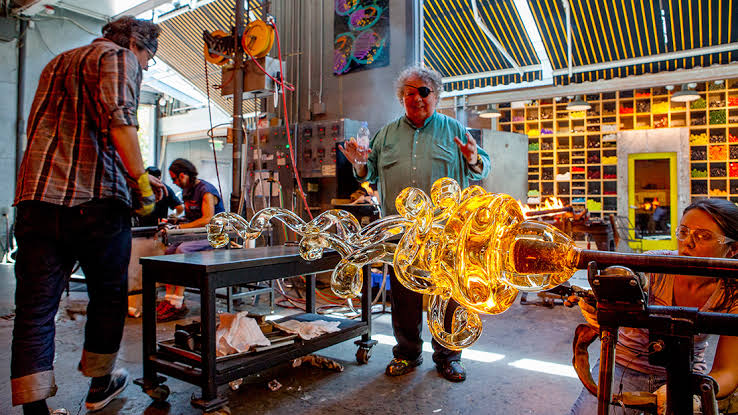
![Chihuly] is so inventive; he's so complex. Deliberately diverse…He likes surprises. Artists are mischievous.”—Thomas Hoving, former Director of the Metropolitan Museum of Art Learn more about the work and life of #Chihuly](https://encrypted-tbn0.gstatic.com/images?q=tbn:ANd9GcTB3RBhzOThMVfuDK8bKKI4nEOwFRVHc4hu8jQvg9K0APiCeuyY7e4yNqmw&s=10)
The problem with the outside
Textured glass is not new. Pressing, etching, sandblasting and mould-blowing have all been used for centuries to give a vessel surface interest, and Iittala's own archive is full of examples. But every one of those techniques works from the exterior inward, and the result always looks like what it is: a decision made after the form existed.
Marcelis, a Dutch designer whose reputation is built on an almost obsessive relationship with material and light — resin, marble, neon, glass — wanted the opposite. Light passing through a wall of glass behaves differently depending on where the distortion sits. Put the ripple on the outside and you get a decorated object. Put it on the inside and you get an object that appears to contain moving water.
The solution
Working with Iittala's glassblowers, Marcelis developed a new production method built around welded metal grids used to press the ripple texture into the interior of the mouth-blown glass. Pressing a pattern onto the inside of an object is something the glassworks had never done before.
The effect is at its most dramatic in the lamp. The wave pattern is subtle when the piece is unlit — a soft irregularity in an otherwise clean cylinder. Switched on, it becomes the whole point: light refracts through the internal texture and throws the caustic pattern outward, so the lamp does not merely display the ripple, it projects it.
What is in the collection
'Unda' — Latin for wave — comprises three pieces. There is a cylindrical table lamp, measuring 240 by 180 millimetres. There is a vase. And there is a jumbo version of that vase standing nearly half a metre tall, produced as a limited edition of 500.
All three come in one of three colourways, each named for a moment in the day's light: Dawn, a soft pink; Dusk, a light umber; and Shadow, a smoky grey. The palette is restrained to the point of severity, which is the correct decision — a strong colour would compete with the optical effect the entire collection exists to produce.
The lamp is sold with a replaceable glass shade, available separately as a spare part. This is a small detail with a large implication: a mouth-blown glass lamp whose most fragile component can be individually replaced is designed to survive an accident rather than be discarded after one.
Why Iittala needed this
Iittala has been making glass in the Finnish village that gives it its name since 1881, and its identity rests on a small number of designs — Alvar Aalto's undulating vase chief among them — that have been in continuous production for the better part of a century. That heritage is an asset and a trap. Brands built on canonical objects tend to spend decades reissuing them in new colours.
The Marcelis partnership is a different move. Rather than commissioning a designer to work within the existing vocabulary, Iittala allowed one to arrive with a requirement its factory could not meet and then built the capability to meet it. The output is three products. The more valuable outcome is a technique the glassworks now owns.
It also fits a wider pattern in the company's recent commissioning, which has increasingly paired the factory's hand-blowing expertise with designers from outside the Nordic tradition — a strategy that treats the workshop as a laboratory rather than a museum.
The designer's method
Marcelis has spent her career treating light as a material with the same weight as the substances that carry it. Her resin work uses colour gradients that appear to be lit from within; her neon pieces treat the tube as sculpture rather than signage. The through-line is that she designs the behaviour of light first and the object second.
'Unda' is a clean expression of that method. The lamp is not a lamp with a decorative shade. It is an instrument for producing a specific optical event, and the cylinder exists to hold the mechanism that produces it. The vases are the same logic without a bulb: they rely on ambient daylight to activate the same internal texture, which is why the colourways are named for times of day.
What this means for you
Practically: 'Unda' becomes available this month, through Iittala's own retail and stockists, in the three colourways. The jumbo vase's edition of 500 makes it the scarce object in the group and the one most likely to be treated as collectable.
More broadly, this is a useful example of what to look for when buying design rather than decoration. The distinguishing feature of the collection is not its shape or its colour, both of which could be copied by a factory in a fortnight. It is a manufacturing process that did not exist eighteen months ago and that lives inside the wall of the glass. That is the part that cannot be knocked off cheaply, and it is the part you are actually paying for.
It is also a quiet argument for a kind of product development that has become rare. Most collaborations between a designer and a heritage manufacturer amount to a new colourway and a signature on the box. This one required the factory to learn something.
Light, held still
There is something appropriate about a Finnish glassworks producing an object about the movement of sunlight on water. Finland's relationship with light is famously extreme — endless in summer, largely absent in winter — and its design tradition has always been unusually attentive to how interiors behave in the dark.
'Unda' catches a fleeting outdoor phenomenon and holds it inside a cylinder of hand-blown glass, where it can be switched on in February. That is a fair definition of what good design does.
Published By | Features Editor