Written By | Business Experts
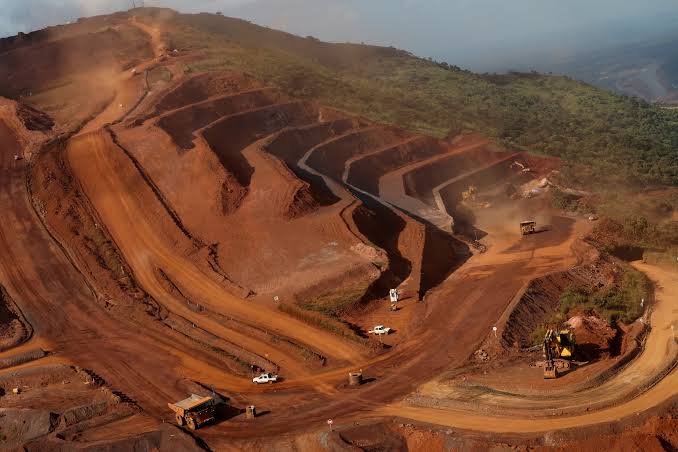
The Simandou range holds roughly four billion tonnes of recoverable high-grade iron ore, the largest undeveloped deposit of its kind anywhere
Economic & Social Transformation
On 11 November 2025, a ceremony in the forested highlands of south-eastern Guinea marked the commissioning of what may prove to be the most consequential mining project on the African continent this decade. Three weeks later, on 2 December, a bulk carrier pulled away from the newly built port of Morebaya on Guinea's Atlantic coast carrying the first iron ore ever exported from the Simandou range. By March 2026, a full cargo had reached Chinese steel mills, closing a supply chain that took more than a quarter of a century, several failed consortia, an international corruption scandal and roughly twenty billion dollars of capital expenditure to complete.
For a country of some 15 million people that has spent its independence exporting unprocessed bauxite and importing almost everything else, Simandou represents a genuine structural break. The question that will define Guinea's next decade is not whether the ore flows. It is whether the fiscal, industrial and social architecture around the mine is strong enough to convert a commodity windfall into broad-based development, a conversion that West Africa's resource economies have historically failed to achieve.
The fastest-growing economy in Africa
The macroeconomic numbers are, for the moment, spectacular. The African Development Bank projects Guinean growth of 9.3 percent in 2026, driven by the Simandou ramp-up and resilient household consumption. The World Bank's estimate of 8.8 percent would make Guinea the fastest-growing economy on the continent this year, and the International Monetary Fund's projection of roughly 8.7 percent places it among the fastest-growing economies in the world. Over the medium term the picture is more striking still: growth is projected to average 10.3 percent across 2026 to 2028, with the mining sector alone expanding at an average annual rate of 23.3 percent as iron ore volumes climb.
That growth arrives on a reasonably stable footing. Inflation eased to 3.2 percent in 2025 from 5.1 percent the previous year, and is projected at around 4.2 percent in 2026. The fiscal deficit narrowed to 4.1 percent of GDP in 2025 from 4.9 percent in 2024, though the improvement was tempered by rising capital spending and public consumption, which pushed public debt to an estimated 47.9 percent of GDP. By the standards of Guinea's regional peers, and certainly by the standards of the Sahelian states to its north and east, this is a comparatively benign starting position.
The IMF has responded accordingly. Following its 2026 Article IV mission, Fund staff reached a staff-level agreement with the Guinean authorities on a 41-month Extended Credit Facility arrangement worth SDR 310.59 million, equivalent to 145 percent of Guinea's quota, with Executive Board approval expected in September 2026. The Fund's framing is telling: Guinea, it argues, stands at an important juncture, with the arrival of Simandou creating an unusual opportunity to raise both growth and domestic revenue mobilisation simultaneously. The programme is designed less as a rescue than as a fiscal guardrail for a country about to receive a very large amount of money.
The scale of Simandou
The Simandou range holds roughly four billion tonnes of recoverable high-grade iron ore, the largest undeveloped deposit of its kind anywhere. Its development has been split between two consortia. Simandou South, comprising blocks 3 and 4, is led by Rio Tinto's Simfer joint venture in partnership with China's Chalco and the Guinean state. Simandou North, blocks 1 and 2, is operated by the Winning Consortium Simandou, a Singaporean-Chinese grouping bringing together Winning International Group, Shandong Weiqiao and China Hongqiao, and Yantai Port Group.
What distinguishes Simandou from a conventional mine is that the ore body was economically stranded without an entirely new transport corridor. The project therefore financed a trans-Guinean railway of roughly 650 kilometres running from the interior to the coast, together with the greenfield mineral port at Morebaya. Chinese state banks, commercial lenders and the operating companies themselves carried an infrastructure bill exceeding twenty billion dollars. Simfer expects to ship between five and ten million tonnes in 2026, building over approximately thirty months toward an annual run rate of 60 million tonnes, with combined capacity across both blocks eventually reaching 120 million tonnes a year.
The IMF has estimated that at full capacity Simandou could lift Guinean GDP by more than 25 percent by 2030, and that the project would still be contributing 3.4 percentage points of GDP growth as late as 2039. Those figures explain both the enthusiasm in Conakry and the anxiety among economists watching for the classic symptoms of a resource boom: currency appreciation, the crowding out of agriculture and manufacturing, and a fiscal system that grows dependent on a single revenue stream priced in Shanghai.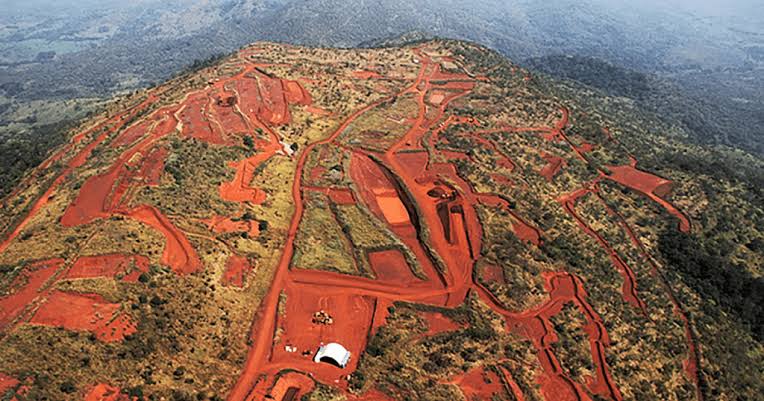
Bauxite, alumina and the value-addition question
Simandou is not Guinea's only mining story. The country remains the world's leading producer of bauxite, and output rose 25 percent in 2025 to 182 million tonnes, with export volumes up 31 percent year on year as new operators came on stream. Global aluminium demand has kept that momentum intact into 2026. But bauxite is also the clearest illustration of Guinea's structural problem: the country supplies a large share of the world's aluminium feedstock while capturing almost none of the refining margin.
The government has begun to press on this. Guinea has set a target of five to six operational alumina refineries by 2030, with combined capacity of around seven million tonnes a year, and has signalled its intention to phase out raw bauxite exports altogether. The first refinery agreement, signed with China's state-owned SPIC, is already under construction with completion slated for the end of 2027. Local content rules are being used to push international service providers into partnerships with Guinean firms.
The obstacle is electricity. Alumina refining is enormously power-hungry, and Guinea's grid is already inadequate for existing industrial and household demand. A refining strategy that is not matched by a generation and transmission strategy will either fail outright or divert power away from the population. The World Bank has argued that a successful shift into refining would create durable industrial employment and reduce Guinea's exposure to commodity price swings, but that outcome is contingent on infrastructure the country has not yet built.
Simandou 2040 and the politics of the windfall
The government's answer to the distribution question is the Simandou 2040 Programme, a fifteen-year national development framework that proposes to channel mining revenue into infrastructure modernisation, industrialisation, economic diversification and improved living standards. A dedicated Delivery Unit was created in December 2025 to accelerate implementation, and the African Development Bank has publicly committed to supporting the programme.
The politics surrounding it are impossible to separate from the economics. The Simandou launch ceremony was presided over by General Mamadi Doumbouya, who seized power in a 2021 coup, and took place six weeks before the presidential election of 28 December 2025 in which he was a candidate. Simandou 2040 branding was ubiquitous in Conakry during the campaign. On 30 December the electoral authority declared Doumbouya the winner with 86.72 percent of the vote, ahead of Yéro Baldé on 6.59 percent, inaugurating what the government terms Guinea's Fifth Republic. A development programme that doubles as a governing mandate carries obvious risks to the independence of spending decisions.
The social ledger
Guinea's poverty statistics are contested, in part because different institutions use different thresholds. The most recent IMF-linked estimate puts the poverty rate at 22.3 percent in 2025, down from 26.7 percent in 2024, a rapid improvement consistent with strong mining-led growth. Other assessments using broader measures placed roughly 47 percent of the population below the poverty line in 2023. What the divergent figures share is a common diagnosis: Guinean growth has historically been poorly inclusive, concentrated in enclaves that employ relatively few people and generate persistent social discontent in the mining regions themselves.
That discontent is not abstract. Communities along the Simandou corridor and in the bauxite belt of Boké have raised repeated concerns about land acquisition, water quality, dust and the destruction of farmland, and environmental reporting on the project's first exports has emphasised the tension between national windfall and local cost. A railway and a port do not automatically create jobs in the villages they pass through; without deliberate policy, they can simply move value from the interior to the sea.
The genuine test of the Simandou decade, then, is administrative rather than geological. Guinea now has strong growth, moderate inflation, a manageable debt stock and an IMF programme designed to help it save and spend a windfall well. It also has a newly consolidated executive, weak power infrastructure, an unresolved value-addition agenda and a population whose experience of mining has largely been one of exclusion. Whether the ore trains running to Morebaya become a development story or another chapter in the long history of African resource enclaves will be settled over the next five years, in budget documents rather than in mine plans.



