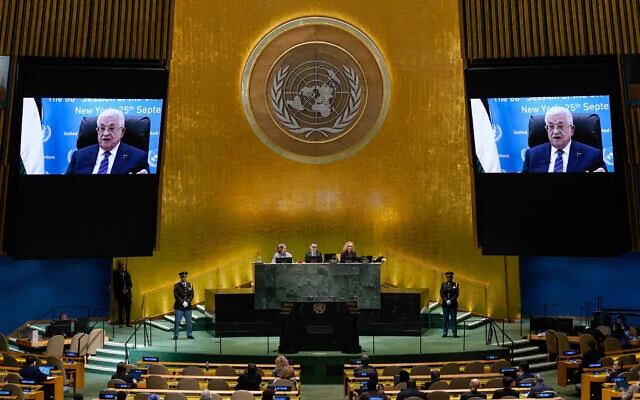
The State Department has extended visa sanctions on Palestinian Authority and PLO officials days before the General Assembly's high-level week, forcing the Assembly to decide once more whether a president kept out of New York may address it by video.
Daily World Politics
For the second September running, the president of the Palestinian Authority will not walk into the General Assembly Hall. The United States State Department announced on Wednesday that it would extend visa sanctions on members of the Palestine Liberation Organization and officials of the Palestinian Authority, and a source familiar with the case confirmed to Agence France-Presse that Mahmoud Abbas, 90, is covered by the measure. He had been expected in New York next week to press the case for Palestinian statehood before an Assembly in which a large majority of members now recognise one.
The decision was announced without naming him. "As a consequence of their failure to reform, contrary to their commitments to the United States, and their ongoing activities that undermine the prospects for peace, the United States will extend sanctions that deny visas to PLO members and PA officials," the department said in a media note. It added that it had reported to Congress that the PLO and the Palestinian Authority had "once again" failed to meet their obligations under the PLO Commitments Compliance Act of 1989 and the Middle East Peace Commitments Act of 2002. The Palestinian Authority condemned the move as an "unjustified measure" and a breach of the 1947 agreement under which the United Nations is headquartered on American soil.
Background: the rule the host country is meant to follow
The legal frame is the United Nations Headquarters Agreement, signed in 1947, under which the United States undertook to facilitate access to the organisation's New York headquarters for representatives invited to attend. Washington has long maintained that the agreement leaves it room to deny entry on grounds of security, terrorism or foreign policy, and it has used that reading before — most recently in May of this year, when it blocked senior Iranian and Russian participants from a Security Council debate. Legal specialists and United Nations human rights experts have argued the opposite: that the host state's obligation is close to absolute precisely so that no single government can decide which member states may speak.
Asked about the reports before the announcement, the United Nations spokesman Stéphane Dujarric said visa applications for heads of state and other senior officials are handled by the host country rather than the Secretariat, that the Secretariat had received no official notification, and that "our call and our hope remains that the host country will fulfil its obligations under the host treaty agreement."
The precedent is a year old. Ahead of the 80th session in September 2025, the Trump administration denied visas to Abbas and around eighty other Palestinian officials. The General Assembly responded with a special resolution permitting the State of Palestine to submit a pre-recorded address to be played in the hall, and to take part by videoconference or recorded statement in certain high-level meetings. It passed 145 votes to 5, with 6 abstentions; the United States and Israel were among those against. Abbas duly addressed the Assembly by video.
That resolution, however, was written to apply only to the 80th session and stated explicitly that it set no precedent for future debates or high-level meetings — language the Assembly itself insisted on, describing the arrangement as exceptional and stressing that Palestinian representatives should ordinarily attend in person. It therefore does not carry over. The Assembly is expected to vote again in the coming days on a fresh remote-participation measure for the 81st session, which according to reporting in The Jerusalem Post could also cover other senior Palestinian representatives barred from entering the country. Whether Washington will simply vote against it or attempt to challenge it procedurally is not yet clear.
Key developments: the charge sheet, and what is exempt
The State Department set out four categories of conduct behind the decision: taking the dispute with Israel to international institutions, naming the International Criminal Court and the International Court of Justice; seeking recognition of Palestinian statehood unilaterally rather than through negotiations; continuing to pay stipends to people the United States and Israel classify as convicted attackers, and to their families; and glorifying terrorism in public statements and school textbooks. "It is in our national interest to impose consequences and hold the PLO and PA accountable for glorifying terrorism," the department said.
One carve-out survives. Personnel formally assigned to the PLO Observer Mission to the United Nations retain their waiver under the Headquarters Agreement, so the mission's accredited staff can keep working and Palestine will be represented in New York by diplomats already in the country. What is blocked is the arrival of the political leadership — the delegation that would ordinarily fly in for the week, hold bilateral meetings and speak from the rostrum.
No Israeli official faces comparable restrictions, a contrast that has drawn steady criticism given that the International Criminal Court has issued an arrest warrant against Prime Minister Benjamin Netanyahu over alleged war crimes in Gaza. That asymmetry, United Nations human rights experts argued after last year's ban, undermines the American claim to be defending a negotiated path to peace.
Reactions
Israel's ambassador to the United Nations, Danny Danon, welcomed the American position and directed his response at Abbas personally. "Abu Mazen cannot continue paying terrorists, rewarding the families of terrorists and promoting a culture that glorifies terrorism, and then be surprised when doors are closed to him," he said, using the Palestinian leader's customary Arabic name. "Anyone who wants to be part of the international community must first behave accordingly. You cannot reward terrorism with one hand and demand international legitimacy with the other."
The Palestinian mission's public posture has been more restrained than in May, when the United States threatened to revoke the visa of the Palestinian ambassador Riyad Mansour and pressed him to withdraw a candidacy; Mansour then told reporters only that "we will see exactly what it means and how it applies to any of our delegation, and we will respond accordingly." This week the Authority's line has been that the denial is unjustified and unlawful under the 1947 agreement, and that it will be represented in New York regardless.
The measure also puts Washington at odds with a large part of the Assembly it is hosting. A total of 142 member states endorsed Palestinian statehood following the conference on the two-state solution co-chaired by France and Saudi Arabia, and the United Kingdom, France and Canada were among those that formally recognised Palestine over the past year. The address Abbas had prepared was expected to build on that wave, to press for renewed momentum behind a two-state settlement, and to draw attention to conditions in Gaza and the West Bank.

The context he intended to describe
The backdrop has worsened sharply. According to an AFP tally based on Palestinian health ministry data, Israeli soldiers or settlers have killed at least 1,109 Palestinians in the occupied West Bank, fighters and civilians together, since October 2023, with settler violence escalating through this year; an Israeli rights group this week accused the government of pursuing what it called an "elimination project" there. In Gaza, the health ministry — which operates under Hamas authority and whose figures the United Nations regards as reliable — puts the death toll from the Israeli campaign above 73,700. On Wednesday a bombed-out apartment building in Gaza City collapsed overnight, killing at least twelve people including five children who had been sheltering inside.
Washington has said little about the West Bank beyond opposing annexation. It has, meanwhile, informally notified Congress of a $2.8 billion package of heavy bombs for Israel, most of it financed through American foreign military financing, according to officials who spoke to The Washington Post. Egypt's President Abdel Fattah el-Sisi publicly rejected any displacement of Palestinians from Gaza this week, and the United Nations Secretary-General said the world owed the victims in Gaza, Sudan and Lebanon an apology.
What's next
The immediate question is procedural and will be answered within days: whether the General Assembly again authorises a pre-recorded address, and by what margin. Last year's 145-5 result suggests it will, and a second such vote would establish something closer to a pattern than an exception — an annual workaround by which the Assembly routes around its host government. That is a small constitutional development in the life of the organisation, and not a comfortable one for anyone, including those voting for it.
The larger question is what the Palestinian Authority is for. Abbas, more than two decades into what began as a four-year term, presides over an institution that the United States is sanctioning, that Israel has largely stopped treating as a partner, and that a majority of the world's governments have just recognised as the government of a state. Kept off the podium for a second year, he will speak to that Assembly from a screen — recognised by 142 of its members and barred by the one that hosts it.
Published By | News Editor