Written By | International News Agencies
American presidents have praised the peace process, funded cross-border reconciliation work and hosted both traditions at the White House, but they have not publicly advocated an outcome
Dublin
Donald Trump did not fly to Ireland this weekend to talk about the constitution. He came for a golf tournament at a course he owns. But a single, unhedged answer to a reporter’s question at Farmleigh House in Dublin’s Phoenix Park on Saturday has reopened an argument that Washington has spent nearly three decades deliberately staying out of, and has left the British government, the Northern Irish parties and the Irish coalition all responding to a remark that changes nothing legally and a great deal politically.
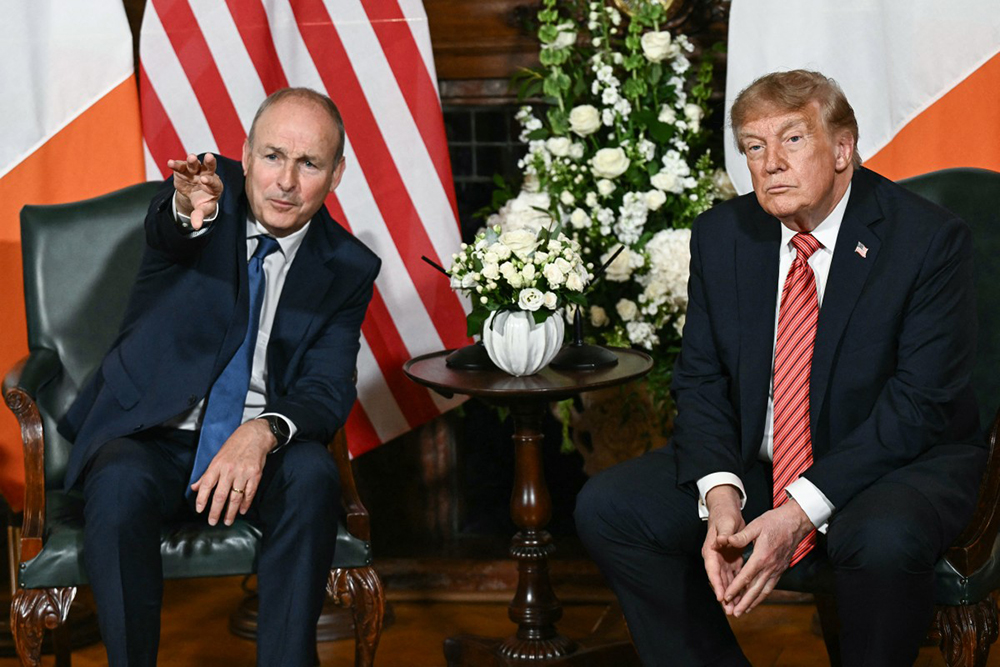
Asked, while sitting beside Taoiseach Micheál Martin, for his view on Irish reunification, the US president said he would “love to see it unified.” He called a united Ireland “fantastic,” a “great feather in everybody’s cap,” and something that was “going to happen eventually” and “may as well happen now.” He acknowledged, in the same breath, that “the UK will have something to say about it,” and turned to Martin to tell him he was “the right man over here to get it moving.” Later that evening, speaking to business figures at the US ambassador’s residence, he described a united Ireland as “a very cool thing” while conceding that on this subject “no matter what you say or how you say it, there’s no good answer.”
Background
The reason those sentences carry weight has little to do with their content and everything to do with who spoke them. Since the Good Friday Agreement of 1998 — negotiated with heavy American involvement, and for which Washington supplied both a special envoy and considerable political capital — successive US administrations of both parties have treated Northern Ireland’s constitutional status as a question for its own electorate and for the two sovereign governments. American presidents have praised the peace process, funded cross-border reconciliation work and hosted both traditions at the White House, but they have not publicly advocated an outcome. That studied neutrality was itself a product of the agreement: an outside power visibly favouring one constitutional destination undercuts the premise that the choice belongs to the people of Northern Ireland alone.
The agreement is also specific about mechanics. A border poll can be called only by the British government, and only when it appears likely that a majority in Northern Ireland would vote to leave the United Kingdom. Unification would then require concurrent majorities north and south. There is no provision under which an American endorsement, a Dublin initiative or a Sinn Féin campaign can trigger a vote. That is the point most often lost in the coverage a presidential remark generates.
The timing, however, was not accidental. British Prime Minister Andy Burnham had recently declared a border poll “off the table,” telling parliament that he was “not aware that there is majority public support for another referendum, and until that changes, there will not be one.” Accounts differ slightly on the setting — Reuters reporting tied the remarks to answers Burnham gave MPs mid-week, while other accounts place the initial declaration at a visit to Belfast roughly a fortnight earlier — but the substance is not in dispute, and it had already drawn sharp criticism from nationalists before Air Force One landed at Dublin Airport on Saturday morning.
Trump was also arriving in a republic whose head of state is now Catherine Connolly, elected last year, a left-wing politician with a long record of criticising American foreign policy who joined protesters at Shannon Airport during Trump’s 2019 visit and has previously called him a bully. That she received him at Áras an Uachtaráin as ceremonial head of state, while activists urged her to use the occasion to defend Irish neutrality, captured the awkwardness of the whole trip.
Key Developments
Trump landed on Saturday morning, greeted at Dublin Airport by Tánaiste Simon Harris and Foreign Minister Helen McEntee. He held a courtesy call with Connolly, then the bilateral with Martin at Farmleigh, where the reunification exchange took place. The scheduled agenda was trade: Martin said afterwards that the president was “very conscious of the goods surplus that Ireland has, particularly through the pharmaceutical issue” — a reference to the sector that dominates Irish exports to the United States and that has been squarely in the line of fire of this administration’s tariff campaign. The constitutional question was not on the agenda at all until a reporter raised it.
Martin, notably, declined to engage. He took no follow-up questions on the president’s remarks and steered subsequent comment toward the government’s existing Shared Island initiative, which funds cross-border infrastructure and economic cooperation and is explicitly framed as an alternative to any near-term push for a vote. That silence was itself a decision: Fianna Fáil and Fine Gael have spent years arguing that unity talk without preparation is reckless, and a Taoiseach visibly accepting an American endorsement would have handed Sinn Féin the frame.
On Sunday the president moved west to County Clare for the Amgen Irish Open at Trump International Golf Links in Doonbeg, the commercial purpose of the visit and the reason the trip was scheduled at all. Protests followed him. Organisers of Saturday’s Dublin march — from the Garden of Remembrance to the Dáil — claimed about 25,000 participants, though Irish media suggested the real figure was lower. Demonstrators carried Palestinian flags and placards attacking the administration over Gaza, the war against Iran, climate policy and the continued use of Shannon Airport by the US military, which campaigners argue has hollowed out Irish neutrality. Further protests were planned near Doonbeg.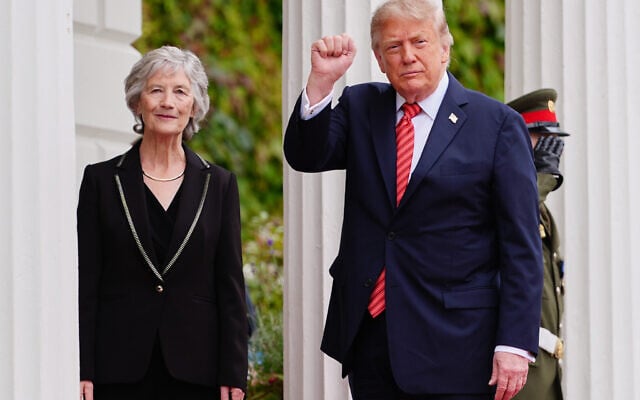
Reactions
The response split along entirely predictable lines, which is part of why it mattered so little in practice and so much in tone. Gavin Robinson, leader of the Democratic Unionist Party, rejected the intervention outright. “President Trump knows better than most that elections matter,” he wrote. “Northern Ireland’s constitutional future will be decided by the people of Northern Ireland, not by commentary in London, Dublin or Washington.” Other unionist voices were blunter, framing unification as the destruction of their country.
In Britain, the reaction was cooler than it was calm. Downing Street reaffirmed Burnham’s position and restated the government’s commitment to the Good Friday framework. Conservative leader Kemi Badenoch accused the president of “shooting from the hip,” adding that “this sort of loose talk about the future of democratic countries is deeply unhelpful and creates unnecessary tension” — a comparison, made explicitly, to his earlier musings about Greenland and Canada. Nigel Farage, whose Reform UK has been among the administration’s warmest British admirers, broke with him: Northern Ireland, he wrote, is “a proud and integral part” of the United Kingdom, its people “neither want a referendum, nor unification,” and “I disagree with President Trump.”
Sinn Féin leader Mary Lou McDonald took the opposite lesson, calling the remarks timely and arguing that the conversation on unity “has shifted” and that the onus now falls on Martin to begin planning for an organised, peaceful transition. The awkwardness in that position is obvious and she did not pretend otherwise: her party boycotted the St Patrick’s Day events in Washington this year over Gaza and has continued to attack the administration’s Middle East record. On the constitutional question, for one weekend, they were aligned.
American officials, for their part, moved quickly to stress that nothing had formally changed and that US policy remains anchored in the Good Friday Agreement — the standard clarification that follows a presidential improvisation, and one that in this case is legally accurate.
What’s Next
Very little, in procedural terms. The threshold for a border poll is a judgement made by the British Secretary of State, and neither current polling nor the UK government’s own assessment suggests it has been reached. Surveys continue to show a comfortable majority in Northern Ireland for remaining in the United Kingdom, though the margin has narrowed since Brexit pushed the constitutional question back up the agenda and shifted trade arrangements in ways that have made the border more salient. Demographic change keeps the issue alive as a long-term proposition. None of that accelerates the legal timetable, and Burnham’s position was unchanged within hours.
The political consequences are more interesting. The remark deepens the sense in London that Washington is an unpredictable partner on questions Britain regards as sovereign — a perception already strained this year by Trump’s public equivocation over whether the United States would back the United Kingdom in a Falklands confrontation. It hands Sinn Féin a rhetorical asset going into a period when the party is pressing Dublin for a formal unity-planning process. It puts Martin in the position of having to decline an endorsement rather than welcome it. And it complicated the position of the demonstrators in Dublin, many of whom favour unity but oppose the president personally.
There is a domestic reading too. With American midterm elections on 3 November and roughly a tenth of the US population claiming Irish ancestry, a remark tailored to that constituency is not out of character for a president who rarely separates diplomacy from audience. Whether it was calculated or simply spoken is unknowable. What it demonstrated is how much room the question still occupies on both sides of the Irish Sea — and how easily an American president can be pulled into it without intending to move anything at all.



