PRETORIA, South Africa
Eleven days after South Africa's Home Affairs Department told refugee reception offices to start accepting asylum applications that might previously have been turned away, the government has withdrawn the order, defended the retreat as consistent with the law and promised the Constitutional Court a new plan. In between, anti-immigrant protesters burned vehicles in Durban and Soweto, police arrested about 30 people, and President Cyril Ramaphosa was forced to insist publicly that his government was not defying the country's highest court.
The episode tests a government trying to honor a binding judgment while managing a public that is angry about unemployment, with local government elections scheduled for Nov. 4. It also carries consequences beyond South Africa's borders, where neighbors have been repatriating citizens for months.
The ruling behind the directive
The trigger was a judgment the Constitutional Court handed down on July 7, 2026, in a case brought by the Scalabrini Centre of Cape Town, according to a legal explainer published by the Rio Times. The court found that three barriers cannot, on their own, stop someone from lodging an asylum claim: entering the country irregularly, lacking an asylum transit visa, and failing to report within the prescribed period. The state must still assess each claim on its merits. The ruling does not grant refugee status, permanent residence, citizenship or an unconditional right to remain.
On Sept. 28, the Home Affairs director-general issued an operational directive to refugee reception offices telling them to accept applications that might previously have been turned away, the Rio Times reported. Hundreds of people went to the offices, Agence France-Presse reported, which renewed local tensions against illegal migrants. Home Affairs later said its offices were "overwhelmed within a matter of days."

Thursday's violence
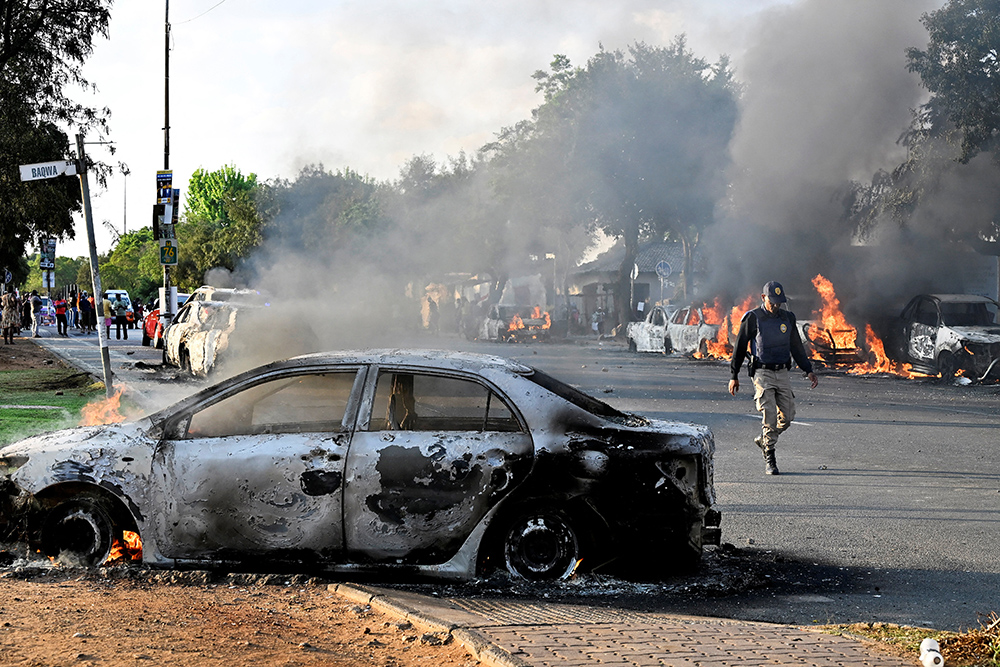
On Oct. 8, protests by anti-illegal-immigration groups turned violent. Police said 10 vehicles were torched in Johannesburg's Soweto township and 14 in Durban, Al Jazeera reported. AFP said a municipal building in Durban was also set alight. In Soweto, residents looted a shop that they said belonged to a Somali national and chased out its occupants, who fled when police arrived. In Durban, foreign-owned shops were looted, and police fired rubber bullets to disperse crowds. Three people were arrested in Durban, according to Al Jazeera.
Government spokesman William Baloyi blamed people who were deliberately spreading false information about the ruling. He said it does not automatically grant refugee status, permanent residence or other legal rights to undocumented migrants, and that the government was "deeply concerned." The Inter-Ministerial Committee on Migration held an urgent briefing the same day about overcrowding at asylum offices.
The retreat
On Friday, Oct. 9, Home Affairs said it had withdrawn the directive. In a statement quoted by AFP, it said the order had produced "serious consequences" and that "serious threats to public safety and order had emerged." It added that the department "will embark on a fresh process." The Rio Times reported that the withdrawal came reportedly without the minister's knowledge and that the court ruling itself remained binding.
On Monday, Ramaphosa defended the decision in a doorstep interview, reported by Briefly News. "The implementation could have been premature," he said. "It needs to be properly assessed and properly interpreted and evaluated." He rejected suggestions that suspending the directive was a defiance of the court: "By no means is this contempt of court."
Critics on social media challenged the government's account. Briefly News noted that several users said an online application process was continuing even though the in-person process had been paused, and the article could not confirm whether the online process had in fact been suspended. Those assertions are unverified.
The government's plan
On Sunday, the Inter-Ministerial Committee, chaired by Justice Minister Mmamoloko Kubayi, set out what the government would do next, according to IOL. Its main elements:
The government will ask the Constitutional Court for a supervisory order to oversee implementation of the ruling, which could include a suspension period during which Home Affairs builds capacity. A panel of judges appointed by the Gauteng Division Judge President will hear a case on Oct. 29 to review two conflicting Gauteng High Court directives on the same asylum question. By Nov. 10, a new online asylum registration system is to be in place, in which applicants register their intention to seek asylum and receive a receipt with an appointment at a Refugee Reception Office; assisted registration will be available, including for people in detention. The receipt is not a section 22 visa and does not confer refugee status.
Officials and the Border Management Authority will be told not to remove or detain holders of valid receipts solely for being in the country without a visa while their applications are pending. Kubayi stressed that the protection has limits. "Protection applies only to people who have asked to make a first application for asylum," she said, and people whose claims were finally rejected will be flagged and cannot reactivate protection by reapplying. "Our work on enforcing the law will continue; this therefore means deportations will continue," she added.
Longer term, Home Affairs is drafting legislation based on the Revised White Paper on Citizenship, Immigration and Refugee Protection, which Kubayi said was expected in Parliament next financial year, with a request that it be fast-tracked. Following a June announcement by Ramaphosa, refugee reception offices will move to ports of entry, starting with Beitbridge by December, and the government will consider suggestions for refugee camps while weighing legal and financial implications.
Enforcement
Police said 30 people had been arrested since Thursday for offenses including public violence, illegal gathering, obstruction and resisting arrest, 25 in KwaZulu-Natal and five in Gauteng, IOL reported. Some of those arrested were described as ringleaders who allegedly threatened to disrupt football matches in Durban on Sunday. Acting National Police Commissioner Lt. Gen. Puleng Dimpane commended the intelligence-led operations. The Inter-Ministerial Committee urged calm and restraint and asked people to let legal processes run their course.
The wider backdrop
The October unrest follows months of protests by populist, anti-immigrant groups demanding that undocumented foreign nationals leave, Al Jazeera reported. Tens of thousands of people have fled, and some have been repatriated by their governments. AFP said the largest numbers of foreign nationals who left were from Zimbabwe and Malawi, with Ghana, Kenya, Lesotho, Mozambique, Nigeria and Uganda also seeing citizens depart. Police have said at least four foreign nationals were killed in violence earlier this year, while some African governments say the toll is higher, AFP reported.
Nigeria has been among the most active in evacuating citizens. The Federal Government flew home 111 more people from South Africa, bringing the total since June to 2,037, according to ThisDay as summarized by the Rio Times. The same brief said a donation of $265,854 from the Redeemed Christian Church of God supported the operation.
The economic context is unforgiving. Al Jazeera reported that about a third of South Africans are out of work three decades after apartheid, and AFP put unemployment above 30 percent. Migrants are often blamed for taking jobs, fueling crime and straining services; Al Jazeera noted that the evidence does not support those claims.

Analysis: a legal obligation meets a political deadline
The government is caught between two constraints that pull in opposite directions. The Constitutional Court has said that procedural technicalities cannot bar asylum seekers from lodging claims, and any attempt to resist that outcome openly would invite precisely the contempt-of-court charge that Ramaphosa has been at pains to deny. But the first attempt at implementation, delivered by operational directive with little preparation, overwhelmed reception offices within days and handed anti-immigrant groups a visible target.
The new plan tries to square the circle by routing the ruling through process rather than announcement. A supervisory order from the court would give the state a legally recognized timetable, an online system would reduce crowding at offices, and the narrow definition of who is protected, first-time applicants only, with deportations continuing, appears designed to sound firm to a skeptical public. The risk is that it satisfies neither side. Refugee advocates will watch whether receipts offer meaningful protection in practice, while anti-immigrant mobilizers have shown they will treat any visible processing of undocumented applicants as a provocation.
Election timing raises the stakes. With the local government vote on Nov. 4, parties have incentives to harden their stances, and the government has an incentive to avoid further images of burning cars. The Oct. 29 High Court hearing and the Nov. 10 registration date both fall on either side of the vote, so the court process and the new registration system will both be tested around the vote.
What to watch
Key markers include whether the Constitutional Court grants the supervisory order the government wants and on what terms; whether the Nov. 10 online system launches on schedule and without renewed crowding; whether violence flares again around the elections, and how police and prosecutors handle the cases of the 30 people arrested; and whether neighboring governments continue repatriations or press Pretoria for protection guarantees for their citizens. Rio Times noted that Home Affairs had not announced a replacement operational approach as of Oct. 10 and that the number of applications lodged during the directive period was unknown. Those numbers will shape how the next round of this fight unfolds.
Published By | News Editor