Written By |
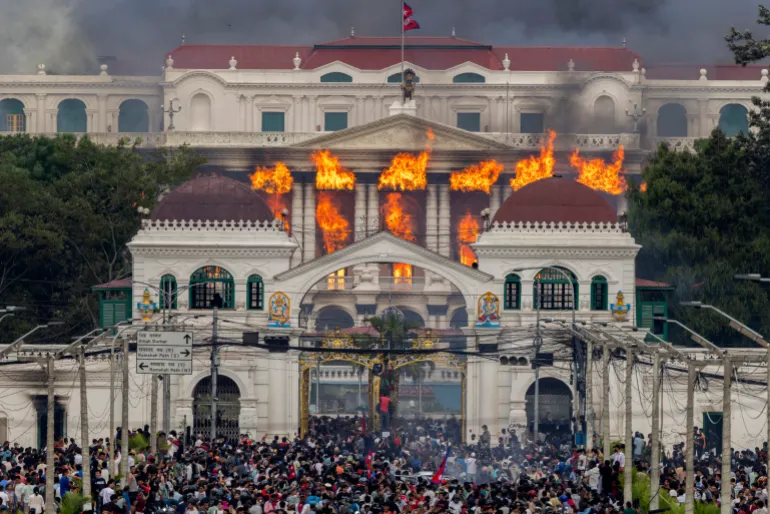
Fire and smoke rise from the Singha Durbar palace, which houses government and parliament buildings, after protesters stormed the premises during violent demonstrations in Kathmandu on September 9 [Photos: EPA]
Islamabad – On Sunday, Nepal’s then–Prime Minister KP Sharma Oli mocked youth protesters who had planned a major demonstration in Kathmandu against corruption and nepotism. By Tuesday, he was out of office. Police firing on demonstrators killed at least 19 people, sparking anger that escalated into violent protests. Parliament and politicians’ homes were set on fire, cabinet members resigned, and by the end of the day, Oli had stepped down. The death toll from two days of clashes has now risen to 31.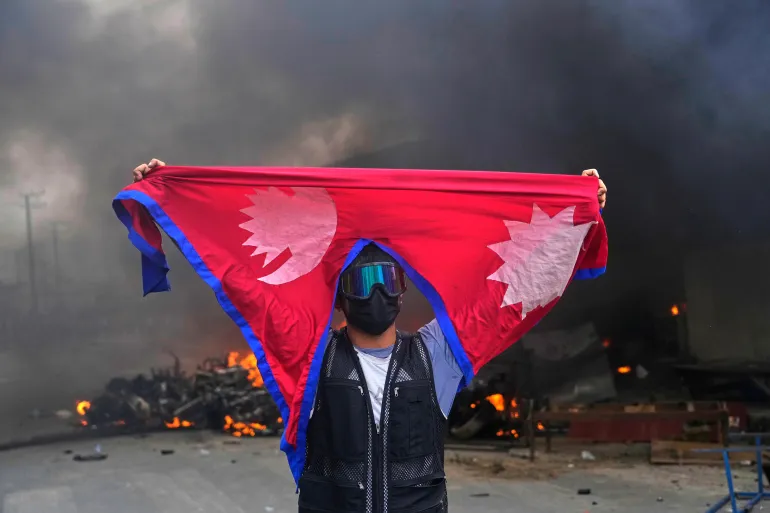
A protester shouts slogans, carrying the national flag, after burning down a police station during protests against a social media ban and corruption in Kathmandu, Nepal, on September 9
These dramatic events have turned the Himalayan nation of 30 million into the latest epicenter of youth-led upheaval in South Asia, echoing movements that toppled governments in Sri Lanka (2022) and Bangladesh (2024). Experts warn that Nepal’s crisis has implications far beyond its borders, shaped by its turbulent history and its sensitive position between India, China, and Pakistan.
What’s happening in Nepal?
On September 8, tens of thousands of young people – calling themselves the “Gen Z movement” – poured into the streets to protest corruption, nepotism, and a government ban on social media.
When demonstrators breached barricades at parliament, security forces opened fire, killing at least 19. The crackdown only fueled more violent protests, with party offices, media houses, and politicians’ homes torched. Although Oli resigned, protesters are demanding much more: the dissolution of parliament, fresh elections, an interim government they help shape, and accountability for those who ordered the shootings.The army is now deployed in Kathmandu under a strict curfew.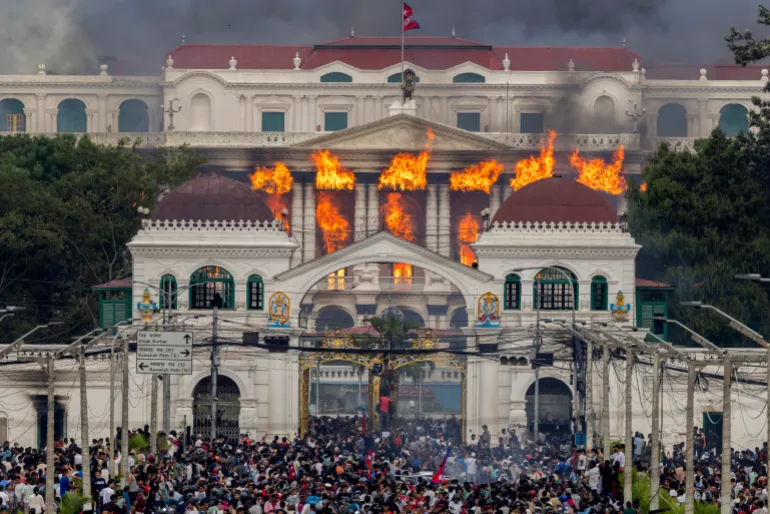
Fire and smoke rise from the Singha Durbar palace, which houses government and parliament buildings, after protesters stormed the premises during violent demonstrations in Kathmandu on September 9
A history of unrest
Nepal’s modern politics has been shaped by cycles of student movements, royal interventions, and violent struggle:
Since then, eight leaders from three main parties have rotated power 14 times. Oli himself served four terms. Analysts say the Gen Z protests are less about one government and more about deep frustrations over corruption, poor governance, and an out-of-touch political elite.
Why the world is watching
Nepal is a small, landlocked country, but its location makes it strategically vital. Stretching 885km along the southern Himalayas, it borders China to the north and India on three sides.
Though traditionally closer to India, Nepal has shifted alignments with political winds. Oli was viewed as leaning towards Beijing, prompting speculation that his removal could alter the balance of influence.
Some experts suggest a neutral interim figure such as former Chief Justice Sushila Karki or Kathmandu’s young mayor Balendra Shah could lead the next government. Whoever emerges will face pressure to maintain Nepal’s delicate balance between its two giant neighbours.
The regional calculus
What’s next?
For now, Nepal’s protesters are refusing to settle for cosmetic change. Their demands go beyond the resignation of Oli and signal a deeper generational push against entrenched corruption and elitism.
As Nepal faces a precarious transition, the region – and the world – will be watching closely to see if this Gen Z movement can force lasting reforms, or whether the country will return to its familiar cycle of unrest and power struggles.
In summary
What's causing the crisis?: The government imposed a ban on 26 social media platforms, which was seen as an attempt to suppress dissent and criticism of widespread corruption and nepotism.
How have people responded?: Youth-led protests erupted across the country, with demonstrators demanding the lifting of the ban and greater accountability from the government. The protests turned violent, resulting in at least 31 deaths and hundreds of injuries.
What's next?: Prime Minister KP Sharma Oli has resigned, but the underlying issues remain unaddressed. The future of Nepal's government and stability hangs in the balance, with potential implications for regional dynamics and relationships with neighboring countries like India and China
Source: Aljazeera
READ THE FULL STORY HERE: Why does Nepal’s crisis matter to South Asia – and the world?



