Written By | Fashion and Design Desk
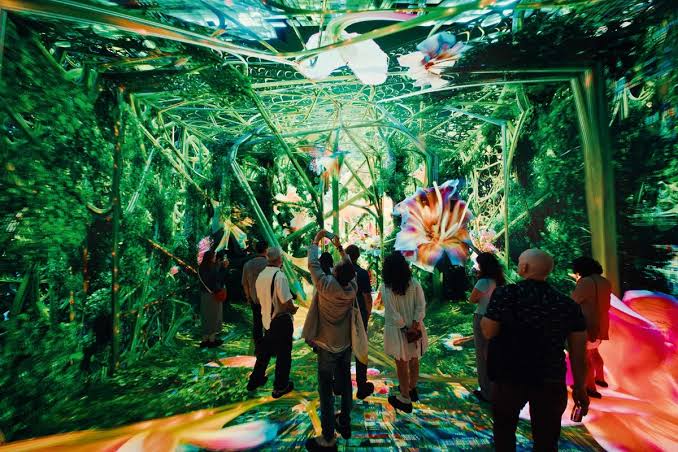
Refik Anadol's Dataland just opened inside Frank Gehry's Grand LA, the first museum built entirely around AI art
LOS ANGELES
Most museums ask you to look quietly and touch nothing. Dataland, which opened its doors in downtown Los Angeles two days ago, asks something stranger of its visitors: it asks to look back. Billed as the world's first museum dedicated entirely to AI arts, the 25,000-square-foot space inside Frank Gehry's Grand LA complex was co-founded by artist Refik Anadol and curator Efsun Erkılıç, and it represents one of the more ambitious bets yet that artificial intelligence belongs not just in labs and chatbots, but in galleries built specifically to house what it can create.
The premise sounds almost philosophical until you encounter it physically. Visitors are given two wearable devices on entry: a medical-grade biosensing band worn at the wrist that tracks heart rate, skin temperature, and skin conductivity in real time, and a second device worn around the neck that delivers a personalized scent journey synced to whatever gallery a visitor is standing in. The data those sensors collect doesn't just measure the audience's reaction to the art — in Dataland's central conceit, it becomes part of the art, feeding back into installations that shift and respond to the collective emotional state of the room.
“Is It Possible for Artworks to Feel Us Back?”
That question, posed by Anadol himself, sits at the center of Dataland's pitch. “For 5,000 years humans have been emotionally moved by artworks, but the relationship has always flowed in one direction,” he has said. “While developing Dataland we asked ourselves, is it possible for artworks to feel us back?” It's a line that could read as marketing gloss if the museum weren't backing it with five full galleries' worth of installations built to test the idea, beginning with Machine Dreams: Rainforest, the inaugural centerpiece exhibition.
Rainforest is an immersive, audiovisual installation built from millions of images and sounds drawn from the natural world, developed after Anadol and Erkılıç made a research trip to the Amazon. It's the kind of large-scale, data-driven environmental piece Anadol has spent roughly a decade refining — he has described feeling a particular responsibility as “an artist pioneering this field for ten years” to get the museum's foundational gesture right. “This is a laboratory of imagination,” he said. “We have walls, but no limits in the ideation.”
The Infrastructure Behind the Spectacle
Dataland's ambitions required partners well outside the usual museum-world Rolodex. The space was developed in collaboration with architecture firm Gensler and global engineering consultancy Arup, the kind of technical-build team more associated with stadiums and transit hubs than gallery design — a signal of how much custom infrastructure the biosensing and scent-delivery systems alone demanded. The interactive backbone of the museum runs on Google Cloud, with Google Arts & Culture also funding a new artist residency program housed at the museum, tying one of the world's largest technology companies directly into the institution's ongoing programming rather than just its opening-week press cycle.
Coverage since the June 20 opening has been a genuine mix of fascination and skepticism, which is probably the most honest review an AI art museum could hope for at this exact cultural moment. One widely circulated description from opening week characterized the experience in deliberately sensory, slightly bewildered terms — “data chocolate,” dreams rendered physically real, artworks reshaped in real time by visitors' own emotional signals — capturing both the genuine novelty of the experience and the slightly uncanny feeling of being measured by the thing you came to look at.
An Old Argument, Restaged
Dataland arrives into a cultural environment where AI-generated imagery remains deeply, sometimes bitterly, contested — accused by critics of devaluing human craft, trained on questions of consent and copyright that remain legally unresolved, and treated by a meaningful share of the art-going public with outright suspicion. Anadol, who has spent a decade building a career specifically on data-driven and machine-learning-assisted installation work, is betting that a museum built around emotional reciprocity rather than novelty alone can shift that conversation, at least for the segment of the public willing to put on a heart-rate sensor and find out.
What This Means for You
If you're in or planning a trip to Los Angeles this summer, Dataland is now open daily at the Grand LA, within easy walking distance of the Broad and Walt Disney Concert Hall, making it a plausible addition to an existing downtown arts itinerary rather than a destination requiring a special trip. Tickets are timed and the biosensing component means the experience genuinely changes depending on how many people are in the room with you and how they're reacting — there is, by design, no identical visit twice.
Conclusion
Museums dedicated to a single medium or technology tend to be remembered either as prescient or as relics of a moment's enthusiasm, and it is far too early to know which fate awaits Dataland. But the bet underneath it is a serious one: that the next era of art-going might not just involve looking at a screen, but being read by it, and that an institution willing to build that experience from scratch, with Google's cloud infrastructure and Gensler's architectural muscle behind it, deserves to be taken at its word when it says it wants to find out what happens when the art studies the audience right back.



