Written By | International News Agencies
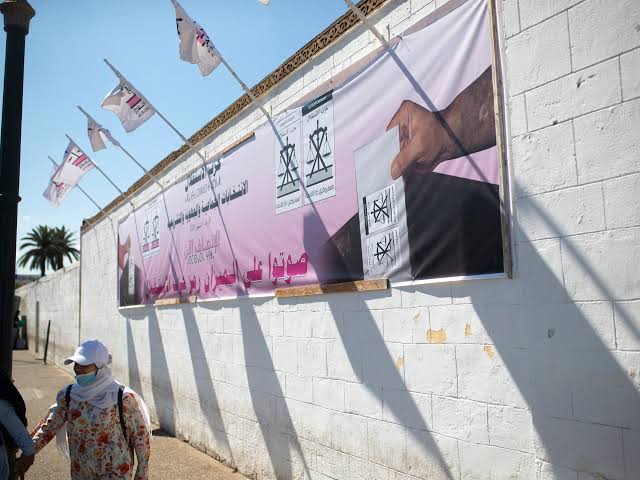
Moroccans vote on Sept. 23 for all 395 seats in the House of Representatives, the lower chamber of parliament. The official campaign period opens Sept. 10
RABAT, Morocco
Four days before Morocco's official election campaign is due to begin, the three parties that have governed the country together for five years are publicly accusing one another of poaching candidates, quarreling over a leaked audio recording, and arguing over who should hold the finance portfolio in a government that has not yet been formed. The country's top prosecutor, meanwhile, has ordered courts across Morocco onto an electoral footing, instructing prosecutors to investigate complaints quickly and prosecute anyone who breaks electoral law.
Moroccans vote on Sept. 23 for all 395 seats in the House of Representatives, the lower chamber of parliament. The official campaign period opens Sept. 10. What is unusual about the run-up is not that the governing coalition is divided — coalition partners in any proportional system compete for the same voters — but how openly the fight has spilled into public view before a single campaign rally has been held.
What is being decided
Under Morocco's constitution, King Mohammed VI appoints the head of government from the party that finishes first in the House of Representatives election. Coming first is therefore the prize, but it is not the whole contest: no party in Morocco's fragmented multi-party system wins a majority alone, and 198 seats are needed to command the chamber. The winner must then assemble a coalition, which makes the relative size of every parliamentary group consequential.
Of the 395 seats, 305 are elected from 92 local multi-member constituencies returning between two and six members each. The remaining 90 come from 12 regional constituencies, and at least a third of those must go to women.
The incumbent coalition consists of the National Rally of Independents (RNI), led into the last election by Head of Government Aziz Akhannouch; the Authenticity and Modernity Party (PAM); and the Istiqlal Party. In the 2021 election the RNI took 102 seats, PAM 87 and Istiqlal 81. The Islamist-rooted Justice and Development Party (PJD), which had governed for two consecutive terms from 2011, collapsed from 125 seats to 13 — one of the most abrupt reversals in the country's electoral history.
The scale of the field this year suggests broad participation, at least at the level of party organization. Candidate nominations opened Aug. 31, and by the afternoon of the first day 702 candidate lists from 27 political parties had been filed, according to the Interior Ministry. About 15.8 million voters are registered, in a country of 36.8 million people according to the 2024 census; the High Commission for Planning estimates the voting-age population at roughly 25 million.
The recording
The immediate flashpoint is an audio recording attributed to Rachid Talbi Alami, the Speaker of the House of Representatives and a senior RNI figure. In it, a voice attributed to Talbi Alami appears to criticize Fouzi Lekjaa without naming him and warns against allowing him to obtain the economy and finance portfolio in the next government. The recording began circulating after the RNI accused PAM of drawing away its elected officials and candidates.
Lekjaa is one of the more recognizable figures in Moroccan public life. He has served as minister delegate in charge of the budget and has headed the Royal Moroccan Football Federation since 2014, a role that made him a national figure during Morocco's run to the semifinals of the 2022 World Cup and its quarterfinal appearance this year. He recently moved to PAM, according to Morocco World News — the kind of transfer that has fed the RNI's poaching complaint.
The recording drew responses from the RNI's president, Mohamed Chaouki, and from Akhannouch, who defended internal party discussions as ordinary political debate and said the focus should be on winning the election rather than allocating government posts in advance. Lekjaa rejected the premise directly, saying that "dividing up the spoils without having hunted them" was not his concern.
The substance of the dispute is narrower than its symbolism. If senior figures in governing parties are already negotiating who holds which ministry, voters are entitled to ask how much of the next government is being settled before ballots are cast. That does not make the outcome predetermined — the seat arithmetic genuinely is not yet known — but it does illustrate how much of Moroccan coalition politics happens in rooms rather than at rallies.
The prosecutor's circular
On Sept. 1, the Prosecutor General of the Court of Cassation and Head of the Public Prosecution, Hicham Balaoui, issued a circular instructing prosecutors at appeal and first-instance courts to follow every stage of the electoral process. Balaoui invoked Article 11 of the constitution, which establishes free, fair and transparent elections as the basis of legitimate democratic representation, and ordered prosecutors to act firmly against practices that could damage the integrity of the vote.
The circular requires that electoral complaints be investigated quickly, that the criminal provisions of electoral law be applied, and that prosecutors remain available throughout the electoral period. It also orders tighter coordination between regional and local units handling election cases and a central unit at the Public Prosecution.
Read in isolation, the circular is routine administrative preparation. Read against the coalition's public quarrels, it is a signal that the judiciary expects trouble at the constituency level — the retail end of Moroccan elections, where candidate transfers and patronage networks matter more than national manifestos.
What the campaign will actually be about
The parties will fight over living costs, jobs, health care and education — the issues that have topped voter concerns for years and remain there.
Employment offers the sharpest test of the government's record. The 2021–2026 government program pledged to create at least one million net jobs over five years. By the end of 2025, net job creation stood at about 95,000, according to an analysis by the Moroccan outlet Medias24. The government uses a different metric, saying 850,000 non-agricultural jobs were created between 2021 and 2025. Both numbers can be defended on their own terms; the gap between them is precisely the argument the opposition intends to have.
Prices are the second front. Inflation has slowed from the sharp increases of recent years, but slower increases are not reductions, and household budgets have not returned to where they were. The point has crystallized around an unlikely symbol: the price of sheep for Eid al-Adha. Last year Moroccans were urged to forgo the traditional sacrifice after drought cut livestock numbers and pushed prices up. This year animals were available but expensive, and many families said they could not afford them. On Sept. 4, Akhannouch defended the government's sheep import policy by citing years of drought — an intervention that shows how thoroughly a religious observance has become an economic argument.
Then there is Ceuta. On July 30, a mass movement toward the Spanish-administered enclave drew what Reuters reported as at least 72,000 people. The episode resulted in 82 deaths on the Spanish side and 14 confirmed deaths on the Moroccan side. Spanish authorities said between 5,000 and 8,000 people remained in Ceuta as of Aug. 28. By Aug. 21, according to data provided by Ceuta's court, only six of the dead had been identified.
The crossing was fueled in part by misleading social media posts suggesting Spain had opened its border. Spanish Prime Minister Pedro Sánchez said on Aug. 31 that there was no evidence Morocco had organized the movement, attributing it to criminal networks and disinformation. The PJD has called for a royal commission of inquiry, moving the episode from the diplomatic file into the campaign. Morocco claims sovereignty over Ceuta and Melilla, which Spain administers as part of its territory, so the issue arrives pre-loaded with nationalist charge — but the political question that will resonate domestically is simpler: what conditions persuaded tens of thousands of young Moroccans to walk toward a border in a single day?
Turnout is the real variable
Turnout in the 2021 parliamentary election was about 50 percent of registered voters. Interior Ministry figures reported before this election showed that citizens aged 18 to 24 accounted for about 3 percent of registered voters — a figure that describes the registration rolls, not the size of that age group in the population, but that nonetheless indicates how thin youth participation in the formal process has become.
That is the number to watch on Sept. 23. Morocco's electoral law, amended in 2021, removed the previous thresholds and calculates seat allocation on the basis of registered voters rather than ballots cast, which compresses the advantage of any dominant party in a district. In a low-turnout election under that formula, small shifts in mobilization translate into meaningful shifts in seats, and a fragmented parliament becomes more likely rather than less.
What to watch
Three things will determine whether the next two and a half weeks produce a result anyone regards as decisive. The first is whether the RNI–PAM feud escalates once campaigning formally begins on Sept. 10. Public quarrels between governing partners are survivable; a coalition that cannot credibly promise to re-form after the election gives undecided voters a reason to look elsewhere or stay home.
The second is whether the PJD converts visibility into votes. It has spent five years as a small, vocal opposition attacking the government over prices, employment, public services and alleged conflicts of interest. Whether that record persuades voters who abandoned the party in 2021 to return is the single most consequential unknown in the seat count.
The third is enforcement. Balaoui's circular commits the prosecution service to a visible role. If complaints are filed and nothing follows, it will be read as choreography. If prosecutions do follow, they will land in the middle of a campaign in which the governing parties are already accusing each other of bad faith.
Morocco's monarchy sets the outer limits of what the vote decides; the palace's role is not on the ballot. Within those limits, though, this is a real contest over who governs and on what record. The campaign has not officially started. The fight plainly has.



