NEW YORK
A Century of Listening, On Display
Design museums have long treated the visual world as their exclusive territory — chairs, typefaces, buildings, product packaging. "Art of Noise," the exhibition currently running at Cooper Hewitt, Smithsonian Design Museum through August 16, 2026, makes the case for an overlooked companion discipline: the design of how things sound. Organized in partnership with the San Francisco Museum of Modern Art, the show pulls together more than 300 objects from the two institutions' collections to trace a full century of music design, from ornate hand-cranked phonographs to sleek digital streaming hardware, alongside concert posters, record sleeves, handheld radios and full sound systems.
More Than a Nostalgia Trip
It would be easy to frame a show like this as pure nostalgia — a parade of vintage Victrolas and boomboxes for design enthusiasts to coo over. "Art of Noise" resists that framing by treating each object as evidence of a specific design problem being solved for a specific cultural moment: the phonograph's ornate cabinetry designed to make new technology feel like acceptable parlor furniture; the transistor radio's miniaturization designed to make music portable and personal for the first time; the boombox's oversized speakers and handle designed explicitly for public, communal listening on city streets. Read this way, the exhibition becomes less a music history lesson and more a case study in how designers have repeatedly reimagined the physical relationship between listeners and sound as both technology and social context evolved.

New Commissions Alongside the Archive
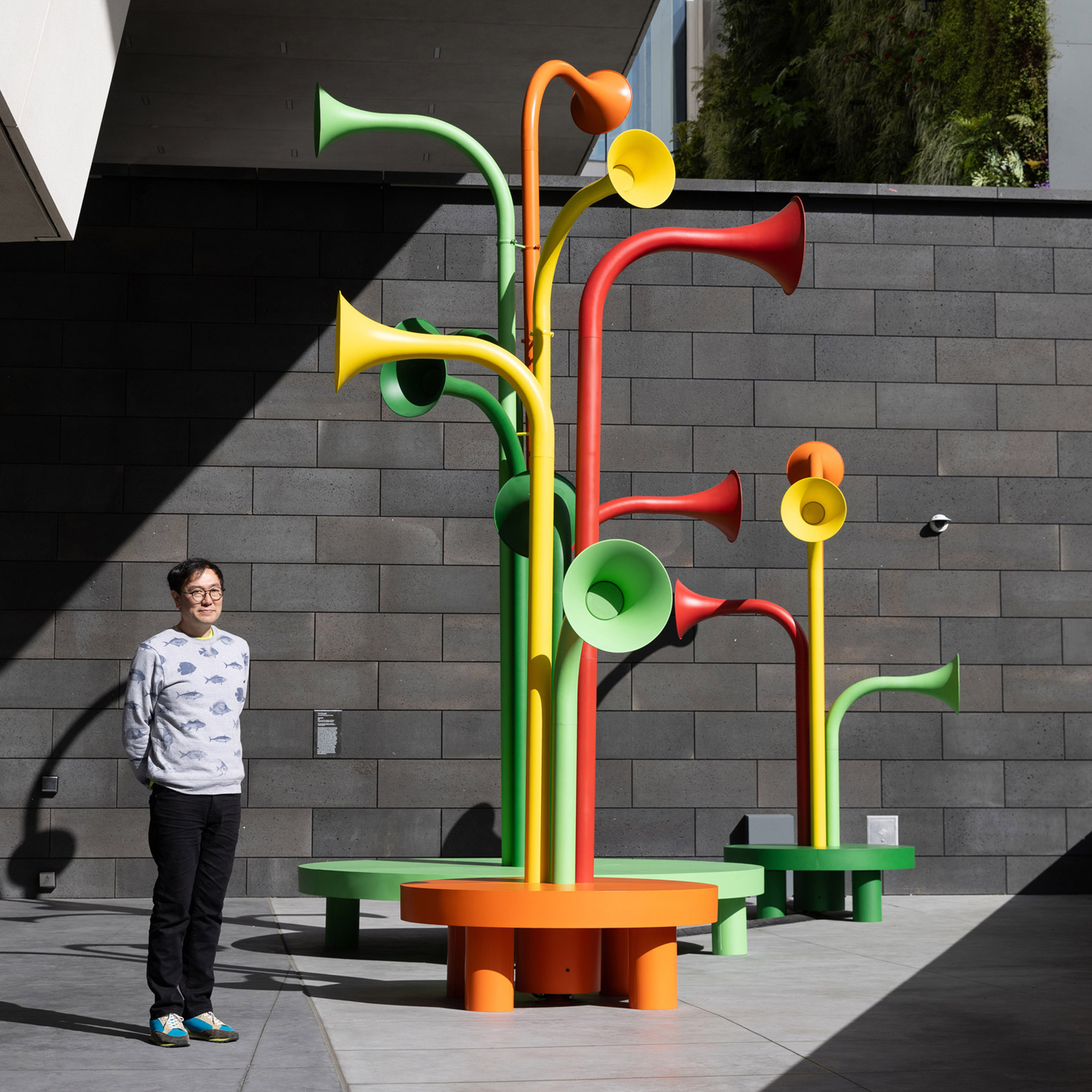
Rather than confining itself to historical artifacts, the exhibition folds in newly commissioned, immersive sound environments that update its central argument for a contemporary audience. Stockholm-based studio teenage engineering contributed a sound environment built specifically for the show, while multidisciplinary artist Devon Turnbull created "HiFi Pursuit Listening Room Dream No. 3," a large-scale, entirely handmade audio system installed as its own listening room within the museum. That installation ran from December 12, 2025 through July 19, 2026, giving visitors a rare chance to experience audio playback as a piece of considered, sculptural design rather than a purely functional afterthought bolted onto a piece of furniture.
The listening room concept is deliberately provocative in a design context: most consumers interact with sound systems as invisible infrastructure, judged purely on output rather than form. Turnbull's installation — and the broader exhibition around it — argues that the physical vessel for sound deserves the same design scrutiny as the chair someone sits on or the lamp that lights the room, an argument that feels particularly timely as more listening moves to wireless earbuds and smart speakers whose design language has increasingly converged on interchangeable minimalist pucks and sticks.
A Museum Betting on Sound as the Next Design Frontier
Cooper Hewitt's programming around the exhibition reinforces that ambition. The museum has run public events explicitly framed around sound and music design throughout the exhibition's run, treating the topic as a legitimate strand of design education rather than a novelty adjacent to its core mission. That institutional bet mirrors a broader, quieter shift happening across the design world: as visual design tools become increasingly democratized and accessible to non-specialists — a trend design trade press has been tracking closely this year, alongside the rise of plain-text "design system" files that let non-designers maintain visual consistency without deep expertise — sensory and experiential design disciplines like sound, haptics and spatial audio are emerging as areas where specialist expertise still commands a clear premium.
"How something sounds is not a neutral byproduct of engineering — it's a design decision, made the same way a color palette or a typeface is chosen," is the underlying thesis running through the exhibition's wall text and programming, one that reframes a century of consumer audio hardware as a parallel design history running alongside better-documented visual design movements like mid-century modernism or Bauhaus functionalism.

What This Means for Design-Curious Visitors
For visitors without a design background, "Art of Noise" offers an unusually accessible entry point into design thinking generally: nearly everyone has an emotional relationship with at least one object in the show, whether it's a childhood boombox, a parent's record collection, or a first pair of headphones, which makes the exhibition's underlying arguments about form, function and cultural context land more immediately than a show built around, say, industrial furniture. For design professionals and students, it's a rarer opportunity to study a full century of a specific design category in one place, tracing clear through-lines from ornate wooden phonograph cabinets to the deliberately invisible design language of today's wireless earbuds.
A Closing Argument, Literally in the Room
With the exhibition's run extending through mid-August, there's still time to catch it before it closes, and the museum has signaled the show is likely to be remembered as a template for future exhibitions treating sensory, non-visual design disciplines with the same institutional seriousness traditionally reserved for architecture and product design. Whether or not "Art of Noise" changes how mainstream design criticism talks about sound, it has already made a compelling, room-filling case that the story of how we listen deserves its own place in design history — not as a footnote to the story of what we look at, but as a parallel narrative worth telling on its own terms.
Published By | Features Editor