Written By | Fashion and Design Desk
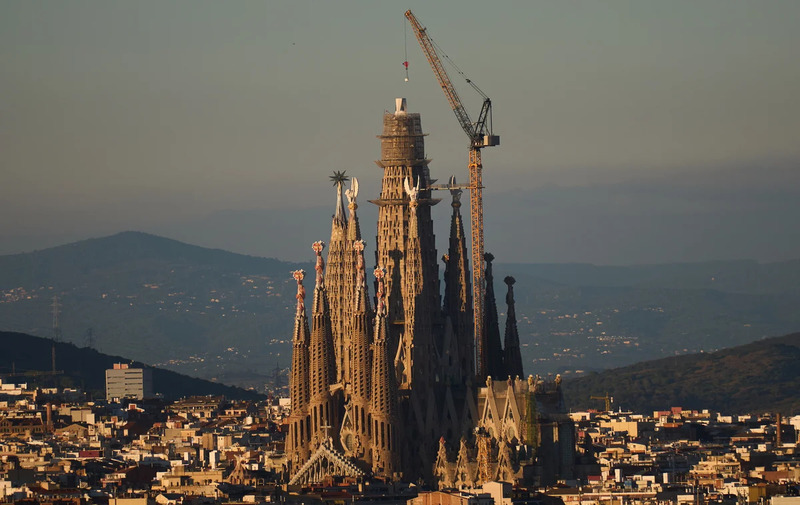
The Sagrada Família has reached its full height exactly a century after its architect's death — and the milestone is reshaping how the world understands Barcelona's most unfinished masterpiece
BARCELONA
For 144 years, the Sagrada Família has been the world's most famous unfinished building — a basilica so large, so strange, and so slow to complete that generations of Barcelona residents grew up, grew old, and in some cases died without ever seeing it finished. This year, that changed. In February, construction crews installed the final structural element of the church's central spire: a 100-ton cross atop the Tower of Jesus Christ, pushing the building to its full and final height of 172.5 meters — roughly 566 feet — and making the Sagrada Família the tallest church on Earth.
The timing was not incidental. 2026 marks exactly one hundred years since the death of Antoni Gaudí, the visionary Catalan architect who devoted the last years of his life almost entirely to the project, living for a time inside the workshop on site, and who died in June 1926 after being struck by a Barcelona tram — famously so shabbily dressed at the time that bystanders mistook him for a beggar and delayed getting him medical help. That a project he could never have imagined finishing in his own lifetime has now reached full height in the exact year of his centenary has given 2026 an almost mythic weight in Barcelona's cultural calendar, one the city has been building toward for years.
A Blessing, a Pope, and a City-Wide Celebration
The completed central tower was formally blessed on June 10, 2026 — the precise date, one century later, of Gaudí's death — in a ceremony led by Pope Leo XIV. The event drew global attention not just for its religious significance but for what it represented architecturally: the near-completion of a building that has functioned, for over a century, as a kind of open-ended collaboration between one visionary and the generations of architects, engineers, and stonemasons who inherited his unfinished vision.
Jordi Faulí, the chief architect currently overseeing construction, framed the milestone in terms that stretched well beyond the engineering feat itself. "Completion of the cross on the tower of Jesus Christ represents much more than the culmination of a phase of construction," Faulí said. "It is the result of years of work and studying the legacy Antoni Gaudí left us. It is also a firm commitment to the future, to continue working to complete the Sagrada Família."
That last phrase is telling. Even at full height, the Sagrada Família is not finished — decorative elements, facade details, and surrounding site work are expected to continue for years, if not longer, a reminder that "completion" for this particular building has always been a relative term rather than an endpoint.
A Yearlong Citywide Commemoration
The tower's blessing is the centerpiece of a much larger citywide program that Barcelona has been rolling out since autumn 2025 and will continue through the end of 2026. Museums, cultural institutions, and churches across the city have organized exhibitions, guided architectural tours, concerts, lectures, restoration projects, and design symposiums, all oriented around what local organizers have taken to calling "the Gaudí Year."
Beyond the Sagrada Família itself, other Gaudí landmarks have become focal points of the celebration. Casa Vicens, Gaudí's first major residential commission and one of the earliest built expressions of Catalan Modernisme, is hosting specialized installations exploring the architect's structural relationship with the natural world — a theme that runs through nearly all of his work, from the tree-like columns inside the Sagrada Família's nave to the organic, almost skeletal forms of Park Güell. Symposiums throughout the year have focused specifically on this relationship between Gaudí's structures and natural forms, an area of his work that architectural historians say remains under-examined relative to his more famous ornamental flourishes.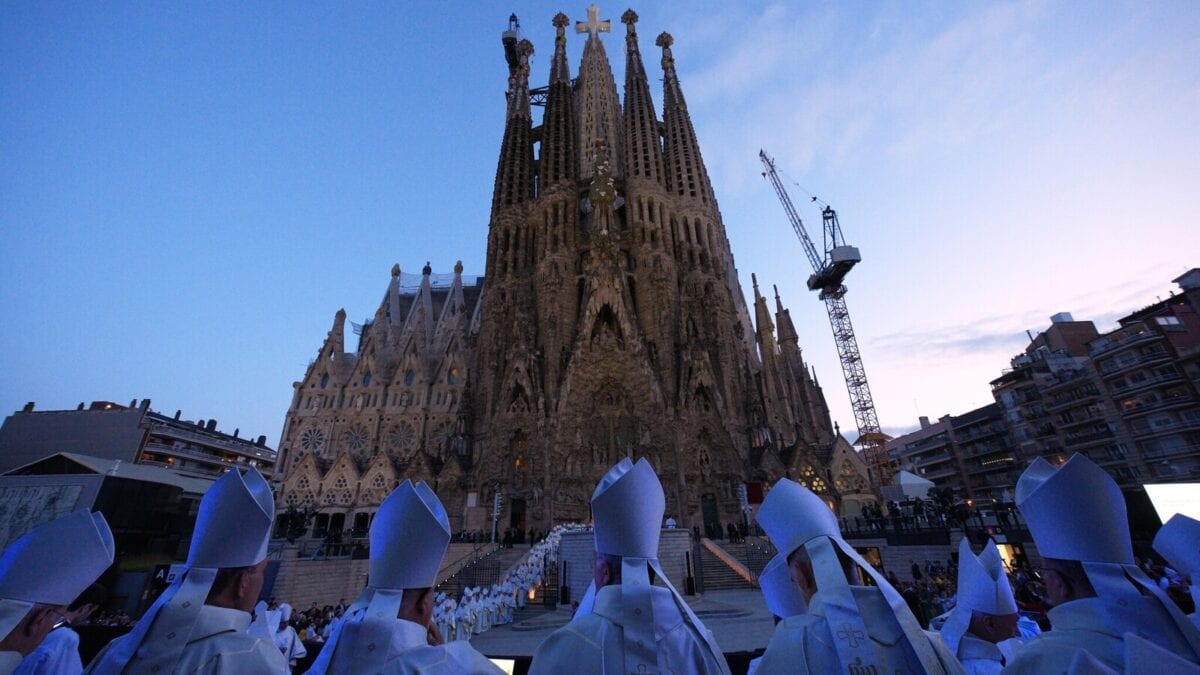
Why Gaudí Still Matters to Contemporary Design
For an architect who died a century ago, Gaudí's influence on contemporary design and architecture remains strikingly current — arguably more current than it was even a generation ago. His structural experiments, particularly his use of catenary arches and hyperboloid forms derived directly from natural load-bearing structures, anticipated computational and parametric design techniques by nearly a hundred years. Contemporary architects working with algorithmic and generative design tools frequently cite Gaudí's hanging-chain models — physical simulations he used to calculate the Sagrada Família's arches decades before computers existed — as an intellectual ancestor of today's digital form-finding software.
That lineage is part of why the Sagrada Família's completion resonates beyond Barcelona and beyond religious architecture specifically. It represents the endpoint — or at least the current endpoint — of what may be architectural history's longest-running case study in a single building outliving its author, its era, and multiple generations of construction technology, and still being completed according to principles the original architect laid down using little more than string, weights, and mirrors.
What This Means for Travelers and Design Enthusiasts
For anyone planning a trip to Barcelona this year, the Gaudí Year programming offers an unusually rich window into the architect's full body of work, not just the Sagrada Família's now-completed silhouette. Visitors can expect elevated crowds and demand throughout 2026, particularly around key dates tied to the centenary, and many of the citywide exhibitions and symposiums are time-limited, running only through the end of the year.
For design enthusiasts more broadly, the milestone is a rare opportunity to witness the literal completion of a building most assumed would remain perpetually unfinished — a status that had, over decades, become almost as central to the Sagrada Família's identity as Gaudí's architecture itself.
The Takeaway
The Sagrada Família reaching its full height in the exact year of Gaudí's centenary is more than a construction milestone — it's the closing of a loop nearly a century and a half in the making. It's a reminder that some architectural visions are large enough to outlive not just their creators, but the very cultural and technological eras that first attempted to build them, and that patience, at a large enough scale, is itself a kind of design principle.



