MEDORA, N.D
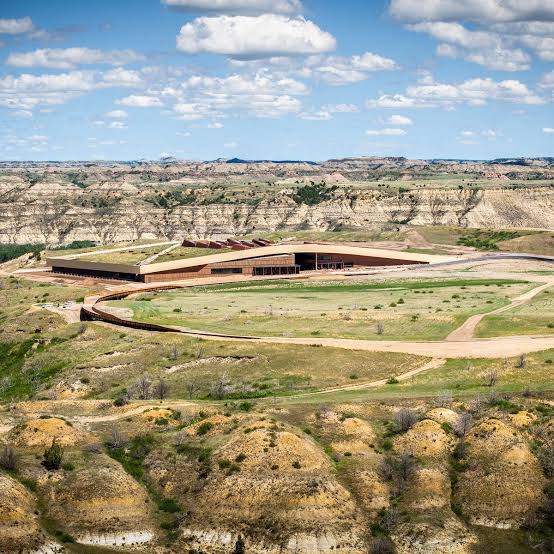
Presidential libraries tend to follow a formula: marble or limestone, a grand rotunda, a building that announces its own importance from the highway. The Theodore Roosevelt Presidential Library, which opened its doors on July 4 — the 250th anniversary of American independence — breaks that formula almost entirely. From certain angles, it barely looks like a building at all.
Designed by the Norwegian-American firm Snøhetta, the 95,000-square-foot library sits on a 93-acre site in Medora, North Dakota, adjacent to Theodore Roosevelt National Park — the rugged badlands landscape that a young, grief-stricken Roosevelt retreated to in the 1880s and later credited with shaping his conservation ethic. Rather than compete with that landscape, Snøhetta built the library into it. The structure rises from a butte with an accessible earthen roof spanning 121,000 square feet of living prairie grass, walkable by visitors and largely indistinguishable, from a distance, from the terrain around it. The guiding design principle, repeated throughout the project's promotional materials, is disarmingly simple: "The Library is the Landscape."
A Building That Wants to Be Certified, Not Just Admired
The library's most consequential ambition isn't visual, though — it's environmental. Snøhetta designed the project to pursue full certification under the Living Building Challenge, widely regarded as the most rigorous green building standard in the world, alongside the highest tiers of LEED and SITES certification. The Living Building Challenge doesn't just ask a building to minimize harm; it requires the building to actively generate as much energy as it consumes, treat and reuse all of its own water on-site, and eliminate a lengthy list of red-listed building materials — an extraordinarily difficult bar to clear, especially at the scale of a 95,000-square-foot public cultural institution in a climate that swings from subzero winters to scorching prairie summers.
The design team organized that ambition around what they call a "Four Zeros" framework: zero energy, zero water, zero emissions and zero waste, paired with a commitment to full ecological restoration across the entire 93-acre site. If the certification process succeeds, the Theodore Roosevelt Presidential Library will become the only Living Certified presidential library in the country, and reportedly the largest and most complex Living Certified cultural institution built anywhere to date — a claim that, if it holds up through the multi-year post-occupancy verification process the standard requires, would put a small library in rural North Dakota ahead of far larger, better-funded institutions on the most demanding green-building scorecard that exists.

North America's First Curved Rammed-Earth Wall
Inside, the building's signature feature is a rammed-earth wall unlike anything constructed in North America before it: an approximately 30-foot-tall, 240-foot-long curved centerpiece running through the main hall, built using a technique that compacts layers of earth into dense, striated walls rather than relying on poured concrete or quarried stone. The result reads almost geological — walls that look like they were exposed by erosion rather than built by a construction crew, a deliberate echo of the badlands' own layered rock formations just outside the building's windows.
That kind of construction had no domestic playbook to follow. Marc Mellmer, Vice President and North Dakota Office Leader at JE Dunn Construction, the general contractor on the project, described the process bluntly: "Nobody could point to a playbook for this project. We were asking our teams, our trades, and our suppliers to solve challenges none of us had tackled before, which meant collaboration was required from day one." Contractors, in effect, had to invent and refine a large-scale curved rammed-earth construction method in real time, on a remote North Dakota job site, for a building with essentially zero margin for structural error.
A $180 Million Bet on Restraint
The full project carried an estimated construction cost of roughly $180 million — a significant sum for a facility expected to draw more than 200,000 visitors annually to a town of fewer than 200 year-round residents. That visitor projection is itself a bet: that a building conceived around restraint, ecological integration and Roosevelt's own conservationist legacy can draw the kind of sustained tourism traffic that typically flows to more conventional, monument-style presidential libraries in larger cities.
It's a bet consistent with its subject. Roosevelt, the 26th president, created the U.S. Forest Service, established five national parks, and set aside roughly 230 million acres of public land during his presidency — a legacy the library's design team has clearly treated as a design brief rather than just a biographical footnote. A building that flattens itself into the prairie, generates its own power and treats its own wastewater isn't simply thematically appropriate to Roosevelt's legacy; it's arguably the most literal translation of a presidential library's subject matter into architecture that the genre has ever produced.

Why This Matters Beyond North Dakota
For the architecture world, the Theodore Roosevelt Presidential Library is being watched as a test case for whether truly ambitious sustainable design can scale to major civic and cultural institutions without abandoning either budget discipline or public accessibility. Living Building Challenge projects have historically skewed toward smaller academic buildings or single-purpose research facilities; a 95,000-square-foot public library and museum expected to host hundreds of thousands of annual visitors is a considerably higher-stakes proving ground.
For travelers, meanwhile, the library adds a genuinely novel architectural destination to a part of the country better known for its national park than its buildings — giving visitors to Theodore Roosevelt National Park a compelling reason to extend their trip, and giving architecture enthusiasts a rare opportunity to see large-scale rammed-earth construction and a working Living Building Challenge candidate in the same visit.
The Takeaway
Most presidential libraries are built to be seen from far away. The Theodore Roosevelt Presidential Library was built to nearly vanish into the landscape it sits on — and in doing so, it may have found the most fitting possible tribute to a president whose defining legacy was deciding what parts of America to leave alone.
Published By | Features Editor