Written By |
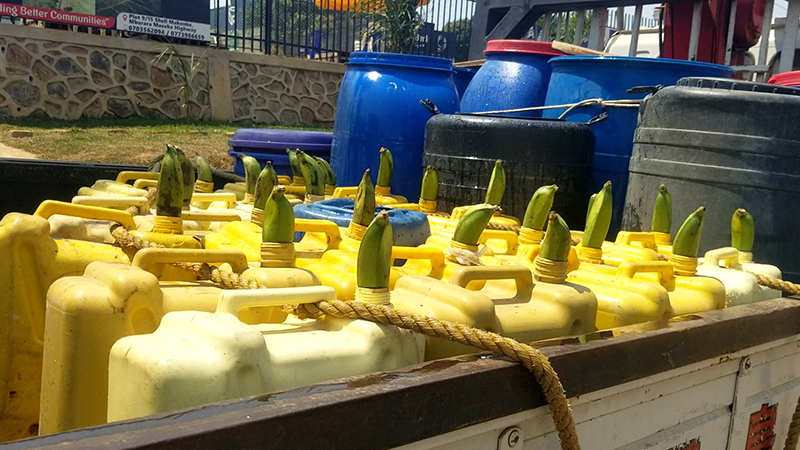
A vehicle carrying jerrycans of water to serve Ibanda people
By Jovita Hasto
IBANDA: Residents of Ibanda District have decried the persistent shortage of clean and reliable water supply in their communities. The district, which comprises eight sub-counties and a municipality with a population of about 255,500 people, continues to struggle with limited access to safe water. In some areas, there is no supply at all.
Water scarcity has become a major problem affecting most villages, towns, and parishes in Ibanda. The worst-hit areas include Nsasi Ward (Bufunda Division), Keihangara Sub-county, and Ishongororo Town Council, where locals rely on dams whose water is unsafe and poses serious health risks.
Mr. Akim Katongole, a barber in Nsasi Ward, said residents have waited in vain for piped water for years. “Whenever I put water in a basin to wash a client’s head after a haircut, they refuse because it looks like black tea. We request our leaders to address this concern because it has been long overdue,” he said.
Ms. Macklean Nshemereirwe, a Village Health Team (VHT) member at Nsasi Health Centre II, said the water crisis has affected both homes and health facilities.
“We are not only affected at our homes but also at the health facility because the water here comes from dams and is dirty. People cannot use it to wash their hands after visiting the toilet or to swallow medicine,” she said.
She added that the only public tap in the area provides water just twice a month.
“We elect leaders expecting them to solve such problems, but instead they return seeking another term without delivering on their promises,” she noted.
Residents also expressed fears for their children who fetch water from deep dams. Ms. Nairah Atusasirwe, a resident of Nsasi Ward, said:
“You cannot imagine what we go through to get water. The dams are deep and risky; we fear our children could drown. We once had a borehole, but it broke down, and since then, we have had no clean water.”
In Ibanda Town, residents are forced to buy a 20-litre jerrycan of water at Shs1,000, supplied by the National Water and Sewerage Corporation (NWSC) at rationed hours.
Mr. Ronald Muhirwe, a resident of Bufunda Street, said people sometimes pay boda boda riders to fetch water, which makes it even more expensive. “Sometimes there is no water at all across town. Those who sell it fetch from drums and charge Shs1,000 per jerrycan, and then you have to pay extra for transport by boda boda. It is costly,” he said.
He added that, at worst, residents walk to nearby villages to draw unsafe pond water.
“The water is creamy. When used to cook posho, it tastes like curry powder was added, and it also turns white clothes yellow when used for washing,” he explained.
District leaders blamed NWSC for failing to provide consistent water supply. Mr. Elias Tumubwiine, the district vice chairperson, said most communities either have no connection or only receive water irregularly.
“Water is often released at night, and by morning it is gone. Those who cannot stay up late to fetch water miss out completely,” he said.
Attempts to get a comment from the NWSC area manager were futile as she was unavailable and did not respond to repeated calls or messages.
Health experts warn of the dangers of consuming unsafe water. Dr. Vincent Mugisha, the Ibanda District Surveillance Officer, said residents risk contracting waterborne diseases such as cholera, dysentery, diarrhoea, hepatitis A, typhoid, polio, and bilharzia.
“Dirty water often contains organisms from animal contamination or open defecation during the rainy season. These practices pollute water bodies, and when people use such water without boiling it, the consequences can be severe,” he said.
A World Health Organization (WHO) study in 2024 revealed that about 1.4 million people die annually due to unsafe water, while more than 2.2 billion people globally lack access to clean water.
Dr. Mugisha confirmed that Ibanda has registered several cases linked to water contamination.
“Every month, our facilities receive patients suffering from waterborne illnesses. While the cases are not yet overwhelming, they pose a serious public health concern. We advise residents to always boil water before use to reduce risks,” he said.



