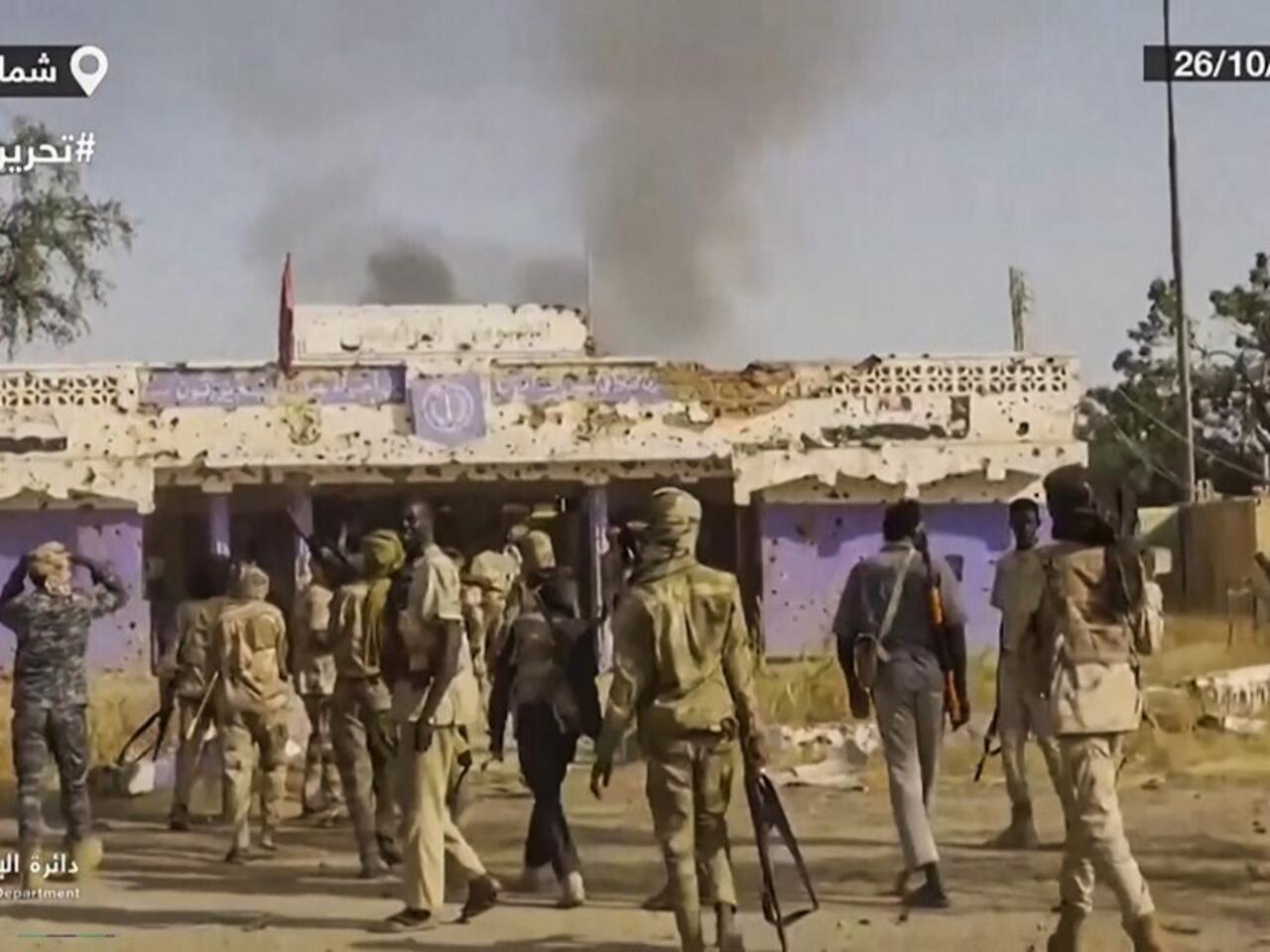
Khartoum and El-Obeid, Sudan
Sudan's civil war delivered another mass-casualty strike this week, underscoring how a conflict now well into its fourth year continues to escalate rather than wind down. At least 35 people were killed and several wounded on Aug. 2 when Sudanese army drones struck a traditional court in the North Darfur village of Garra al-Zawaya, according to the Emergency Lawyers group, a Sudanese rights organization that has documented abuses by both sides since the war began. The dead included four tribal leaders and two commanders of the paramilitary Rapid Support Forces (RSF), which controls the village, a witness told Agence France-Presse.
The strike is a single, grim data point in a war that has killed tens of thousands of people, displaced more than 13 million and produced what the United Nations calls the world's largest displacement crisis. But it also points to where the conflict is heading next: toward El-Obeid, the capital of North Kordofan state, where more than half a million residents and at least 100,000 people already displaced by earlier fighting are, in the words of U.N. High Commissioner for Human Rights Volker Türk, facing "relentless" drone attacks and the prospect of becoming the war's next atrocity site.
A war between former allies
Sudan's war began in April 2023, when the RSF attacked Khartoum in a power struggle between two former allies: army chief Gen. Abdel Fattah al-Burhan and RSF commander Mohamed Hamdan Dagalo, widely known as Hemedti. The two men had jointly overthrown a transitional civilian government in 2021 before turning on each other. More than three years later, the country has effectively split in two. The army controls the northern, central and eastern states, including Khartoum, from which it expelled the RSF in March 2025. The RSF controls most of Darfur and large parts of the three Kordofan states, and has increasingly sought to project that it, too, can govern — including through a rival administration it has floated for RSF-held territory.
The RSF traces its roots to the Janjaweed militias accused of atrocities in Darfur in the early 2000s, and its conduct in the current war has repeatedly echoed that history. In October 2025, RSF forces stormed El-Fasher, the army's last stronghold in Darfur, after an 18-month siege that began in May 2024. The U.N.'s Office of the High Commissioner for Human Rights said 6,000 people were killed in a three-day rampage as the city fell, and an independent U.N. fact-finding mission concluded in February that the assault bore "the hallmarks of genocide." In late June or early July, Amnesty International went further, saying the killings amounted to ethnic cleansing.
El-Obeid: the next flashpoint
That history is why El-Obeid has become the focus of international alarm. The city sits at a strategic crossroads between RSF-held Darfur and army-controlled territory to the east; it hosts the army's 5th Infantry Division and an airbase, an oil pipeline and a major gum arabic market. Whoever controls it controls the flow of people, goods and military supplies into central Sudan — which is why analysts say its fall would let the RSF stitch together its western strongholds and, as Sudan analyst Ahmed Ben Omer told Al Jazeera, "rebuild its political project after losing Khartoum."
Unlike El-Fasher, which endured a classical siege, El-Obeid is being throttled primarily by drones. "El-Obeid is really an example of the pervasive use of drones, and how the use of drones then essentially creates the conditions of a siege without having them to do an actual full encirclement of the city," Leena Badri, a nonresident fellow at the Tahrir Institute for Middle East Policy, told Al Jazeera. The RSF now controls all routes into the city except the road east, according to briefings given to the U.N. Human Rights Council.
The toll on civilians has been documented in granular detail by U.N. investigators. In a three-week span in June, Türk's office recorded 15 drone strikes on El-Obeid and its surroundings that killed at least 45 civilians. A coalition of 28 countries — including the United Kingdom, Canada, France, Germany, Ireland, the Netherlands and Sierra Leone, in a statement delivered by Norway — said 10 consecutive days of drone strikes killed at least 50 civilians across El-Obeid and North Kordofan more broadly. Strikes have repeatedly hit markets, schools, fuel stations, water infrastructure and civilian vehicles, Türk told the Human Rights Council on July 3. Power-station attacks have caused blackouts and disrupted water supplies, and Badri said food prices in the city have surged by as much as 300% while water prices have doubled. The International Organization for Migration said newly displaced people across the Kordofan region rose by nearly two-thirds in just three months, with more than 100 displacement-causing incidents recorded in under nine months — an average of one every two to three days.
Sudan's own ambassador to the Human Rights Council, Salim Ahmed Ibrahim, who said he is from El-Obeid, delivered a defiant message to fellow diplomats: "This wounded city, it will never fall, as long as we are alive."
Both sides have continued to jockey for position around the city. The army claimed control on July 27 of a major highway linking Khartoum and El-Obeid, a potential lifeline for resupplying the garrison. Three days later, the RSF released a video of Hemedti telling his forces to press toward retaking Khartoum, even as fighting intensified in North Kordofan — a sign that neither side sees the war settling into a stable partition, whatever the current map of control might suggest.
Diplomacy stalled
International mediation has made little visible progress. In September 2025, the "Quad" — the United States, Egypt, Saudi Arabia and the United Arab Emirates — agreed on a roadmap that envisioned an initial three-month humanitarian truce, to be followed by a permanent ceasefire and an inclusive political transition. But the Sudanese army has resisted the proposal, fearing a truce would lock in RSF territorial gains, and subsequent meetings between the Quad and the warring parties have not translated the roadmap into action on the ground, according to analysis from the International Crisis Group. Sudan's readmission to the East African bloc IGAD earlier this year has opened a potential parallel mediation track, though it has yet to produce results either.
Meanwhile, the war's toll keeps compounding. The U.N. says more than 1,000 civilians were killed in drone strikes alone during the first five months of 2026, a marker of how both sides have industrialized a form of warfare that lets them project lethal force over cities they cannot or will not fully occupy. Famine was formally confirmed in El-Fasher in September 2025 before its fall, and humanitarian officials warn the same trajectory — sieges, drone bombardment, starvation — is now repeating in North Kordofan.
What to watch
The immediate question is whether El-Obeid follows El-Fasher's path or whether the international pressure generated by U.N. warnings, the 28-country coalition statement and appeals to the U.N. Security Council translate into any concrete protective action; Türk has specifically urged limits on the use of the veto in cases like this one, an idea first floated by France and Mexico more than a decade ago. A second major question is whether the Aug. 2 drone strike in Garra al-Zawaya — which, notably, killed local tribal leaders as well as RSF commanders — signals a broadening of the army's targeting in Darfur that could further inflame tribal dynamics in a region already fractured along ethnic lines. And a third is whether Hemedti's public vow to retake Khartoum is bravado aimed at rallying RSF fighters after the loss of the capital, or a genuine signal that the RSF believes it can reverse the army's gains — a scenario that would extend a war already responsible for one of the worst humanitarian catastrophes of the 21st century well into a fifth year.
For now, neither side shows signs of pursuing the off-ramp diplomats have spent nearly a year trying to build, and the residents of El-Obeid are left, as IOM Chief of Mission Refaat Mohamed put it, wanting "a way out" but unable to find one.
Published By | News Editor