Written By | Evan Sande Ndahura

Sande Evan Ndahura is a Ugandan political and social affairs commentator whose work focuses on constitutionalism, governance, electoral justice, and human rights
By Sande Evan Ndahura
Elections in Uganda are constitutionally anchored in the 1995 Constitution of the Republic of Uganda (as amended), which clearly defines the legal, institutional, and rights-based framework within which electoral processes must operate. Article 1 vests all power in the people of Uganda, exercised through regular, free, and fair elections. Article 61 establishes the Electoral Commission as an independent body mandated to ensure that elections are conducted freely, fairly, and regularly, while Article 62 outlines its functions, including organizing, conducting, and supervising elections in a manner that reflects the will of the people.
Equally central to elections are fundamental rights. Article 29 guarantees freedom of expression, assembly, association, and the press. Article 38 affirms every citizen’s right to participate in the affairs of government, including voting and influencing public decisions. Article 41 provides the right of access to information, while Article 43 allows limitations on rights only where they are acceptable and demonstrably justifiable in a free and democratic society. Together, these provisions make it clear that elections cannot be separated from media freedom, access to information, and open communication. It is against this constitutional background that the unfairness witnessed in the recent Ugandan elections must be examined.
One of the most striking irregularities was the continued circulation of coordinated SMS messages through major telecom companies beyond the officially designated campaign period. Many Ugandans, including myself, received messages late at night on both MTN and Airtel lines stating:
“My fellow Ugandan, tomorrow we choose our future. Vote early and calmly, go home safely. Security is in place—follow guidelines, be patient, respect all.”
A similar version was delivered on a different SIM card with minimal wording changes. These messages arrived after the Electoral Commission’s official campaign time had lapsed.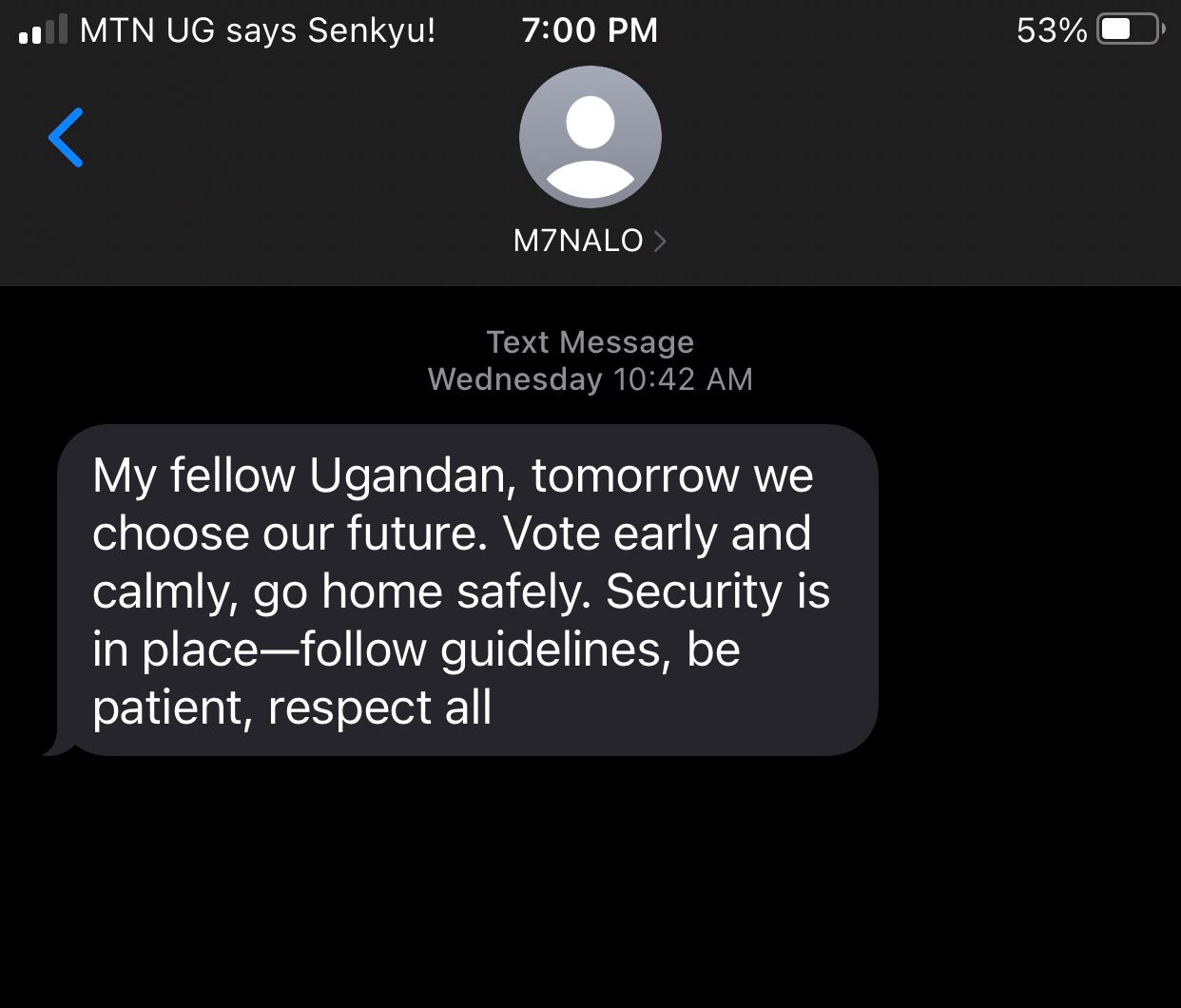
Under Uganda’s electoral laws and the spirit of Article 61, once the campaign period ends, all candidates and actors are expected to observe silence to allow voters space for independent decision-making. When telecom infrastructure—licensed and regulated under state authority—is used to disseminate mass political messaging during this restricted period, it raises serious concerns about institutional imbalance. Opposition actors lacked access to comparable platforms, undermining the constitutional principle of equality before the law under Article 21. Even when framed as civic guidance, the tone, timing, and coordinated nature of these messages carried political implications that favored the incumbent narrative of order and security.
Perhaps the most far-reaching infringement, however, was the shutdown of internet access during the election period. In modern elections, the internet is not a luxury; it is an essential civic infrastructure. Its removal had immediate economic, social, and democratic consequences.
Businesses—especially small and medium enterprises—were abruptly cut off from mobile money services, online trade, logistics platforms, and digital marketing. This disruption interfered with citizens’ ability to engage in lawful economic activity protected under Article 40 of the Constitution. No prior notice, compensation, or clear legal justification was provided, leaving many Ugandans to bear losses individually for a decision taken centrally.
From a human rights perspective, the shutdown struck at the heart of Articles 29, 38, and 41. Freedom of expression, access to information, and participation in public affairs were all curtailed simultaneously. While Article 43 permits limitations in the interest of public order or security, such limitations must be proportionate and necessary. A nationwide, preventive blackout affecting millions—journalists, observers, voters, and businesses alike—was neither targeted nor transparent.
The elections unfolded in an information vacuum. Without internet access, citizens could not easily report irregularities such as intimidation, violence, delayed voting materials, or denial of access to polling agents. Journalists were unable to conduct live coverage, transmit verified results, or preserve digital evidence in real time. Civil society organizations and political parties could not compile parallel vote tallies or coordinate rapid legal responses.
This silence benefited wrongdoing. In environments where visibility is removed, accountability weakens. Elections rely not only on ballots but also on the ability to communicate, verify, and challenge outcomes. The shutdown disrupted this entire chain.
Communication between polling stations, party headquarters, legal teams, observers, and media houses became fragmented. In many areas, information had to travel physically or through unreliable channels, increasing the risk of distortion or suppression. The result was a process in which official announcements dominated, while alternative verification mechanisms—essential to electoral credibility—were largely incapacitated.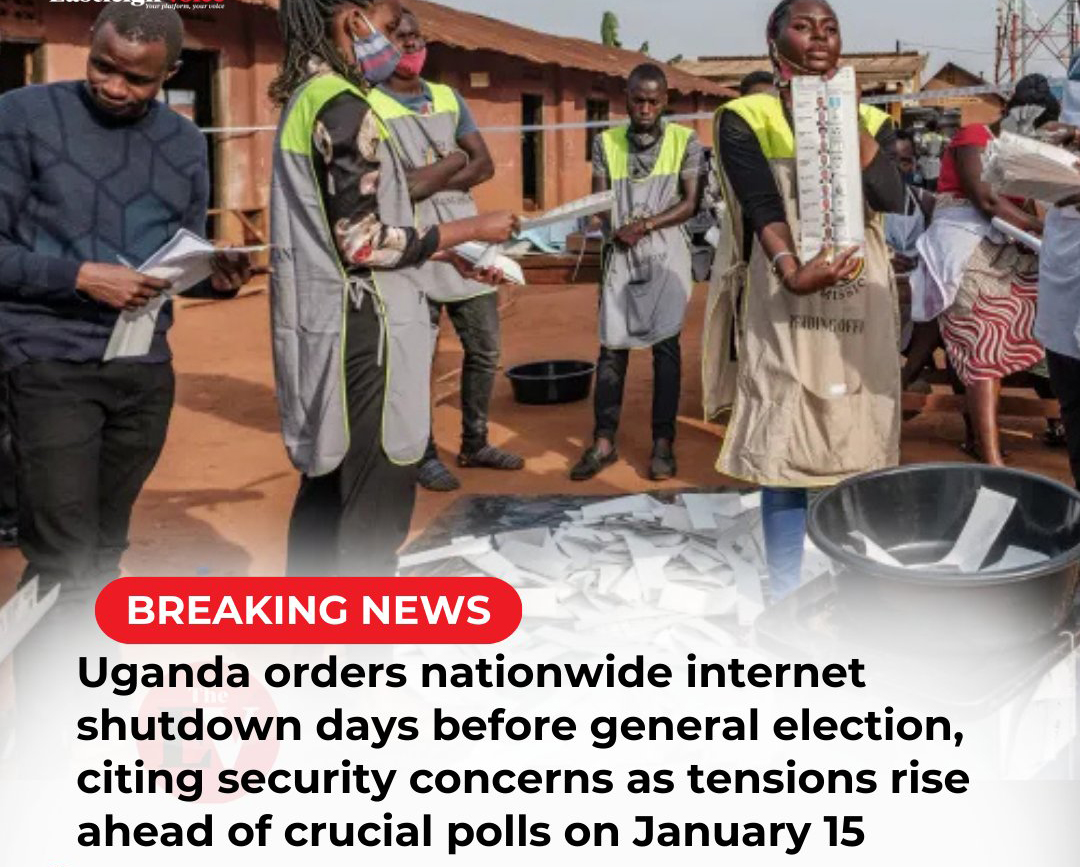
Authorities often justify internet shutdowns on grounds of national security or prevention of misinformation. However, Uganda’s constitutional order does not endorse collective restriction of rights based on speculative threats. Less intrusive measures—such as targeted law enforcement, content-specific takedowns, or post-event accountability—were available. The choice of a total shutdown suggests motivations extending beyond public safety into control of narrative and visibility.
Legally, while the Uganda Communications Commission has regulatory powers, those powers must be exercised within constitutional limits. Any directive affecting communications must be lawful, reasoned, time-bound, and open to scrutiny. Media freedom, protected under Article 29, was indirectly but severely undermined when journalists were denied the digital tools essential for contemporary reporting.
What is often forgotten in such discussions is the long-term damage. Repeated election-related shutdowns normalize exceptional measures, weaken investor confidence, erode trust in institutions, and condition citizens to expect silence rather than transparency during moments of national decision-making. Over time, this corrodes the very democratic culture the Constitution seeks to nurture.
Uganda’s Constitution does not merely create offices; it creates obligations. The Electoral Commission’s independence under Article 61, the media’s freedom under Article 29, and citizens’ participatory rights under Article 38 are not optional conveniences. They are the pillars of legitimate governance.
For future elections to align with the law, campaign silence periods must be respected by all actors, including those with access to telecom infrastructure. Internet access should never be curtailed without strict constitutional justification and judicial oversight. Telecom companies must uphold neutrality, and citizens’ rights to information, expression, and economic activity must be treated as central to electoral integrity.
An election conducted in openness strengthens the Republic. One conducted in silence and imbalance weakens the bond between the people and the state.
Sande Evan Ndahura is a Ugandan political and social affairs commentator whose work focuses on constitutionalism, governance, electoral justice, and human rights. He is also a poet, believing deeply in liberation through a mighty pen rather than a gun. His writing consistently explores the power of words, law, and ideas as tools for freedom, accountability, and democratic transformation in Africa.



