Written By | Business Experts

The Bank of Uganda has told the SACCO movement in writing that the 30 September licensing deadline will not move
Feature / Analysis
Hundreds of cooperators are expected at the Makerere University Business School grounds in Nakawa today for the Uganda Cooperative Alliance's National Cooperative Conference, held under the theme “Showcasing Cooperative Achievements, Sustainable Industrialisation for Inclusive Growth, Employment and Wealth Creation.” Two days later, the apex body for savings and credit cooperatives convenes its 11th Annual National SACCO Conference at Silver Springs Hotel in Bugolobi.
Between the two meetings sits a deadline that the movement spent much of August trying to move, and which the central bank has now confirmed in writing will not move at all.
In a letter dated 14 September to Sylvester Ndiroramukama, chief executive of the Uganda Co-operative Savings and Credit Union Limited (UCSCU), Bank of Uganda Governor Michael Atingi-Ego was unambiguous. “The deadline of 30 September 2026 for Regulated Financial Services Providers [RFSPs] to transact with only licensed large SACCOs remains in effect,” he wrote. The Governor confirmed the central bank had not agreed to an indefinite extension or lifting of the deadline, and the letter was a direct response to proposals raised by SACCO stakeholders at a Kampala conference in August seeking a more collaborative approach to regulation.
What happens on 1 October
The threshold is specific. The framework applies to registered societies providing financial services to their members whose voluntary savings exceed Shs1.5 billion and whose institutional capital exceeds Shs500 million. The governing law is the Microfinance Deposit-Taking Institutions Act, Cap. 58, read with the Micro-Finance Deposit-Taking Institutions (Registered Societies) Regulations, 2023.
More than ninety large SACCOs across the country fall inside it. The number that have actually obtained a licence remains in single digits. Those confirmed include EBO Co-operative Savings and Credit Society in Bwizibwera, Mbarara District; Kyazanga-Kwegatta Microfinance Co-operative Savings and Credit Society in Lwengo; MADFA Co-operative Savings and Credit Society in Masindi; Share an Opportunity Zirobwe Co-operative Savings and Credit Society in Luwero; and, most recently, Kibaya Youth Development Co-operative Savings and Credit Society in Mbarara City, licensed on 16 September.
The operative consequence is not that unlicensed SACCOs are shut. It is that from 1 October, regulated financial institutions - the commercial banks, credit institutions and microfinance deposit-taking institutions where SACCOs hold their accounts, clear their transfers and draw wholesale credit lines - will be permitted to transact only with licensed large SACCOs. A society that misses the deadline does not lose its members' money. It loses its plumbing.
The Ministry moves
The Governor's letter has visibly changed the Ministry of Trade, Industry and Cooperatives' posture. In a circular dated 18 September, Registrar of Cooperative Societies Robert Bariyo Barigye, writing for the Permanent Secretary, told SACCO boards and management to stop treating ongoing consultations as a reason to delay preparations.
“Each eligible SACCO is therefore required to undertake an immediate internal review of its compliance position and identify and address any outstanding matters without further delay,” the circular states. The Ministry went further, warning boards, chief executives, general managers and other responsible officers that they would carry institutional and personal responsibility for completing preparations. It acknowledged the sector's concerns about the transition but said the proximity of the deadline made preparation necessary regardless.
Why this matters on the farm
It is tempting to read this as a financial-sector story. For rural Uganda it is an agricultural credit story. MADFA - the Masindi District Farmers' Association SACCO - is on the licensed list precisely because farmer-facing societies are among the largest deposit-takers outside the banking system. In a country where the weighted agricultural lending rate stood at 19.6 percent in the Bank of Uganda's August Monetary Policy Report, well above the 14.8 percent charged to transport and the 17.0 percent charged to trade, the SACCO is frequently the only institution a smallholder can borrow from at planting and repay at harvest.
The timing is uncomfortable. The Parish Development Model has now reached 3.57 million beneficiaries with Shs4.317 trillion disbursed through parish-level SACCO structures, and recovery has been poor - Nakaseke District has recovered Shs28.2 million against Shs25 billion disbursed, Katakwi about Shs6 million against Shs33.8 billion. On top of that sits a drought year. Nationwide reporting through September has documented failed first-season harvests across Masaka, Luwero, Isingiro, Nakasongola, Buliisa, Kumi and much of the north, with PDM borrowers who put loans into coffee now unable to repay. Second-season planting is under way in a rainfall outlook the Ministry of Water and Environment expects to run late and heavy.
A licensing transition that disrupts SACCO access to bank accounts and clearing in October would land squarely on top of that. The Ministry said as much in the language of its own circular: the objective is an orderly transition that does not create unnecessary uncertainty, disrupt operations or expose members' funds to avoidable risk.
Three regulators, one sector
The deadline has also revived the older question of who should be regulating SACCOs at all. Three government institutions currently claim a piece of the sector under three different statutes. The Ministry of Trade, Industry and Cooperatives registers cooperative societies under the Cooperative Societies Act as amended in 2022. The Microfinance Regulatory Department at the Ministry of Finance licenses regulated financial services under the Tier 4 Microfinance Institutions and Money Lenders Act, 2016. The Bank of Uganda is licensing and supervising large SACCOs under the MDI Act and the 2023 Registered Societies Regulations.
Some legal practitioners argue the 2022 cooperative amendment does not expressly or impliedly provide for licensing SACCOs to offer financial services at all - that registration as a cooperative and licensing as a financial-service provider are simply separate processes arising from separate laws, and can operate in parallel. An Attorney General's opinion issued in January 2026 complicated the picture further, concluding that large SACCOs must be regulated and supervised by the Bank of Uganda under the Tier 4 Act.
The practical result is a SACCO that can be validly registered by one regulator while another requires it to hold a licence it does not have, and a third has an opinion on the point.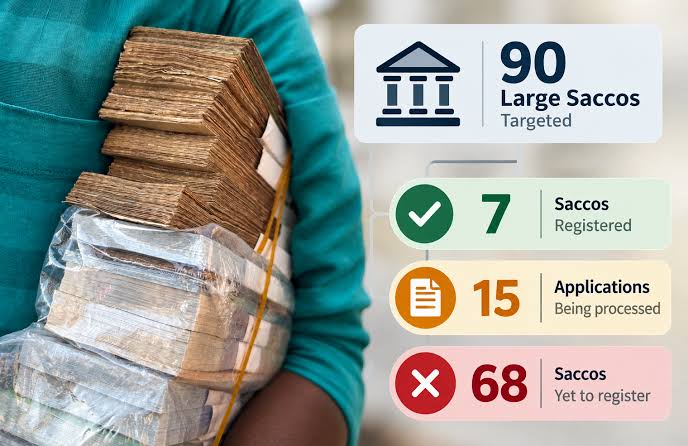
What other countries did
Uganda is not the first to face this. Kenya built a dedicated regulator - the SACCO Societies Regulatory Authority - under a purpose-made SACCO Societies Act, drawing expertise from both the cooperative and financial sectors and including central bank representation. Tanzania folded SACCOs into the microfinance framework under the Bank of Tanzania. Rwanda regulates them through the National Bank of Rwanda. Malawi treats them as financial institutions under a Financial Cooperatives Act, with the Registrar of Cooperatives retaining a registration role. Brazil supervises credit cooperatives through its central bank; France and Germany fold financial cooperatives into the broader mutual and cooperative banking framework.
Proposals now circulating in Uganda's sector borrow from the Kenyan model: a single law covering registration, licensing, regulation and supervision, and one body - with representation from the Bank of Uganda, the Ministry of Finance, the Ministry of Trade, the microfinance regulator, the Uganda Cooperative Alliance and UCSCU, plus independent members - to administer it. That would require legislation and inter-institutional agreement, neither of which can be assembled in eight days.
What to watch this week
Three things. Whether today's UCA conference and Thursday's SACCO conference produce a unified sector position or simply restate the request for an extension the Governor has already refused. How many additional licences the Bank of Uganda issues between now and 30 September - the run rate through September has been roughly one a week, against more than eighty societies still outside the net. And what regulated banks actually do on 1 October, since the rule bites on their side of the counter: a bank that continues to transact with an unlicensed large SACCO is the one in breach.
For the farmer in Masindi or Lwengo with a loan application in at the local SACCO, the answer to that last question is the only one that matters.



