Written By | International News Agencies
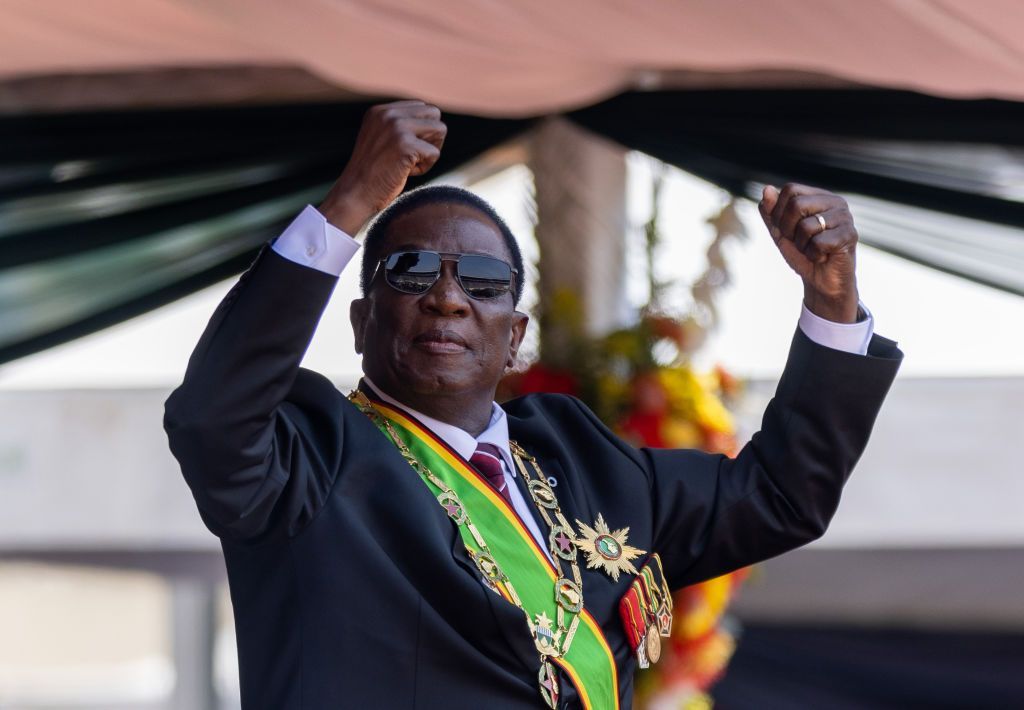
President Emmerson Mnangagwa told an audience in Masvingo on Thursday that he expects to be in office nine years
Masvingo, Zimbabwe
President Emmerson Mnangagwa told an audience in Masvingo on Thursday that he expects to be in office nine years from now — a remark delivered as a joke, received with laughter and applause, and immediately read by allies and critics alike as something considerably more deliberate than a joke.
Speaking at the Sanganai/Hlanganani Zimbabwe World Tourism Expo, Mnangagwa said the event would rotate through the country's other provinces before returning to Masvingo. "So when we come back after nine years, having hosted this event in other provinces, you will then give me an update of what you have planned," he said. "I will still be around; I do not know about you."
Nine years from 2026 is 2035. That is five years beyond the horizon Zimbabwe's constitution now sets for his presidency — a horizon that itself was moved only two months ago, when Mnangagwa signed into law a constitutional amendment extending his current term from 2028 to 2030 and abolishing the direct popular election of the president. Coming from a leader who has spent the past year insisting that the extension was a matter of policy continuity rather than personal ambition, the aside in Masvingo is the clearest signal yet that Zimbabwe's ruling elite is not treating 2030 as a terminus.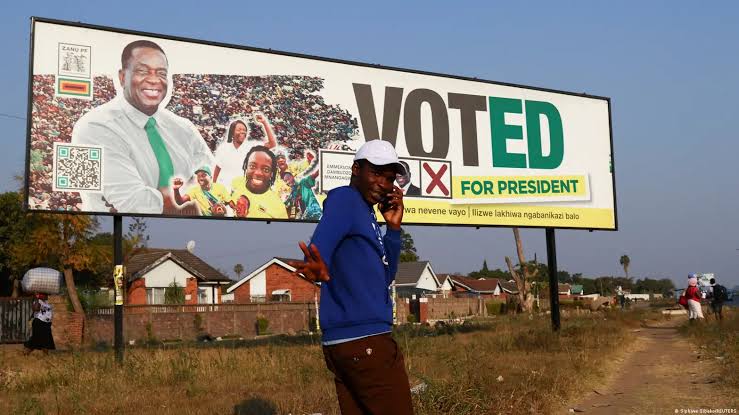
The amendment that reset the clock
The Constitution of Zimbabwe Amendment (No. 3) Act, 2026 — known universally in Zimbabwe as CAB3 — is the most consequential rewrite of the country's 2013 constitution since it was adopted. Cabinet approved the draft on Feb. 10, 2026, and it was gazetted six days later, on Feb. 16, triggering the 90-day public consultation period required by section 328(3) of the constitution.
Its provisions are sweeping. The act extends the terms of the president, Parliament and local authorities from five years to seven, with transitional provisions that expressly apply the new seven-year term to the sitting president and the current Senate and National Assembly. It replaces the direct popular election of the president with election by a joint sitting of Parliament. It enlarges the Senate from 80 members to 90, allowing the president to appoint ten additional senators chosen for professional skills. It creates a new Zimbabwe Electoral Delimitation Commission separate from the Zimbabwe Electoral Commission, transfers responsibility for voter registration and the voters' roll to the Registrar-General, and gives the president the power to appoint judges after consultation with the Judicial Service Commission. It repeals the National Peace and Reconciliation Commission. A proposal to abolish the Zimbabwe Gender Commission was dropped during the parliamentary process.
The bill moved fast once consultations closed. It was read a first time in the National Assembly on June 2, 2026, and passed its third reading there on June 18 by 216 votes to 42 — comfortably above the 187-vote two-thirds threshold set by section 328(5). The Senate passed it on June 24 by 75 votes to 4, with one absence, adding six amendments. Mnangagwa recalled the National Assembly from recess for an extraordinary sitting on June 30, at which the Senate amendments were adopted by 226 votes to 41, giving the bill final parliamentary approval. He assented to it on July 7, 2026.
The process drew sustained legal objections. The Law Society of Zimbabwe, in a May 2026 analysis, argued that term-limit changes applying to sitting office-holders require approval by referendum under section 328(9). Public hearings ran from March 30 to roughly April 2, one meeting per administrative district, most lasting under three hours regardless of population; the government reported receiving more than 500,000 written submissions and claimed an overwhelming majority in support. On June 17, the Constitutional Court struck off two challenges without determining their merits, ruling that the issues should first be argued in the High Court.
Why Masvingo
The venue was not incidental, and Mnangagwa's own supporters said so. The Children of Zimbabwe War Veterans Association, a body associated with ZANU-PF, responded to the remarks by arguing that the president was not merely joking. "President Mnangagwa's remarks today in Masvingo, though delivered in a humorous manner, serve as a highly strategic 'signal' that should not be underestimated, hinting at a political timeline extending beyond Vision 2030 to 2037," the association said. "Take note, he announced this in Masvingo Province."
The point lands because the term-extension campaign followed the same script. The push that culminated in CAB3 began with resolutions and rallies in Masvingo, Mnangagwa's home province, before working its way through party structures and into Parliament — and it was pushed through despite calls for a national referendum. A trial balloon floated in Masvingo has, in recent Zimbabwean politics, tended to become policy.
New Zimbabwe noted that if Mnangagwa remains in office until 2035, he will have served 18 years — eight years beyond the ten initially envisaged for his presidency. He has, on several occasions including his 2018 inauguration, described himself as a constitutionalist and pledged to serve no more than the two five-year terms the 2013 constitution permitted.
The succession problem that will not close
The deeper story behind Thursday's remark is ZANU-PF's unresolved succession, and the most visible symptom of it is Vice President Constantino Chiwenga.
Chiwenga campaigned publicly against CAB3 proceeding without a referendum on the constitution's entrenched provisions. On or around July 2, 2026, he circulated a video message invoking the biblical raising of Lazarus to argue that Jesus deliberately sought the participation of others in the miracle — an allegory analysts read as a coded objection to a process that bypassed public participation. It was not his first such intervention.
The former army commander who led the November 2017 operation that removed Robert Mugabe has an obvious interest in a 2028 handover and an equally obvious problem with a 2030 one — let alone 2035. Every year the timetable slides is a year in which the constituencies that would have carried him are dispersed, retired or bought.
A drafting flaw flagged in early July by the human rights lawyer Douglas Coltart sharpens the point. Coltart warned that language in the Senate amendments could allow a replacement president chosen by Parliament, in the event of a vacancy, to begin a fresh seven-year term rather than complete the unexpired portion of the predecessor's. Because the parliamentary term is tied to the date the president assumes office, that could reset both clocks and postpone harmonized elections indefinitely. Whether or not the loophole was intended, its existence means the succession question can now be settled inside a parliamentary caucus rather than at a ballot box.
A state losing its grip on the ordinary
The Masvingo remark also has to be read against what is happening below the level of constitutional politics, because the two are connected.
In a notice reported on Sept. 9, the Amalgamated Rural Teachers Union of Zimbabwe told the Ministry of Primary and Secondary Education that its members would report for duty only three days a week, dedicating the other two to income-generating activity. The union said the decision followed an earlier notice of incapacitation issued to the government on Jan. 12, 2026, and that its own assessment put the minimum basic salary required for "a living standard that upholds human dignity" at US$1,260 a month. It warned that failure to resolve the dispute before schools reopen could disrupt learning.
The same week, Local Government Minister Daniel Garwe declared that illegal vending in Harare's central business district was "no longer acceptable" and "no longer business as usual," framing urban disorder as a threat to Vision 2030, the government's goal of upper-middle-income status by the end of the decade. "Order must be maintained, not periodically restored," he said. Vendors described the seven-day ultimatum that expired Sept. 9 as insensitive, and many have vowed to stay. The Vendors Initiative for Social and Economic Transformation urged the government to act in line with the National Informal Economy Formalisation Strategy it adopted in April 2026.
And this week the High Court granted US$5,000 bail to Kelsea Tafirenyika, the second wife of Mnangagwa's twin son Collins, overturning a magistrate's refusal and ordering her to report to police twice weekly. Prosecutors allege she acquired properties worth close to US$10 million with proceeds from drug dealing; the court heard she holds more than 13 properties in South Africa and the United Arab Emirates. Harare magistrate Francis Mapfumo had earlier described her as financially "liquid" and a flight risk. She denies the allegations, told the magistrates' court that most of the properties were gifts from her husband, and has written to First Lady Auxillia Mnangagwa claiming the case is driven by detractors of the First Family.
Analysis and outlook
Taken separately, these are four unrelated news items. Taken together, they describe a governing project that has secured its own tenure while conceding ground on almost everything else: teachers rationing their own labor, informal traders defying an eviction order, a presidential in-law litigating a US$10 million asset case, and a president musing about 2035 at a tourism expo.
That is not accidental. Term extension is what a ruling party does when it can no longer be confident of winning a competitive succession — and CAB3's shift to parliamentary election of the president means Zimbabwe's next head of state will be chosen by a legislature ZANU-PF already controls, not by voters. The 2013 constitution's central bargain, that power would change hands through direct election, has been rewritten out of the text. What remains is an internal party question, and internal party questions in ZANU-PF have historically been settled by whoever controls the security services and the provincial structures.
Three things are worth watching. First, whether the High Court challenges the Constitutional Court deflected in June are actually filed and heard, and whether any court is willing to test section 328(9) against a term extension already in force. Second, ZANU-PF's next annual conference, where a Masvingo trial balloon would ordinarily be converted into a party resolution — the same route CAB3 took. Third, Chiwenga: whether he escalates from biblical allegory to open opposition, and how the party responds if he does.
A president who says he will "still be around" in nine years has, in effect, invited his party to contradict him. On Thursday, in Masvingo, it laughed instead.



