Written By | BK Mugizi
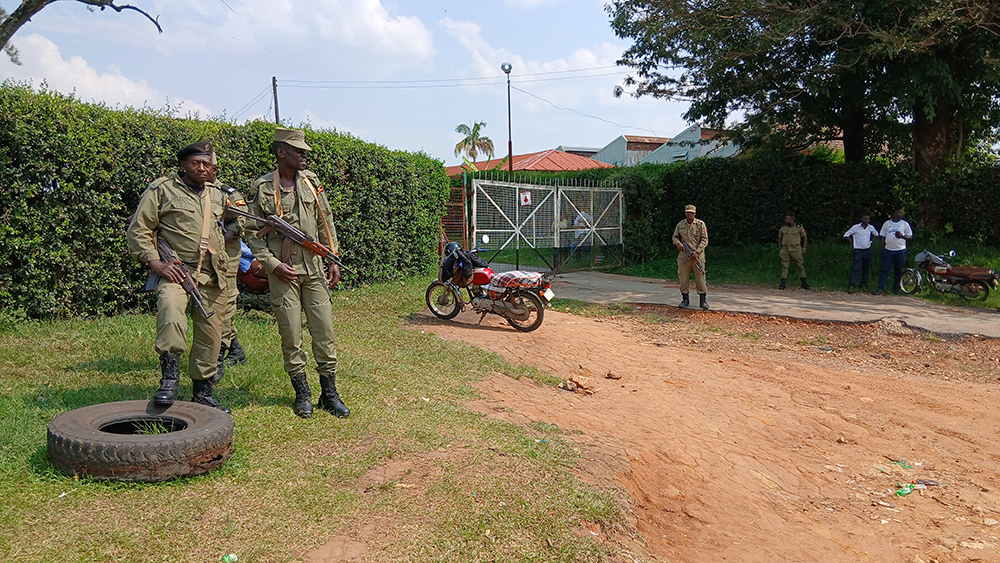
Police deployed at the closed Igara Growers tea Factory In Butare Kyamuhunga
BUSHENYI
Security has taken control of Igara Growers Tea Factory in Kyamuhunga Town Council, Bushenyi District, as a leadership dispute at the farmer-owned company deepens, with shareholders demanding fresh elections and a forensic audit into alleged debts exceeding Shs21 billion.
Police and other security agencies have been deployed at the factory, with shareholders barred from accessing the premises.
The development follows a High Court ruling in Bushenyi that declared the mandate of the factory's board expired in August 2025 and nullified acts undertaken by the board after its mandate ended.
Court orders fresh board elections
On August 21, 2026, the High Court in Bushenyi, presided over by Justice Amos Kwizera, ordered Igara Growers Tea Factory Limited to convene an extraordinary general meeting within six months to elect a new board.
The judge also directed the Registrar of Companies to provide the necessary assistance to facilitate the meeting.
The ruling effectively invalidated the factory's June 2026 annual general meeting and other actions taken after the expiry of the board's mandate.
Justice Kwizera relied on a special resolution passed at an extraordinary general meeting on January 31, 2025, which he said clearly limited the board's tenure to August 2025.
The court consequently declared acts undertaken by persons purporting to act as directors after the expiry of the mandate null and void.
The judge invoked Section 138 of the Companies Act and ordered the extraordinary general meeting because the company did not have a duly constituted board capable of convening the meeting through normal corporate procedures.
Security deployed at factory
Bushenyi District Police Commander Hashim Kasinga, who was deployed at the factory, said security was maintaining law and order and protecting the company's property.
"As police, we don't want violence and disorder. As you can see, the factory is closed despite what has been happening around. You have been in court for a long time, but we, as police, are there to maintain law and order," Kasinga said.
He urged shareholders not to force their way into the factory.
"When you use violence, you won't enter the factory. Whether you are inside or outside, the factory is for Ugandans, and we are in security control of what is taking place inside. When everything is done, you will move forward," he said.
Kasinga commended the farmers for remaining calm and urged them to allow the legal process to take its course.
Shareholders demand new board, audit
Willis Bashasha, the Director of Manifesto Implementation at State House and one of the shareholders who challenged the board, said their immediate priority was to have a legally constituted and transparent board elected with the assistance of the Uganda Registration Services Bureau (URSB).
"We went to court because we needed administrative review. We said, let's go to URSB and report our cases properly. The judge ruled that the board had served beyond August 30 last year," Bashasha said.
He said the absence of a legally constituted board should not be confused with the existence of factory management.
"When there is no board, we believe there is management that should take care of the security of our property. Management has not been sacked; it is the board that was declared null and void," he said.
Bashasha said shareholders also want a forensic audit before any government financial support is injected into the company.
"So what we want is to first sort out the leadership in the factory. We want leadership that is very transparent, passionate and hardworking. We appreciate President Museveni for willingly extending a bailout, but you cannot bring a bailout into this situation without a forensic audit. Otherwise, you may find this money coming in and being eaten," he said.
He blamed part of the company's problems on poor governance and urged farmers to prioritise development over religious and political differences.
"Development does not know whether you are a Catholic, Anglican or Muslim. When we supply tea as farmers, the factory does not first consider the religion of the person.
"We all supply tea and earn money as farmers. Therefore, you must first put religion aside when it comes to development," Bashasha said.
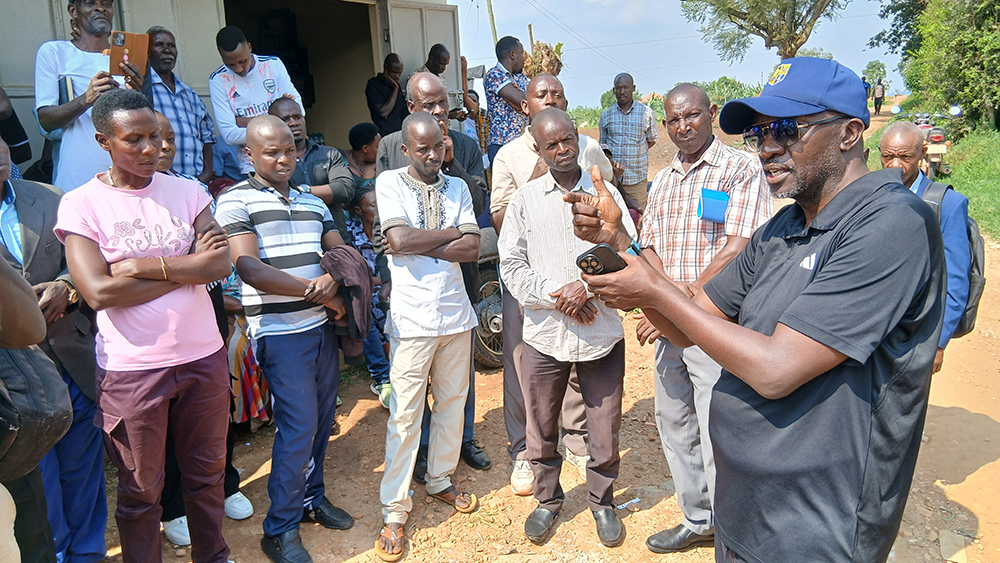
Willis Bashasha addressing farmers and stakeholders out side the factory premises over the weekend
Factory's liabilities exceed Shs21 billion
Another shareholder, Godfrey Agaba, said an analysis conducted by shareholders showed that the factory had accumulated liabilities of more than Shs21 billion.
"We want URSB to help us elect a board that can steer the factory out of the deep hole it is in. Some months ago, we did an analysis as part of our struggle and discovered that the factory has over Shs21 billion in debts," Agaba said.
He said the liabilities included a loan of more than Shs4 billion from DFCU, unpaid fertiliser supplied to farmers, about Shs6 billion owed to farmers for green leaf, more than Shs2 billion in NSSF obligations, over Shs1 billion claimed by the Uganda Revenue Authority and unpaid salaries.
"Employees haven't been paid for over eight months. When we tried to stand up and ask why this was happening, we were seen as opposition. We have been supplying tea ever since I was young, but we have never come to this situation," Agaba said.
The debt figures are broadly consistent with figures contained in the URSB proceedings, where shareholders alleged that the company had accumulated about Shs21.1 billion in liabilities, including Shs1.4 billion in salary arrears, Shs1.7 billion in unremitted NSSF contributions and about Shs6 billion owed to green-leaf suppliers.
Shareholders worry over factory assets
Bukwatuzo Moses, a farmer, said the closure of the factory and the inability of shareholders to access the premises had raised concerns about the safety and security of machinery and other company assets.
"Our biggest concern now is the safety of the factory's machinery and other assets. Since shareholders cannot access the premises, who will account for these assets if anything goes missing or is damaged?" Bukwatuzo said.
Asuman Batangaya said shareholders were waiting for the process of electing a new board to begin.
"We have been in the fight so that our factory reopens and we start work. Since we haven't been allowed to enter the factory, we are now waiting for URSB so that the election process of electing the board is put in order," Batangaya said.
Nyetaza Victor, a tea farmer from Kanuka, Buhweju, questioned who was responsible for protecting the factory's assets during the leadership vacuum.
"We have not been allowed to enter the factory, but I am asking myself: those who are helping us in this struggle, are our machines safe and who is protecting them? Because currently there is no board or management, who is in charge?" he asked.
Long-running leadership dispute
The shareholders initially petitioned the High Court in October 2025, challenging the board's tenure and raising concerns over the company's governance and financial affairs.
The High Court initially dismissed the petition in May 2026 on procedural grounds and directed the shareholders to first exhaust administrative remedies through URSB.
The shareholders subsequently petitioned URSB, which referred the disputed question of the board's mandate back to the High Court.
In July, URSB Assistant Registrar of Companies Daniel Nasasira barred persons claiming to be directors from filing company resolutions, returns or other statutory documents until the High Court determined the legality of the board.
The Registrar said the allegations raised by shareholders were serious enough to warrant investigation but deferred the appointment of inspectors until the question of the lawful board was resolved.
In June 2026, an AGM was held at the factory under heavy security, where shareholders reportedly approved a new board. However, the legality of the process was later challenged, with the High Court ultimately ruling that the previous board's mandate had already expired before the meeting.
Bashasha welcomed the ruling, saying the outcome belonged to the farmers.
"It is the farmers of tea that have won the case, not me as an individual," he said.
He said the next step should be to restore proper governance and establish how the company accumulated its debts.
"Next is the opportunity to sort out the longstanding issue of governance. However, this should come with a forensic audit to determine how we got here and avoid future pitfalls," he said.
Factory has faced financial difficulties
Igara Growers Tea Factory has faced financial difficulties for several years.
A 2024 High Court decision noted that the company had reported losses of about Shs4.44 billion in 2023 and a further loss of about Shs1.15 billion between January and March 2024.
The court granted the company more time to hold an annual general meeting after it argued that severe financial losses had made it difficult to meet the cost of convening the meeting.
The leadership dispute subsequently intensified, with disagreements over board elections and delayed annual general meetings.
The factory has also faced declining supplies from farmers amid the leadership and financial crisis. Earlier reports indicated that some farmers had stopped supplying green leaf, further affecting the company's operations and cash flow.
Farmer-owned factory
Igara Growers Tea Factory was established in 1969 and is owned by thousands of smallholder tea farmers in the greater Bushenyi area.
The company was later privatised, with ownership transferred to smallholder farmers.
The factory has historically been an important source of income for tea farmers in Bushenyi, Buhweju, Sheema, Mitooma and surrounding areas.
The current leadership and financial crisis therefore threatens not only the company's operations but also the livelihoods of thousands of farmers who depend on it for the sale and processing of their green leaf.
Shareholders now want URSB to facilitate a fresh and lawful election while calling for a comprehensive forensic audit to establish the extent and origin of the company's liabilities before any proposed government bailout is released.



