SEOUL
Every art fair, at some point, outgrows its building or gets outgrown by it. For Frieze Seoul, that reckoning is arriving after just five editions — and the fair's solution is one of the more architecturally striking pivots the art world has made in recent memory.
Frieze announced this month that its sixth edition, opening in 2027, will relocate from the COEX exhibition center in Gangnam — where it has staged every edition since its 2022 debut — to the Dongdaemun Design Plaza, known universally by its acronym, DDP. The move isn't really a choice so much as a forced hand: COEX is entering a major redevelopment project slated for completion in 2029, making the convention center unavailable for the fair's usual footprint. But the destination Frieze has landed on is, by any measure, an upgrade in architectural significance, if not necessarily in raw square footage.
The Building Doing the Talking
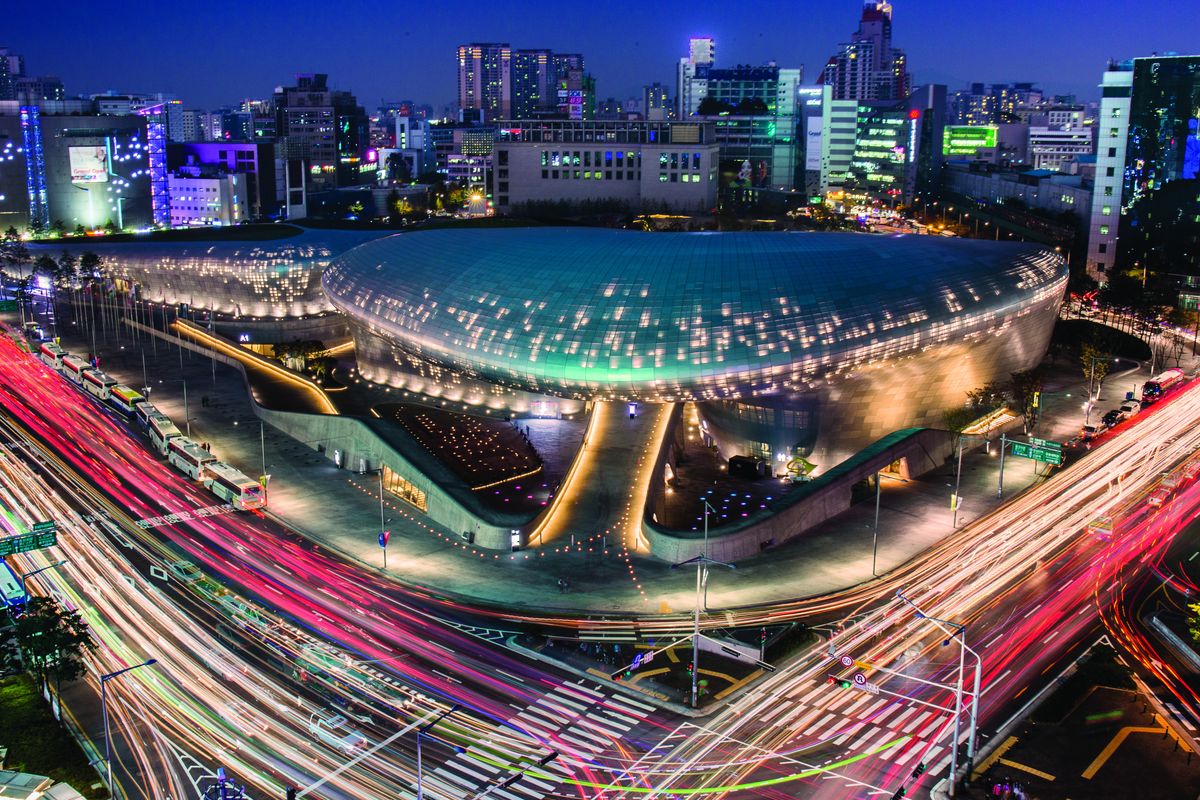
The DDP is not a neutral container. Designed by the late Zaha Hadid in collaboration with Samoo Architects & Engineers and completed in 2014, it remains widely described as the largest three-dimensional freeform building in the world — a sweeping, silver, almost liquid-looking structure clad in more than 45,000 curved aluminum panels, each one individually fabricated to fit the building's continuously shifting geometry. There isn't a straight wall or a right angle to be found across its 86,574 square meters, which house exhibition halls, a design museum, retail spaces and an education-focused design center.
Since opening, the DDP has welcomed more than 126 million visitors and holds the distinction of being the first public building in Korea designed using Building Information Modeling (BIM), the digital-construction methodology that has since become industry standard for large-scale architectural projects worldwide. For a city like Seoul — which has spent the past two decades aggressively positioning itself as a global design and culture capital, from K-pop to cinema to contemporary art — the DDP has functioned as something closer to civic identity than mere infrastructure. Hosting Frieze inside it isn't just a venue swap; it's a statement about which building Seoul wants representing it on the international art-fair circuit.

A More Concentrated, More Curated Fair
Practically speaking, the move changes the shape of the fair itself. According to Frieze's own statement, the DDP's exhibition halls will give the 2027 edition "a more concentrated footprint" than COEX provided, meaning the fair "will be carefully edited as a result, giving each gallery and presentation greater prominence within a single focused environment." That's a notably different curatorial posture than the sprawling, booth-after-booth format that convention-center art fairs typically default to, and it suggests Frieze is treating the relocation as an opportunity to rethink the fair's density and pacing rather than simply finding equivalent square footage elsewhere.
The fair's concurrent sister event, Kiaf Seoul — the longer-running Korean art fair that has shared dates and, informally, audiences with Frieze since 2022 — will remain at COEX, meaning the two fairs will, for the first time, operate from separate venues across the city rather than under one roof. That's a meaningful shift for a gallery ecosystem and collector base that has grown used to moving between both fairs in a single afternoon, and it will likely reshape how galleries plan their Seoul week logistics, from shuttle routes to which fair gets top billing on VIP itineraries.
Why This Matters Beyond the Art World
Even for readers with no interest in contemporary art fairs, the DDP relocation is worth paying attention to as a case study in how cities leverage signature architecture for economic and cultural strategy. Seoul spent roughly $450 million building the DDP as a flagship project under a broader push to be recognized as a UNESCO City of Design — an investment that, at the time of its 2014 opening, drew as much criticism for its scale and cost as praise for its ambition. More than a decade later, landing an internationally significant art fair inside the building represents exactly the kind of validation that civic architecture investments are designed to eventually pay off with: increased tourism, elevated global cultural standing, and continued relevance for a building whose novelty could otherwise have faded with time.
It's also a data point in a broader pattern of major art fairs rethinking their relationship to conventional convention-center formats. As fairs worldwide compete for collector attention and gallery participation, venues with genuine architectural identity — rather than interchangeable trade-show halls — have increasingly become a competitive differentiator. A fair hosted inside a Zaha Hadid landmark carries a different cachet, and different photo opportunities for exhibitors and collectors alike, than one hosted in generic convention space, and organizers know it.

What This Means for Visitors and Collectors
For those planning to attend Frieze Seoul in 2027, the practical takeaway is straightforward: expect a different physical experience than in past years, with a more compact, deliberately curated layout inside one of the most photographed buildings in Asia, rather than the sprawling aisles typical of convention-center fairs. Given the DDP's continuous curved geometry and multi-level exhibition halls, expect gallery booths to be arranged in ways that play with the building's architecture rather than simply filling a flat floor plan — a dynamic that past exhibitions inside the DDP have leaned into rather than fought against.
For design and architecture enthusiasts specifically, the move offers a rare occasion to experience the DDP being used at genuine capacity for a globally significant event, rather than as a backdrop for smaller domestic exhibitions or fashion week presentations, which have made up much of its programming in recent years.
The Bigger Picture
Frieze's move to the DDP is a reminder that even temporary events — a five-day art fair, gone as quickly as it arrives — increasingly depend on architecture to do real narrative work. Zaha Hadid's building was controversial in its ambition when it opened; more than a decade on, it's become exactly the kind of instantly recognizable cultural landmark that a global art fair wants attached to its name. For Seoul, it's another marker of a city whose design ambitions, once viewed skeptically, have become central to how the rest of the world sees it.
Published By | Features Editor