Written By | Evan Sande Ndahura

Evan Sande Ndahura is an African writer, researcher, and socio-political commentator whose work examines power, memory, conflict, and governance across the Great Lakes region
By Evan Sande Ndahura
From the Northern Hemisphere to the Southern Hemisphere, and back to the centre of the Earth’s Equator, we shall travel to observe, to learn, to understand, and, as a norm, at the end, we shall write.
Since 2018, I have physically and spiritually journeyed to Rwanda. Officially, I crossed borders as a tourist guide; in reality, I was a student of history, power, memory, and the fragile architecture of peace. From Kigali International Airport to the Katuna/Gatuna entry point, from parliamentary halls to silent burial grounds, my journeys have been a continuous gathering of social, economic, and political evidence. This article is, therefore, not tourism. It is an examination.
Here, Sande Ndahura examines Rwandan politics and their impact on social and economic life within Rwanda and across the Great Lakes region. More critically, this piece revisits the causes of Rwanda’s violent ruptures: the 1959–1961 massacres following the 1957 Hutu Manifesto, and the 1994 Genocide against the Tutsi, carried out between April and July 1994.
The question is unavoidable:
Does prolonged political control protect Rwanda from genocide, or does history warn us that power without renewal risks reopening old wounds?
This time, Rwanda is not visited with a camera, but with a pen sharpened by memory.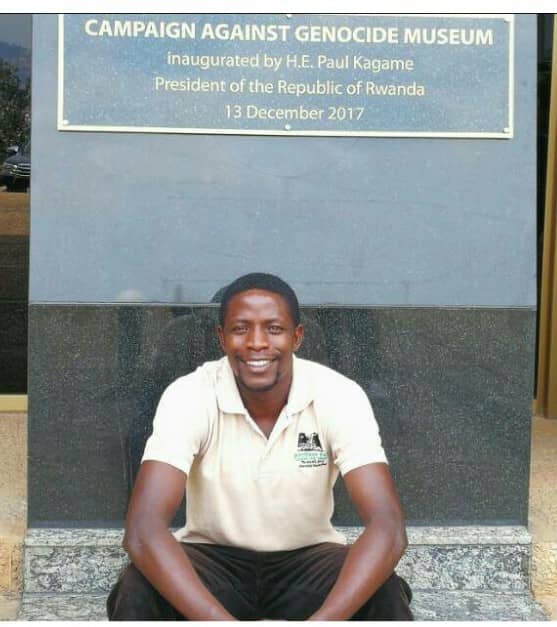
The writer in the Rwanda Genocide museum
Entering the Kigali Genocide Memorial at Gisozi, in Gasabo District, Kigali City, is not merely an educational experience; it is a moral confrontation. The memorial, which holds the remains of over 250,000 victims, forces one to confront the terrifying truth that genocide was not an accident of chaos but a deliberate political project, planned and executed by human beings against fellow human beings.
Understanding this humiliates the intellect.
Tears fall unannounced, like snowmelt streams from Mount Rwenzori during a prolonged summer, slow, heavy, and uncontrollable. At Gisozi, one realises that humanity’s greatest threat is not nature but organised hatred armed with authority. No wise and living soul can imagine such inhumanity happening again. Yet history teaches that memory fades fastest where power feels safest.
An African proverb cautions: “The man who forgets the hunger that broke him will soon mock the hungry.”
Nothing is more dangerous than forgetting suffering once stability and control are achieved.
Rwanda today stands among East Africa’s most admired states. Kigali is consistently ranked among the cleanest and most orderly cities in the world. The country has maintained tight control over corruption, currency stability, fraud, and public order. Social life is carefully regulated, and obedience to state directives is deeply ingrained.
When COVID-19 struck, curfews and restrictions faced little resistance, not because fear was new, but because discipline had long been institutionalised.
This reality invites a necessary political reflection: Is Rwanda’s peace sustained by consensual governance, or by structured compliance enforced from above?
History demands that we ask.
1. Ethnic Identity as a Political Weapon
From the colonial period onward, social categories were hardened into political identities. The claim that Tutsis were foreign, often framed as originating from Ethiopia, was used to legitimise exclusion and domination. This narrative, fuelled violence during the 1959–1961 massacres, was later institutionalised in state ideology, and culminated in the 1994 genocide.
Scholar Mahmood Mamdani argues that Rwanda’s tragedy lay not in “ancient hatred,” but in state-engineered political identities.
2. Authoritarian Rule and Silenced Dissent
Both pre-1994 regimes and post-conflict governance models relied heavily on centralised power. Political opposition was equated with a national threat. When dialogue dies, resentment grows underground.
History shows that suppressed voices do not disappear; they wait.
3. Economic Pressure and Social Frustration
Land scarcity, unemployment, and inequality, especially among the youth, created fertile ground for manipulation. Political elites transformed economic pain into ethnic blame, a strategy observed repeatedly across African conflicts.
President Paul Kagame’s leadership has undeniably restored order, rebuilt institutions, and prevented renewed mass violence. Rwanda’s development indicators and infrastructure growth are real and commendable.
However, extended tenure in power, constitutional amendments, constrained political space, restricted media freedom, and the exile of opposition figures echo historical patterns that Africa knows too well.
Peace preserved without democratic renewal is fragile.
The danger is not what Rwanda is today, but what it might become if power forgets history.
An African proverb warns: “The house that locks every door eventually traps its own children.”
Rwandans themselves have used music as remembrance, warning, and healing. Songs crafted specifically in response to genocide include:
Mr President,
Rwanda has risen from the ashes to admiration. Few nations carry such moral authority born of suffering and resilience. But history is clear: no peace is permanent without democratic breathing space.
To safeguard Rwanda’s future and to stand as Africa’s democratic model, the following are essential:
Africa’s fastest-developing nations are those that have mastered order with freedom, and stability with succession.
Another African proverb reminds us:
“A river that forgets its source will soon run dry.”
Rwanda must remember where it came from, not to live in fear, but to govern with wisdom.
ABOUT THE WRITER
Evan Sande Ndahura is an African writer, researcher, and socio-political commentator whose work examines power, memory, conflict, and governance across the Great Lakes region. Since 2018, his engagement with Rwanda has combined travel-based observation, historical inquiry, and African philosophical thought.
Ndahura believes that Africa’s liberation should no longer be written through the gun, but through truthful memory, democratic courage, and the disciplined use of the pen.



