ECONOMY
Uganda’s economy is still expanding, but the pace has cooled sharply. Figures released by the Uganda Bureau of Statistics (UBOS) in its Key Economic Indicators report at the start of July 2026 show the economy grew 5.8% year-on-year in the third quarter of the 2025/26 financial year — a solid number in isolation, but a marked deceleration from the 8.5% recorded in the same quarter a year earlier. The slowdown, coupled with a weakening shilling, has sharpened attention on the one prospect that could change the story entirely: the imminent start of commercial oil production.
What the numbers show
The headline figure of 5.8% year-on-year growth masks a broad-based softening. On a seasonally adjusted quarter-to-quarter basis, GDP rose just 1.2% in Q3 2025/26, down from 3.6% in the previous quarter — a signal that momentum faded as the financial year progressed. The deceleration was visible across the major sectors of the economy.
Agriculture, which employs the majority of Ugandans, was the weakest link. Its value added grew only 2.1% year-on-year, a steep fall from the 10.3% posted in the same quarter of 2024/25, and on a quarter-to-quarter basis the sector actually contracted, with agricultural value added slipping from about 10,083 billion shillings to 9,948 billion shillings, largely because of a decline in food-crop growing. Industry expanded 5.9% year-on-year, down from 7.4%, while services — the largest part of the economy — remained the main engine of growth.
Inflation stays tame, but the shilling slips
There is genuinely good news on prices. Annual headline inflation for the year ending in early 2026 stood at around 2.8%, easing from 2.9% the month before, with core inflation near 2.9%. That keeps Uganda comfortably within the Bank of Uganda’s medium-term target and gives policymakers room to support growth without stoking price pressures. Commercial bank lending also edged up, with loans rising 2.7% to about 76.8 trillion shillings, a sign that credit is still flowing to businesses and households.
The weaker spot is the currency. The official mid-rate for the Uganda shilling against the US dollar averaged 3,620 shillings per dollar in Q3 2025/26, a depreciation of 2.3% from the previous quarter’s average of 3,538. A softer shilling raises the cost of imports — fuel, machinery, industrial inputs and many consumer goods — and can feed into inflation later, even as it makes Ugandan exports more competitive abroad. For an economy that imports much of what it consumes and much of the capital equipment it needs, currency weakness is a headwind worth watching.
Who the main players are
UBOS is the official source of the data, and its quarterly indicators are the reference point for government planners, the central bank, investors and lenders. The Ministry of Finance, Planning and Economic Development sets the fiscal and growth outlook, and it has been keen to frame the current slowdown as temporary — a dip before an oil-driven acceleration. The Bank of Uganda manages monetary policy and the currency, and multilateral institutions including the World Bank and the African Development Bank shape the external view of Uganda’s prospects, with both projecting a return to stronger growth as new sectors come online.
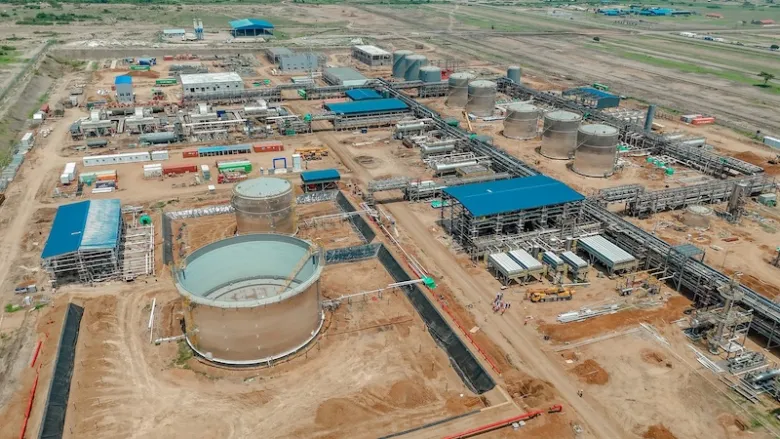
Then there is the oil sector itself, anchored by the Tilenga and Kingfisher upstream projects and the East African Crude Oil Pipeline (EACOP), which is designed to carry Ugandan crude to the Tanzanian coast for export. These projects, developed with international partners, have been years in the making and represent the single largest set of investments in the country’s modern economic history.
![]()

Why it matters
A slowdown from 8.5% to 5.8% is not a crisis — many economies would welcome near-6% growth — but for Uganda the trajectory matters enormously. The country has a young, fast-growing population, and sustaining high growth is essential to absorb new entrants into the labour market and to lift incomes. The weakness in agriculture is especially significant because it is where most Ugandans earn their living; when food-crop output falls, the effect is felt directly in rural livelihoods and in the prices households pay at market.
The data also frames the central economic bet of the moment. Government and its partners are counting on oil to push growth back into double digits. If the non-oil economy is cooling just as the country prepares to open the taps, the timing could either be fortuitous — oil arriving exactly when it is needed — or a warning that the broader economy needs reinforcement beyond a single commodity.
The oil question and what to watch next
The defining event on the horizon is the expected start of commercial crude oil production, which the Finance Ministry and industry watchers anticipate around the middle of 2026. Officials project that first oil, combined with continued strength in services and a recovery in agriculture, could lift growth above 7% and potentially into double digits in the 2026/27 financial year. That would represent a structural shift in the size and shape of Uganda’s economy — with projections pointing toward a GDP approaching the US$66 billion mark.
But the promise comes with caveats. Oil revenues can be volatile and are exposed to global price swings; managing them well — avoiding the boom-and-bust and governance pitfalls that have troubled other resource-rich economies — will determine whether the windfall translates into durable development. In the near term, the signals to watch are whether agriculture rebounds in the next quarterly release, whether the shilling stabilises, whether inflation stays anchored, and, above all, whether first oil actually flows on schedule. Uganda’s economic narrative for the next several years hinges on that final answer.
Published By | Business News Editor