Written By | Agencies
Four years after brain surgery, uniQure's one-shot treatment is still slowing the deadly disease.
LEXINGTON, Massachusetts
A year ago, it was hailed as the moment Huntington's disease was finally beaten. Headlines around the world declared that the cruel, inherited brain disorder had been "successfully treated for the first time". Families who had watched parents and grandparents disappear before their eyes wept with relief.
This week, that hope took a hammer blow — though it did not shatter.
On Tuesday, 29 September 2026, Dutch-American biotech uniQure released four-year results for its experimental gene therapy AMT-130, known formally as ifezuntirgene inilparvovec. The treatment is still slowing the disease in patients who received it. But the size of the benefit has fallen sharply compared with last year's dazzling figures — and on the trial's main yardstick, the result was no longer statistically significant.
Wall Street's verdict was brutal. uniQure's shares plunged by close to two-thirds on the day — about 64%, according to market reports — a dramatic reversal for a company whose stock had soared on last year's results.
Now the real question is not about stock prices. It is whether a treatment that a desperate community has pinned its hopes on will be approved — and what this week's numbers really mean for the roughly 75,000 people living with Huntington's in the US, Europe and Britain.
WHAT IS HUNTINGTON'S?
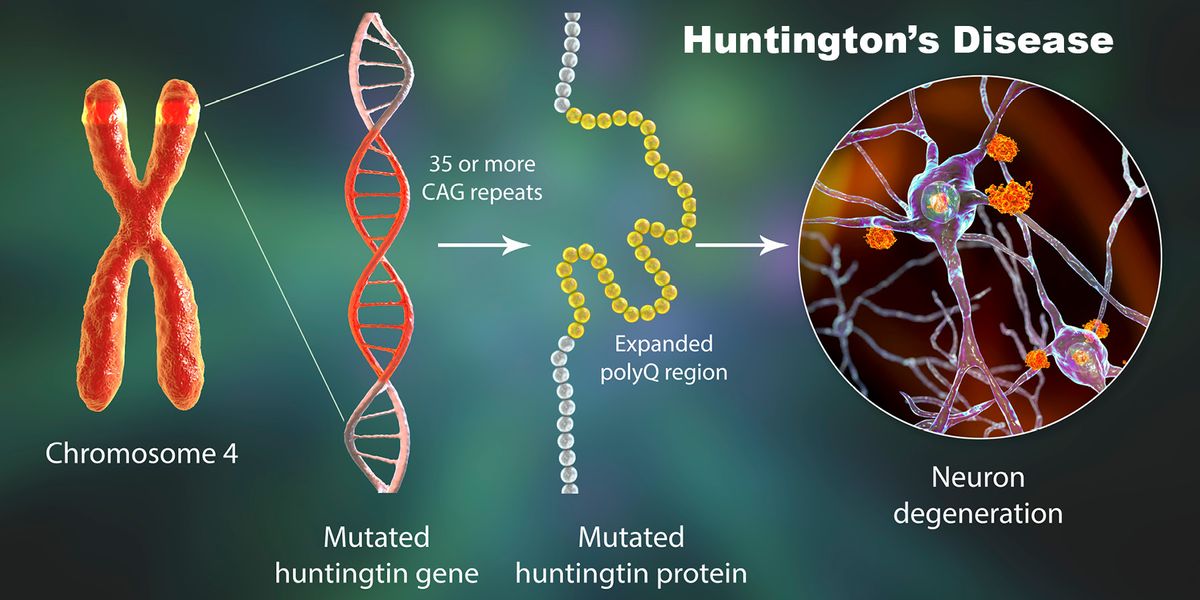
Huntington's disease is caused by a single faulty gene. Anyone who inherits it from a parent will develop the disease, and each child of an affected parent has a 50-50 chance of carrying it.
Symptoms usually strike in a person's 30s or 40s. The faulty gene makes a toxic version of a protein called huntingtin, which slowly destroys brain cells. Patients develop jerky, uncontrollable movements, mood and behaviour changes, and a steady loss of thinking and memory. Over 10 to 25 years, they lose the ability to work, walk, talk, swallow and care for themselves. There is no cure, and no approved treatment that slows the disease down.
Huntington's research has been a graveyard of failed drugs. In recent years, high-profile treatments from Roche, Wave Life Sciences and Sage Therapeutics all stumbled. That is why AMT-130 generated such excitement.
HOW THE TREATMENT WORKS
AMT-130 is a one-time gene therapy. A harmless virus is used to carry genetic instructions deep into the brain, telling cells to "silence" the huntingtin gene and cut production of the toxic protein.
Getting it there is no small matter. Patients undergo a lengthy brain operation in which surgeons, guided by MRI scans, inject the treatment directly into the striatum — the region of the brain hit hardest by Huntington's. The procedure can take up to 12 to 18 hours, according to industry reports.
The idea is that one operation could protect the brain for years, perhaps for life.
LAST YEAR'S BOMBSHELL
In September 2025, uniQure reported that, three years after treatment, a high dose of AMT-130 had slowed the progression of Huntington's by 75% compared with a matched group of untreated patients. Shares rocketed 248% in a day.
"We never in our wildest dreams would have expected a 75% slowing of clinical progression," Professor Sarah Tabrizi, director of the University College London Huntington's Disease Centre, told the BBC at the time.
But even then, some experts urged caution. The study was small. And crucially, treated patients were not compared with a placebo group in the same trial, but with an "external control" — patients drawn from a large, long-running observational study called ENROLL-HD, statistically matched to look as similar as possible.
THIS WEEK'S NUMBERS
The new data, collected up to 30 June 2026, cover 29 patients from the first two groups treated — 17 on the high dose and 12 on the low dose.
At four years (48 months), among 12 high-dose patients:
At three years (36 months), now including 15 high-dose patients, the picture looked much stronger: an 80% slowing on the cUHDRS and 67% on TFC. This three-year snapshot is what uniQure's application to the FDA is built on.
WHY THE BENEFIT SHRANK
uniQure argues that the treatment has not stopped working — the comparison group has changed.
By the four-year mark, 53% of the matched control patients from ENROLL-HD had dropped out of follow-up. According to the company, those who left were declining faster than those who stayed. That leaves a healthier-looking control group, which in turn makes the treated patients' advantage look smaller. The company calls this "survivor bias".
To make its case, uniQure re-ran the numbers using the older version of the control dataset used last year. That produced a 54% slowing on the cUHDRS (nominal p = 0.041) and 68% on TFC. But this was a "post hoc" analysis — done after seeing the results — and scientists treat such re-analyses with great caution.
"Huntington's disease does not slow on its own; the biology is one of inevitable progressive decline," said Dr Victor Sung, director of the Huntington's disease clinic at the University of Alabama at Birmingham, in uniQure's announcement. "What I find particularly notable in the expanded data is the consistently meaningful treatment effect at 36 months, and the apparent stability of the functional capacity benefit through Month 48."
uniQure's chief medical officer, Dr Walid Abi-Saab, said: "Four years after a single administration, ifezuntirgene inilparvovec continues to show meaningful slowing of disease progression, further strengthening our conviction in its benefit for people living with Huntington's disease."
SAFETY: WHAT PATIENTS SHOULD KNOW
The company says the treatment has been generally well tolerated. Most side effects were linked to the brain surgery itself, and all have resolved.
However, five high-dose patients — 17% of that group — suffered a serious treatment-related side effect involving inflammation in the brain. All five recovered fully.
uniQure also disclosed that one low-dose patient died by suicide about five years after treatment. The trial investigator judged it unrelated to the therapy. People with Huntington's are known to be at much higher risk of suicide than the general population.
A ROCKY ROAD WITH REGULATORS
The four-year results land at a sensitive moment. uniQure filed its application for US approval in early September 2026, asking the FDA to grant "accelerated approval" — a fast-track route for serious diseases, based on early evidence, which requires companies to confirm the benefit afterwards.
It has been a bumpy journey. In March 2026, the FDA told uniQure it could not accept a comparison with an external control as the main proof that the treatment works, and strongly recommended a new trial with a "sham surgery" placebo group. The agency pointed to how much Huntington's varies between patients, and to the risk that people who undergo major brain surgery may feel, and be rated as, better simply because they expect to be.
By June, after further talks, the two sides had reached agreement that a filing for accelerated approval based on the existing data, anchored on the three-year results from 12 high-dose patients, was reasonable. The application was submitted before this week's four-year data were available, and those data were not part of it.
The FDA has not made a decision, and its earlier agreement on what the application could be based on does not guarantee approval. Regulators will now almost certainly want to scrutinise the four-year results as well.
EXPERT PERSPECTIVE
Even before this week, some Huntington's experts were warning against over-excitement. Ignacio Munoz-Sanjuan, president of the Huntington's non-profit Factor-H, cautioned last year that with so few patients treated, "one or two people could be disproportionately contributing to the signals of protection" seen in the group average.
Others have pointed out that patients chosen for the brain surgery needed a certain amount of healthy brain tissue in the target area, which could mean they were slower-progressing than average to begin with — making comparisons with external controls trickier.
Yet many specialists see grounds for cautious optimism in this week's data. The treatment has not stopped working; the daily-function benefit appears to have held; and higher doses continue to outperform lower ones — exactly what you would expect from a real drug effect.
STAT News, which covers the biotech industry, reported this week on a Huntington's patient who is not fazed by the waning effect — a reminder that for families living with this disease, a smaller slowing of decline can still mean precious extra years of independence.
WHAT THIS MEANS FOR YOU
If you or someone you love is affected by Huntington's disease:
THE BOTTOM LINE
Last year, AMT-130 was sold to the world as a miracle. This week, it looked more like what it probably always was: a potentially important but still unproven treatment, tested in a few dozen people, against a comparison group that is far from perfect.
The drop in the numbers is real, and so are the questions about how they were measured. But so is the signal that people who received the high dose are, four years later, still holding on to more of their everyday lives than those who did not.
For a disease that has broken so many hearts and so many drug programmes, that is not nothing. Whether it is enough to win approval is now in the hands of the FDA.





