KADUNA/ABUJA
President Bola Tinubu formally launched his campaign for a second term on Saturday, telling thousands of supporters in northern Nigeria that painful economic reforms are beginning to pay off and that his opponents, not his government, created the hunger and poverty now gripping households. The rally opened a roughly 12-week sprint to a presidential election scheduled for Jan. 16, 2027, in a country where the cost of living has become the dominant political fact of life.
The launch matters now because it sets the terms of a contest that will be decided by three overlapping forces: voter anger over prices, a security crisis that spans the northwest and northeast, and an opposition that has so far failed to unite behind a single challenger. Tinubu enters the race with an organizational advantage rooted in the governors and parties rallying to him. He also carries a record that, by his own supporters' account, has been bitterly unpopular in many households.

What happened in Kaduna
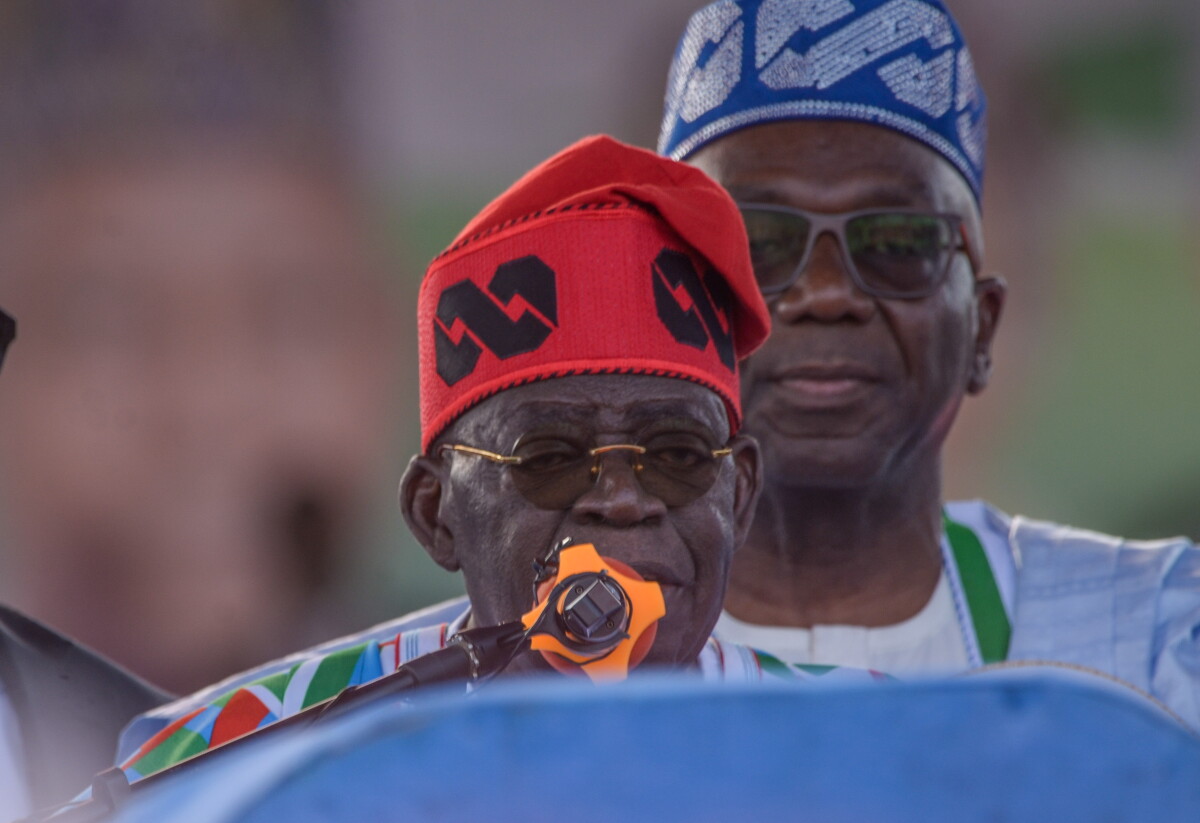
Tinubu, 74, addressed supporters of his All Progressives Congress (APC) at the Ranchers Bees Stadium in Kaduna. Reuters reported that the crowd filled most of the venue's 10,000-person capacity. He argued that the reforms of his first term are starting to bear fruit even as a cost-of-living crisis lingers.
The president turned the economic question back on his rivals. "Who created it? They did," he said, according to The Associated Press, referring to the hardship that many Nigerians blame on his policies. Reuters quoted him as saying: "They created the hunger. They created the poverty." He also told the crowd that the fuel subsidy "is in the past" and promised to end corruption and lies, according to AP. He urged supporters to turn out "massively" on Jan. 16, 2027, Reuters reported.
The response from the opposition was swift. Phrank Shaibu, spokesperson for the campaign of former Vice President Atiku Abubakar, rejected the accusation. He called it "either delusion or a staggering case of political amnesia," Reuters reported, and said the president was evading his own responsibilities.
Background: Why the economy dominates
When Tinubu took office in May 2023, he ended Nigeria's decades-old government fuel subsidy within moments of his inauguration, according to AP. The naira was also allowed to depreciate. Reuters reports that those moves are credited with improving public finances, foreign reserves and investor sentiment. They also fueled what Reuters describes as the country's worst cost-of-living crisis in a generation.
The pump price illustrates the strain. Petrol sold for about 1,400 naira per liter in Lagos and Abuja in September, and for up to 1,500 naira in parts of the north, Reuters reported. Supporters describe the subsidy removal as a bold reform; critics say it pushed already struggling families further into hardship. Tinubu's campaign is betting that voters will credit him with fixing the country's fiscal foundations and give him time to deliver relief.
Neither the Reuters nor the AP account of the launch cited an opinion poll or an official inflation or poverty figure, and this report does not supply one that cannot be verified. What can be said is that analysts quoted by the wire services describe public discontent over economic policy as the central challenge to the incumbent. Political analyst Majeed Dahiru told AP that Tinubu's chances are tested by that discontent. He called the race unpredictable and said no party would have an easy path.
The 2023 baseline
The last election offers a sobering benchmark. According to figures from the Independent National Electoral Commission cited by AP, Tinubu won with more than 8.7 million votes. Abubakar took more than 6.9 million, and Peter Obi won 6.1 million. AP noted that Tinubu's victory came with one of the lowest vote shares ever recorded by an elected Nigerian president, a reflection of how divided the electorate was and how narrow his mandate remained.
That fragmentation is the central structural fact of 2027. AP reports that a divided opposition helped Tinubu win in 2023 and could do so again. Abubakar and Obi formed an alliance in 2025 with the aim of unseating him, but it collapsed before it got started, AP reported.
The field
Tinubu faces more than a dozen challengers, but analysts expect a three-way race, according to AP. Abubakar, a former vice president described by AP as a serial presidential candidate, is running under the African Democratic Congress (ADC). Obi, a former state governor who drew strong support among young voters in 2023, is running under the Nigeria Democratic Congress (NDC).
Abubakar has already moved to build a national machine. According to ThisDay, he inaugurated the ADC's presidential campaign council in Abuja and told members to take the party's case to markets, motor parks, farms, campuses and communities, listening to citizens and explaining plans for national challenges. Reuters identifies the north as Tinubu's toughest test, noting that Abubakar is a veteran northern politician who will try to erode the president's vote there.
The ruling party's machine
The APC has spent the weeks before the launch assembling what it calls a broad coalition. At the Oct. 14 inauguration of the APC Presidential Campaign Council in Abuja, Tinubu said he would not attend every campaign event because governance must continue, ThisDay reported. He told the council to carry the party's record to the ward level and warned party governors, federal lawmakers and leaders not to take past electoral support for granted. On security, he said "state police will be a reality," signaling support for restructuring the country's policing system.
The council is led by Sen. Abdulaziz Yari, a former Zamfara governor, who has said the campaign will run on Tinubu's record since May 2023, his future plans and infrastructure. Yari, according to ThisDay, challenged Abubakar and Obi to name states where they hold comparable support, arguing that "if you don't have anything in the North, you cannot make it." He claimed Tinubu controls more than 10 states in the South and more than 10 in the North.
Reuters reports that Tinubu's camp says it has the backing of 32 of Nigeria's 36 governors, an organizational edge it describes as unprecedented. Reuters added a caution: past elections show governors cannot always deliver their states. Nyesom Wike, the Federal Capital Territory minister, who is a member of the Peoples Democratic Party, is a coordinator for Rivers State and the capital and warned fellow coordinators not to claim victory if they fail to deliver their areas, ThisDay reported. Governors Charles Soludo of Anambra (APGA) and Ademola Adeleke of Osun (Accord Party) also pledged support, according to the same report. Senate President Godswill Akpabio praised what he called a "rainbow coalition" with members from almost all parties.
The opposition has seized on that breadth as a weakness. Abubakar condemned holding the inauguration inside the Presidential Villa as an abuse of public office and called the council a "crowded confession of fear," ThisDay reported.

The campaign calendar
According to Benin Web TV, Tinubu's tour will take him to 12 states rather than all 36, and the closing rally is planned for Jan. 9, 2027, in Lagos, one week before the vote. Reuters reported the same schedule. The lighter itinerary reflects Tinubu's stated intention to keep governing, but it also gives opponents a talking point about an incumbent who is campaigning less visibly than the pressure on households might demand.
Security as a second front
The campaign is unfolding against a backdrop of violence. Reuters points to armed bandits and kidnappers in the northwest and a 17-year Islamist insurgency in the northeast, where militants have stepped up attacks on military positions. Africanews, summarizing reporting from the weekend, said at least 20 people were reportedly killed in a gun attack in the northeast on Friday, the day before the Kaduna rally; the figure comes from that summary and was not independently confirmed here.
Kaduna sits in the northwest, a region Reuters identifies as plagued by armed bandits and kidnappers, and the north is where Reuters says Tinubu faces his toughest test. Kaduna's governor, Uba Sani, urged federal appointees in the state to mobilize for the flag-off and cited federal projects including the Kaduna light rail and the Abuja–Kaduna–Kano highway, according to ThisDay, evidence of how closely the campaign is tying infrastructure to its message.
Analysis: What the launch tells us
Three dynamics stand out. First, Tinubu has chosen to fight on blame rather than apology. By asserting that his rivals created the hunger and poverty, he is trying to move the election from a referendum on his first term to a comparison of records, which is a familiar incumbent strategy and one that carries risk when household pain is recent and visible. The opposition's rejoinder, that he is dodging responsibility, shows that this framing will be contested daily.
Second, the strength of the incumbent's coalition is both an asset and a vulnerability. The reported backing of 32 governors gives Tinubu access to state-level patronage and mobilization on a scale the opposition cannot match. Yet Reuters's own caveat is instructive: governors do not always deliver their states, and a coalition that spans parties can also signal that the underlying party base is thin. The opposition has already seized on the point.
Third, the arithmetic of the 2023 result suggests that opposition unity, not Tinubu's popularity alone, may decide the contest. With Abubakar and Obi both running and their 2025 alliance defunct, the anti-incumbent vote is split between a northern establishment figure and a candidate popular with younger urban voters. AP's reading is that this division helped Tinubu before and could again. That assessment is about structure, not a forecast: no poll cited in the reporting reviewed for this story measures the 2027 race.
What to watch
Several markers will clarify the race over the coming weeks. Observers should watch whether any attempt to revive an Abubakar–Obi arrangement resurfaces, since the collapsed 2025 alliance remains the opposition's most obvious route to consolidating the anti-Tinubu vote. They should watch fuel prices and the naira, which feed directly into the cost-of-living narrative. They should watch the northeast and northwest for further attacks, which could shape both turnout and the credibility of the security promises on offer, including the president's pledge on state police. And they should watch whether the governors' endorsements translate into visible turnout at rallies and, eventually, at polling stations.
For now, the Kaduna launch has done what a launch is meant to do: it has told voters what the incumbent will argue. The harder question, which Nigerians will answer on Jan. 16, is whether they believe him.
Published By | News Editor