NICARAGUA
Background
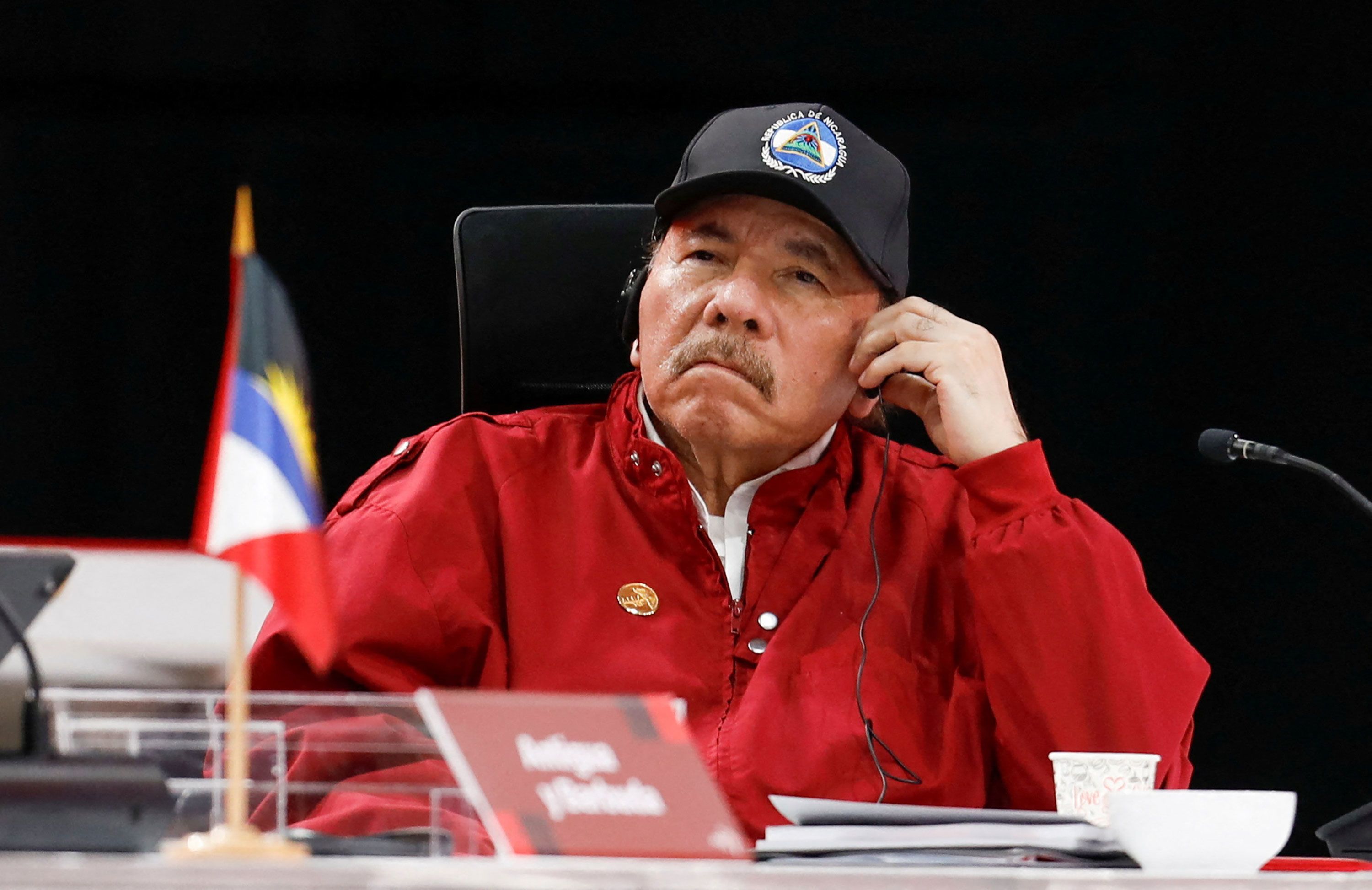
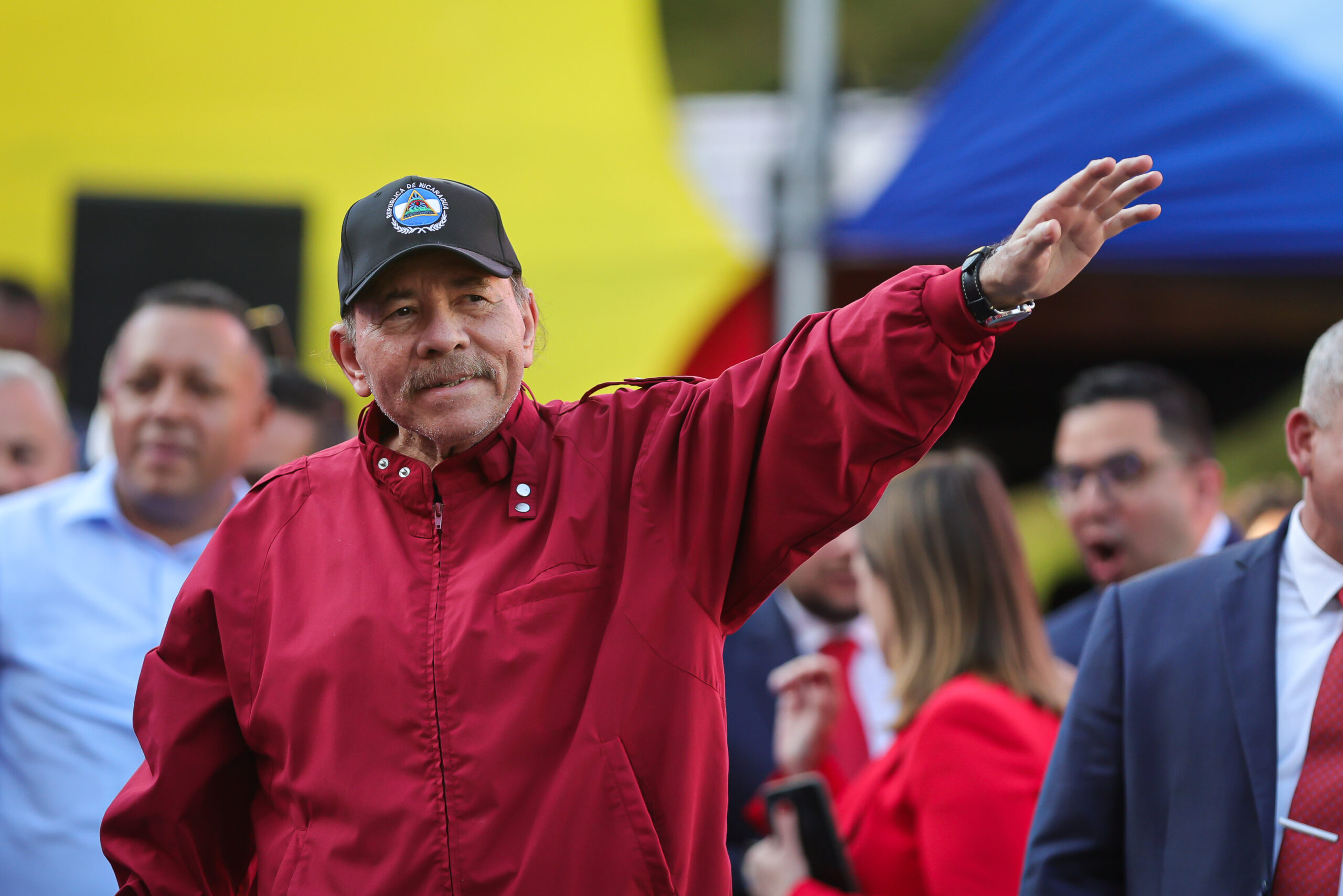
Daniel Ortega has been a central figure in Nicaraguan politics for nearly half a century, first as a commander of the Sandinista National Liberation Front (FSLN) that toppled the Somoza family dictatorship in the 1979 revolution, then as president from 1985 to 1990, and again continuously since retaking office in 2007. Over that second, uninterrupted stretch in power, Ortega has systematically dismantled the institutional checks that once constrained Nicaraguan presidents, packing the Supreme Court and Supreme Electoral Council with loyalists, rewriting term-limit rules, and jailing or exiling a long list of political rivals, independent journalists and civil society leaders.
His wife, Rosario Murillo, has been at his side throughout this consolidation. A poet by training who cultivated a public image built around mysticism and elaborate rhetorical messaging long before she held formal power, Murillo served in Nicaragua's National Assembly during the first period of Sandinista rule in the 1980s. She returned to government as Ortega's vice president in 2017 and has since become arguably the second-most-powerful figure in the country, controlling government communications and playing an increasingly central role in state affairs alongside her husband.
The most decisive step in that consolidation came in January 2025, when Nicaragua's government-controlled National Assembly approved a sweeping constitutional reform altering, by some counts, 185 of the document's 198 articles. Among its most consequential changes, the reform formally created a system of co-presidents, elevating Murillo from vice president to co-president with powers equal to Ortega's own. It also extended the presidential term from five to six years, established indefinite re-election, gave the co-presidents coordinating authority over the legislative, judicial and electoral branches of government, and expanded state control over media and telecommunications. Human Rights Watch and other groups warned at the time that the changes provided legal cover for further human-rights abuses, including provisions allowing the government to strip citizenship from Nicaraguans deemed 'traitors' to the nation.
That same reform process pushed back Nicaragua's next general election, originally scheduled for November 2026, to November 2027 — ostensibly to align the electoral calendar with the newly lengthened presidential term. Nicaragua's government-controlled legislature had already, in earlier years, systematically excluded or disqualified opposition parties and candidates, rendering the country's elections widely regarded by international observers as neither free nor fair even before this month's announcement. Independent watchdog organizations and the U.S. State Department have for years characterized Ortega and Murillo's government as one of the most repressive in the Western Hemisphere, frequently drawing comparisons to North Korea and Iran and citing the more than 2,350 Nicaraguan officials and family members already under U.S. sanctions.
Key Developments
On Sunday, July 19, speaking at an event commemorating the 47th anniversary of the 1979 Sandinista Revolution, Ortega declared that Nicaragua would hold no further elections. 'There won't be any more elections here for them to try to seize the government and power,' he said, according to multiple outlets covering the address, including NPR and CNN. The statement went beyond simply reaffirming the already-postponed November 2027 date; it effectively announced the abandonment of electoral competition as a mechanism of political succession in Nicaragua altogether, formalizing what analysts say had already become the practical reality of the country's politics.
Tiziano Breda, a senior Latin America analyst at the Armed Conflict Location & Event Data Project (ACLED), framed the move as a calculated shift in strategy rather than a sudden escalation. 'Ortega and Murillo are evidently afraid at the idea that the slightest political opening could create the conditions for dissent to manifest and threaten their grip on power,' Breda said, adding that 'instead of staging a rigged election, they have opted to eliminate electoral competition altogether.' That framing captures a broader pattern analysts have tracked in Nicaragua since 2018, when mass anti-government protests were met with a lethal crackdown that killed hundreds of demonstrators and triggered the exile or imprisonment of much of the country's opposition leadership, civil society and independent press.
The July 19 announcement builds directly on the January 2025 constitutional overhaul rather than introducing a wholly new legal mechanism. With co-presidential authority over the electoral council already secured, and opposition parties already effectively barred from meaningful participation in prior votes, Ortega's declaration reads to many observers less as a new policy and more as an explicit public acknowledgment of the endpoint that Nicaragua's institutional dismantling has been building toward for years. It nonetheless marks a symbolic threshold: unlike previous elections, which the government at least nominally staged despite widespread irregularities, this declaration removes even the pretense of future popular consent as a basis for the Ortega-Murillo government's legitimacy.
Reactions
The Trump administration responded swiftly and pointedly. Secretary of State Marco Rubio said the United States 'will not stand idly by,' and called on the broader international community to 'join forces' in responding to what he described as an assault on the hemisphere's democratic principles. In a statement released by the State Department, Rubio said that 'Daniel Ortega's declaration that under his family's dictatorship Nicaragua will never again hold elections lays bare their true authoritarian nature,' adding that 'Daniel Ortega and Rosario Murillo have abandoned even the pretense of popular consent.' The statement continued a pattern of escalating U.S. pressure on Managua that has included expansive sanctions on Nicaraguan officials and their relatives under both the current and prior U.S. administrations.
The Organization of American States, which in June 2026 had already unanimously demanded the restoration of democracy in Nicaragua and the unconditional release of all political prisoners, is likely to face renewed pressure to respond formally to the July 19 declaration, though as of this writing no new OAS resolution specific to the announcement had been reported. Human rights organizations, which have documented Nicaragua's shrinking civic space for years — including the closure of thousands of non-governmental organizations, the revocation of citizenship for exiled dissidents, and the imprisonment of opposition figures, priests and journalists — largely characterized the announcement as confirmation of what they had already been warning about rather than a surprising new development.
Coverage and commentary inside conservative U.S. media outlets framed the announcement in blunt terms, with some describing Ortega as a 'communist tyrant' formalizing indefinite one-family rule. Regional Latin American commentary, meanwhile, has focused more on the practical implications for Nicaragua's already-exiled opposition movement, much of which has relocated to Costa Rica, the United States and Spain in recent years, and for the roughly 355 political prisoners various human rights groups estimate remain in Nicaraguan custody. Notably, Nicaragua's government itself has offered comparatively little formal elaboration beyond Ortega's speech, and Murillo — who as co-president shares equal formal authority — has not been widely reported to have issued a separate detailed statement addressing the elimination of elections specifically.
What's Next
With the November 2027 election date effectively voided by Ortega's declaration, the most immediate open question is what legal or procedural mechanism, if any, the government will use to formally codify the end of electoral politics — whether through a further constitutional amendment eliminating election provisions outright, indefinite postponement without formal repeal, or simply continued non-action. Given the co-presidents' consolidated control over the National Assembly, the Supreme Electoral Council and the judiciary, analysts expect little domestic institutional resistance to whatever path the government chooses.
Internationally, the announcement is likely to intensify debate over further sanctions, diplomatic isolation, or coordinated hemispheric action against Managua, building on the substantial sanctions regime the U.S. has already constructed against Nicaraguan officials. Whether the OAS, the European Union or Latin American governments individually move beyond statements of condemnation toward concrete measures — such as further asset freezes, travel bans, or renewed pushes within multilateral bodies — will likely shape how isolated the Ortega-Murillo government becomes in the coming months. For Nicaragua's exiled opposition and diaspora communities, the declaration is expected to accelerate arguments that international pressure, rather than any prospect of an internal electoral path, represents the only remaining lever for political change, even as the practical effects for ordinary Nicaraguans — under a government already widely described as one of the hemisphere's most repressive — may be more incremental than the symbolic weight of the announcement suggests.
Published By | News Editor