Written By | Staff Writer
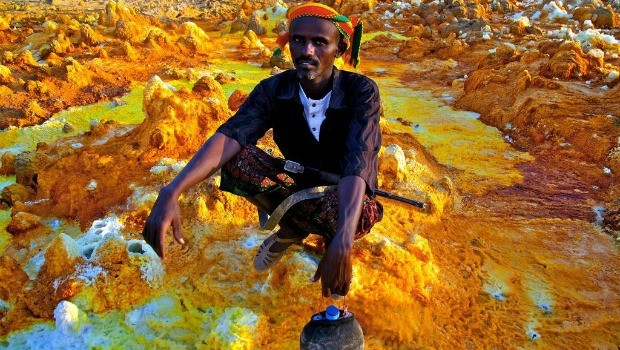
Mining has gone from a marginal contributor to the backbone of Eritrea's formal economy
Eritrea remains one of the least-documented economies in Africa, but the numbers that do escape Asmara tell a striking story: a small, closed, and heavily indebted state whose growth is now almost entirely underwritten by a handful of foreign-operated mines. According to the World Bank's Macro Poverty Outlook, real GDP growth improved from 2.9% in 2024 to 3.2% in 2025, driven primarily by mining and services, with growth projected to ease slightly to 2.8% in 2026. The African Development Bank's medium-term outlook is close, putting growth at around 3.1% for 2025-2026 on the back of continued investment in energy and mining, while one industry tracker, Serwe News, has put 2026 growth as high as 3.3% amid new drilling starts. The spread between these estimates is itself a symptom of Eritrea's core economic problem: the government has not submitted to a full IMF Article IV consultation since July 2019, and the IMF has openly said it cannot produce reliable projections for a country that does not supply basic macroeconomic data, a gap that led the Fund to omit Eritrea from its most recent World Economic Outlook altogether.
A Mining Sector Now Carrying the Whole Economy
Mining has gone from a marginal contributor to the backbone of Eritrea's formal economy. The sector now accounts for more than 20% of national GDP and over 90% of total export earnings, according to industry reporting on the 2026 outlook. Three commodities — gold, copper and zinc — together make up more than 95% of Eritrea's export revenue, and 2025 was an unusually favorable year for all three: international gold prices rose 44%, copper prices rose 9%, and zinc rose 3%, according to World Bank data cited in the Macro Poverty Outlook. The anchor asset is the Bisha mine, a polymetallic gold-copper-zinc operation that has been Eritrea's primary source of hard-currency mining revenue for more than a decade, run as a joint venture between the state-owned Eritrean National Mining Corporation (ENAMCO) and Chinese mining capital. New drilling activity at the Aburna gold prospect in 2026 points to Asmara's determination to keep extending Bisha-linked output even as the flagship deposit matures.
Colluli: A Bet on Becoming a Top-Ten Potash Producer
The more consequential long-term project is Colluli, a potash deposit in the Danakil Depression being developed as a joint venture between ENAMCO and China's Sichuan Road and Bridge Group. Colluli has now entered what mining-industry press describes as a critical scaling phase: an initial $298 million investment is intended to bring production to 472,000 tonnes per year, with a second-phase investment of $202 million — beginning in year six of operation — designed to double capacity to roughly 944,000 tonnes annually. If both phases proceed as planned, Colluli would place Eritrea among the world's ten largest potash producers. Mining Technology's analysis suggests the project could contribute up to 10% of GDP once fully operational and generate an estimated $204 million a year in fiscal revenue for a government whose formal tax base is otherwise thin. For a country with a national budget this constrained, a single mine generating that share of state revenue represents a fundamental reordering of the fiscal base — and a fundamental new source of exposure to global potash and fertilizer prices.
Remittances, the Diaspora Tax, and a Shrinking Safety Net
Mining revenue is arriving at a moment when Eritrea's traditional economic cushion — diaspora remittances — appears to be weakening. Analysts describe a economy still highly reliant on money sent home by Eritreans abroad, collected in part through Asmara's controversial 2% "diaspora tax," a levy Eritrean embassies require expatriates to pay, often as a precondition for consular services such as passport renewal or property transactions at home, despite Eritrea having no double-taxation treaties with the UK or other host countries. Multiple assessments, including the Bertelsmann Transformation Index's 2026 country report, describe a "steep decrease in remittances from the diaspora" combined with chronic drought and what the report terms "autarkic policies" as compounding pressures on ordinary households. With an estimated 53-60% of the population living in poverty — placing Eritrea among the ten poorest countries in the world by some measures — the combination of a narrowing remittance channel and a mining sector whose profits are concentrated in state and joint-venture hands raises hard questions about how broadly the mining boom's gains are actually being distributed.
Debt, Data Gaps, and the AfDB's Narrow Reform Agenda
Eritrea's public finances are difficult to assess precisely because so little data is published, but the figures that are available point to acute debt vulnerability layered on top of chronic informational opacity. Some outside modelling puts Eritrea's overall public debt-to-GDP ratio at roughly 211% in 2024, projected to ease to about 189% by 2026 as mining-led growth takes hold, even as the African Development Bank's own Interim Country Strategy Paper for 2025-2027 separately notes that external debt has averaged a comparatively modest 36.1% of GDP over the past decade, with low debt-service costs owed to concessional lending terms — a reminder that most of Eritrea's debt burden is domestic and effectively invisible to outside creditors and rating agencies. The AfDB opted for an interim rather than a full country strategy precisely because Eritrea has no current National Development Plan; the government has said a new plan would be finalized by the end of 2025. In the meantime, the Bank's engagement is deliberately narrow, concentrated on three areas — energy, water and sanitation, and economic and financial governance — built around a single overarching goal of financing infrastructure to support agricultural value chains and diversification in a country the Bank itself describes as suffering from low productivity, climate pressures, limited infrastructure, and a small private sector.
Agriculture Under Climate and Policy Stress
Agriculture remains the primary livelihood for most Eritreans outside the mining enclaves, and it is under sustained strain. Assessments point to recurring droughts compounding the effects of Eritrea's self-reliant economic policies and its historically tense relationship with Ethiopia, with food security described as a persistent vulnerability rather than an occasional shock. Eritrea has a documented history of recurring famine conditions affecting large segments of the population, and climate models used by regional forecasters, including the Institute for Security Studies' African Futures project, flag worsening climate vulnerability as one of the country's most significant medium-term risks — a risk that mining revenue, concentrated in a handful of enclave projects, does little to directly offset for rural farming households.
The Ethiopia Question: A Trade Relationship Still Frozen
Perhaps the single largest untapped economic opportunity for Eritrea is normalization with Ethiopia, and it remains exactly that — untapped. Despite the widely publicized 2018 peace agreement between President Isaias Afwerki and Ethiopian Prime Minister Abiy Ahmed, analysts note that as of early 2025 no trade agreements existed between the two countries, borders have remained effectively closed, and personal relations between the two leaders have cooled considerably. Structural obstacles run deep: Eritrea is described by regional analysts as among the most closed states in the world to trade, investment and the free movement of people, conditions that make conventional economic diplomacy with any neighbor difficult by design rather than accident. A framework proposed by regional analysts for eventual normalization would require agreement on border demarcation, a security and non-aggression pact, mechanisms for border trade and investment, transit and immigration protocols, and logistics arrangements covering Ethiopia's potential use of the Eritrean port of Assab. The economic stakes of getting this right are large: one 2025 estimate published on the Ethiopian-affairs outlet Borkena suggested normalized trade could grow from an estimated $50-100 million today to as much as $1 billion by 2030, with port handling fees and joint infrastructure investment alone worth $200-400 million a year to Asmara — a figure that would dwarf current mining-linked fiscal revenue and underscores how much of Eritrea's economic potential remains locked behind a political stalemate rather than a resource constraint.
Outlook
Eritrea's near-term growth story is real but narrow: a mining sector benefiting from a strong 2025 commodity cycle and a promising new potash project are generating fiscal resources a government with almost no other formal tax base badly needs. Whether that translates into broader development depends on questions the country's own opacity makes hard to answer from the outside — how mining rents are allocated, whether debt dynamics are as manageable as some models suggest, and whether Asmara is willing to unlock the far larger economic prize sitting on its border with Ethiopia. For now, Eritrea continues to grow mine by mine while the rest of its economic potential stays largely walled off, both from its neighbors and from independent scrutiny.



