Written By | Business Experts
Urbanisation, informal settlements and the financing gap behind Kenya's Affordable Housing Programme
Economic & Social Transformation
A legal victory that settles less than it seems
On 25 September 2026 a five-judge bench of Kenya's Court of Appeal declared the Affordable Housing Act, 2024 constitutional and dismissed 42 cases challenging it. The bench was Justices Wanjiru Karanja, Patrick Kiage, Aggrey Muchelule, William Korir and George Odunga. On the same day the court threw out Senator Okiya Omtatah's challenge to building affordable housing on county and ministry land, finding that public participation had been adequate. The ruling followed an October 2024 High Court finding that the law had been properly enacted. For President William Ruto's administration, it removed the biggest legal threat to the policy that anchors its urban agenda.
The ruling settles the legal question but not the economic one. The Act requires employees to pay 1.5% of gross salary into the Affordable Housing Fund, with employers matching it. That makes it one of the most visible taxes in Kenya, because it appears on every formal-sector payslip. Housing Principal Secretary Charles Hinga said in early September that the levy raises about KSh6 billion a month, and he stated plainly that this cannot sustain the government's target of 200,000 units a year. This article looks at what the levy is meant to fix, what it has delivered so far, and why the next phase depends on capital markets, land and mortgages more than on courtrooms.
The urban pressure behind the policy
Kenya's housing problem is mainly a problem of urbanisation. UN-Habitat's Kenya country brief projects that about half of Kenyans will live in urban areas by 2030. It estimates that around 60% of urban residents live in slums and informal settlements. Devolution to 47 counties is spreading this growth well beyond Nairobi. Towns such as Nakuru, Eldoret, Kisumu and the satellite settlements around the capital are now taking a growing share of new arrivals.
Formal supply has not kept up. The most widely cited estimate, originally from the World Bank, puts the national housing deficit at about 2 million units. Habitat for Humanity estimates annual demand at roughly 250,000 units against about 50,000 delivered, so the gap widens every year. The Kenya Institute for Public Policy Research and Analysis (KIPPRA) counted about 200 informal settlements in Nairobi County in 2019, occupying only about 6% of the county's land despite housing a very large share of its people. Insecure tenure makes the problem harder: Habitat for Humanity reports that 68% of Kenyans lack land documentation or tenure security, which keeps most households out of collateral-based finance altogether.
Mortgage finance is where this shows most clearly. Central Bank of Kenya data cited by Cytonn Investments counted just 30,016 mortgages in the whole market in 2024, in an economy of more than 50 million people. The government's long-term goal is to raise that number above one million. The Kenya Mortgage Refinance Company (KMRC) lends to banks and SACCOs at about 5%, and they on-lend to homebuyers at 10% or less. That has lowered the cost of credit for those who qualify, but it has not reached the informal workers who make up most of the urban labour force.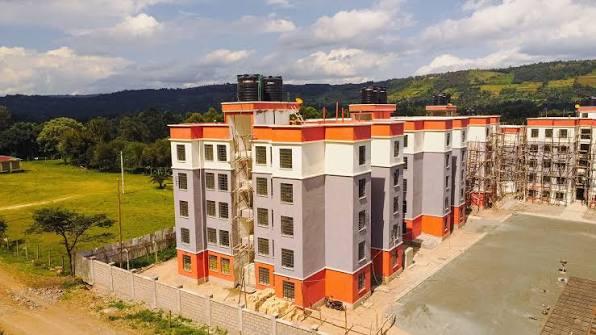
What the levy has collected and what it has built
Collections have been strong. A parliamentary budget-office analysis cited by Cytonn shows the Kenya Revenue Authority collected KSh73.2 billion from the levy in FY2024/25, about 15.8% above the KSh63.2 billion target. Spending has lagged far behind. By mid-2025 more than KSh30 billion was unspent and had been parked in Treasury bills, earning over KSh2 billion in interest. Earlier oversight reports found that only about 52.8% of collections had been used for housing, and in one review period just 30.8% of planned levy spending had actually happened. Procurement, land preparation and phased construction have moved more slowly than the payroll deductions that fund them.
Delivery figures are improving but inconsistent. A communiqué from the 15th National Development Implementation Committee meeting, reported by The Star on 11 September 2026, said about 10,000 affordable units had been completed and about 8,000 were occupied. That is roughly four in five, and the government now highlights occupancy as a measure of success. In June 2026 the President had put completed units at 11,000, the same figure he cited in his June 2025 Madaraka Day speech. Earlier in 2026, PS Hinga cited 8,807 completed units with 198,726 at various stages of construction. A separate September tally put completions at 10,107 and units under construction at 196,846, within a total pipeline of 282,551. Kenya National Bureau of Statistics data show the State Department for Housing and Urban Development completed 6,738 units during 2025 and the National Housing Corporation completed 410.
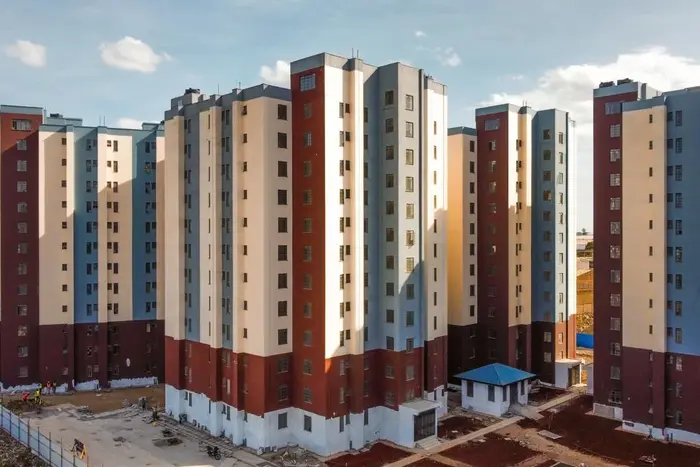
Even on the most generous count, completions since 2022 equal only a few weeks of the stated annual target. The pipeline itself is large and spread across the country, with projects in all 47 counties. Flagships include Park Road in Nairobi (1,370 units), the Shauri Moyo redevelopment (2,400 units) and a 4,096-unit Starehe scheme mixing affordable, market-rate and social housing. Smaller county projects are also being handed over, such as the 220-home Bomet Phase One estate, whose keys the President handed to buyers on 9 September 2026. Nation reporting describes a Rapid Results Initiative aimed at completing at least 45,000 units by the end of 2026. Its spot checks found sites moving at very different speeds, including one 220-home project recorded at about 5% progress.
The arithmetic problem
The core difficulty is easy to show. KSh6 billion a month comes to about KSh72 billion a year. Spread over 200,000 units, that is roughly KSh360,000 per home. That figure is not a construction budget, but it is clearly far below the cost of land, building, bulk water and sewerage, and power connections for a city apartment. The government's ambitions have also grown. In June 2026 the President described a programme of 300,000 housing units, 180,000 student hostel beds and 500 modern markets. The levy, essentially a 3% tax on formal wages, now has to support an agenda well beyond homes for salaried workers.
The state is responding on three fronts. First, it wants to turn the Affordable Housing Fund into a true revolving fund, so that sale proceeds, tenant-purchase payments and mortgages taken out on completed units pay for later phases. In Hinga's words, once units are completed, titled and occupied, the government will have both the levy and the sales. Second, it is in talks with development partners, including the World Bank, about long-term financing. Third, press reports say officials have floated securitising future levy receipts to back a borrowing facility of up to KSh100 billion. That would bring construction forward, but it would also turn a payroll levy into debt service and tie future workers' contributions to today's projects.
Policy has also widened who can buy. Regulations approved by the National Assembly in August 2025 cut required deposits for affordable units to 5%, clarified eligibility and opened the programme to rural housing loans. The Boma Yangu digital platform handles registration, unit selection, tenant-purchase financing and savings tracking. However, allocation has become a political issue. Nation reporting has documented complaints that early units went disproportionately to better-connected or higher-earning applicants. That would defeat the purpose of a programme justified as relief for low-income urban households.
Who pays, who benefits
The distribution of costs and benefits is the levy's weakest point. It falls only on formal employees, a minority of Kenya's workforce. Most urban residents, who work informally and often live in informal settlements, contribute nothing directly and also benefit least, because tenant-purchase schemes still assume steady, documented income. Defending the deduction on 29 August 2026, President Ruto argued that a recent 10% wage increase more than offset the 1.5% employee contribution. That argument appeals to salaried workers, but it says nothing to the informal majority the programme most needs to reach.
Urban economists also note that housing supply depends heavily on what the state does not build itself: serviced land, trunk infrastructure, faster title registration, building codes suited to incremental construction, and rental markets that work. Nairobi's exposure to flooding, sharpened by public debate over the county's El Niño preparedness, is a reminder that where homes are built matters as much as how many.
What to watch before the 2027 election
Kenya has shown it can raise a large, ring-fenced and legally secure stream of housing money. Now that the courts have upheld the levy, the next test is delivery. The country has to show that payroll deductions can be turned into titled, occupied and affordable homes quickly enough to keep pace with the cities they are meant to serve.



