Written By |
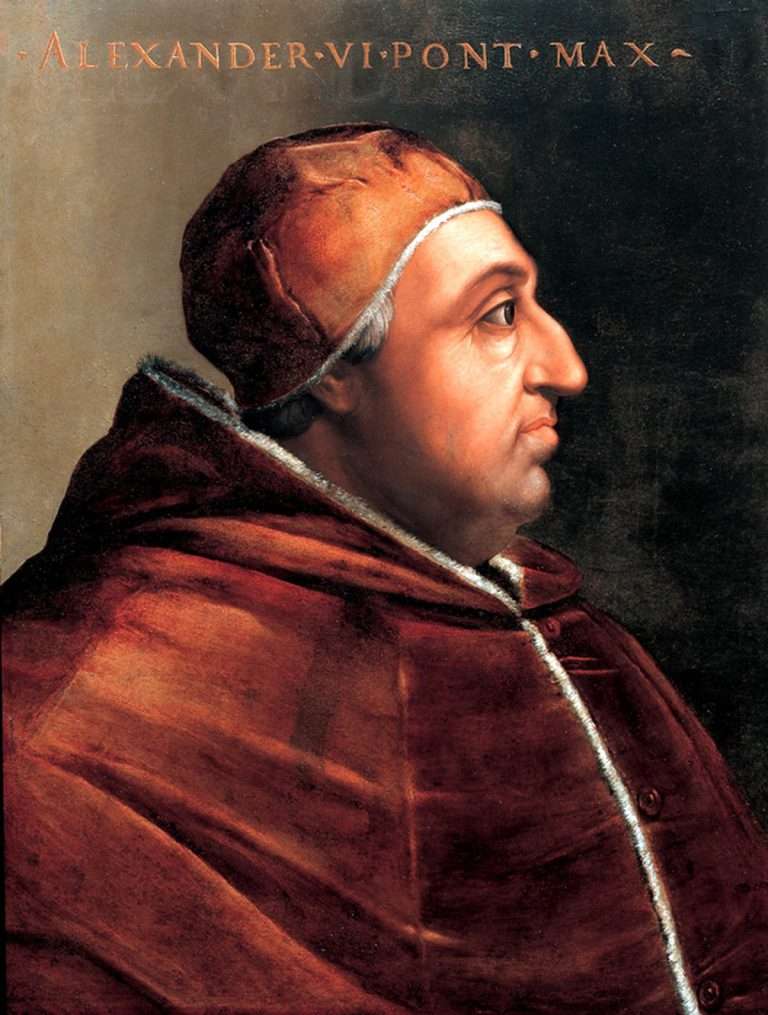
Alexander VI painting
HISTORY
Born Rodrigo Borgia, Pope Alexander VI is widely regarded as one of the most corrupt pontiffs in the history of the Catholic Church. His papacy in the late 15th century was riddled with bribery, nepotism, and sexual scandal—including allegations that he once hired 50 prostitutes in a single night. From selling church offices to enriching his family, Alexander VI's controversial reign earned him a reputation as the "dirtiest pope" in history.
Yet, while the Borgia name has long been synonymous with vice, modern historians have begun to question whether Rodrigo Borgia was truly worse than his contemporaries—or simply more vilified due to his outsider status.
Rodrigo Borgia’s rise to power
Rodrigo Borgia was born in 1431 in the Spanish town of Xàtiva, near Valencia. The Borgia family, originally Spanish nobility, expanded their influence across the Italian peninsula during the Renaissance through a mix of civic and ecclesiastical power grabs. Their fortunes changed dramatically in 1455, when Rodrigo's uncle, Alfonso de Borgia, was elected Pope Callixtus III. The new pontiff appointed several relatives to powerful Church positions, including naming 25-year-old Rodrigo a cardinal and later, vice-chancellor of the Holy See.
Tall, handsome, and known for his financial acumen, Rodrigo was also accused of bribery, nepotism, and licentious behavior. Even Pope Pius II, who succeeded his uncle, warned him about his extravagant sex parties.
At the time, it was not uncommon for high-ranking churchmen to keep mistresses, but Rodrigo’s openness about his relationships set him apart. His two most famous mistresses—Vannozza dei Cattanei and Giulia Farnese—were both married noblewomen. Rodrigo publicly acknowledged fathering at least seven children with them, and historians believe he may have had more illegitimate offspring whose identities were never documented. Despite the scandal surrounding his personal life, Rodrigo ascended to the papacy in 1492, becoming Pope Alexander VI.
The scandalous papacy of Alexander VI
Following the death of Pope Innocent VIII, a fierce power struggle broke out within the College of Cardinals. At 61, Rodrigo Borgia secured his election by bribing a majority of cardinals. Once in office, he used the papacy to further the Borgia family's interests.
Alexander VI appointed 10 relatives as cardinals—including his 18-year-old son Cesare and the brother of his mistress, Alessandro Farnese, who would later become Pope Paul III. He distributed fiefdoms among his allies and routinely engaged in simony—the selling of church offices.
His reign was marked by lavish ceremonies and extravagant spending, including a grand celebration in 1500 to mark the Holy Year of Jubilee. But the most infamous event came the following year.
On October 30, 1501, Alexander VI and Cesare hosted the notorious “Banquet of Chestnuts” at the Apostolic Palace. According to Johann Burchard, the papal master of ceremonies who documented the event, the evening involved 50 prostitutes performing for the pope and his inner circle in a grotesque competition.
Burchard wrote: "After dinner, the candelabra were removed from the tables and placed on the floor, chestnuts were strewn around, and the naked courtesans crawled to pick them up while the Pope, Cesare, and Lucrezia watched. Prizes were given to those who performed sexual acts the most times—with rewards such as silk tunics, shoes, and berets."
While some modern historians question the accuracy of Burchard's account, his diary remains one of the few firsthand sources chronicling the excesses of Alexander VI’s court.
The Borgia family’s infamous legacy
Alexander VI wasn’t the only scandalous figure in the Borgia dynasty. His children—Cesare and Lucrezia—also earned notorious reputations. Cesare, the only person in history to resign as a cardinal, led military campaigns across Italy and married into the French royal family to bolster the Borgia political influence. He was ruthless in battle and politics alike. In 1502, after a group of his commanders rebelled, Cesare feigned reconciliation—then executed them.
His ambitions even inspired Niccolò Machiavelli, whose seminal work The Prince was largely modeled on Cesare’s life. Some believe Cesare was behind the murder of his own brother Giovanni, though other theories suggest Giovanni may have been killed by a jealous lover.
Lucrezia Borgia was also surrounded by controversy. Accusations of poisoning, incest, and political manipulation dogged her throughout her life. At just 13, she was married off to Giovanni Sforza, a noble from Pesaro. When the alliance became politically inconvenient, the pope annulled the marriage on grounds of impotence—despite rumors that Lucrezia was already pregnant. Shortly after, a mysterious child was born into the Borgia household. Pope Alexander issued conflicting papal bulls, first naming the child as Cesare’s, then claiming him as his own. The truth remains unknown. Lucrezia’s former husband accused her of affairs with both her father and brother. Her second husband, Alfonso of Aragon, was later assassinated—many suspected Cesare and Alexander VI were responsible. Her third and final marriage, to Alfonso d’Este, Duke of Ferrara, marked a turn toward respectability. She had eight children and became a respected duchess, though her early years remained shadowed by her family's notoriety.
Did the Borgias deserve their reputation?
Despite the numerous scandals, many historians now argue that the Borgias were not significantly more corrupt than their rivals. Families like the Colonnas, Medicis, and Della Roveres also used political marriages, assassinations, and Church appointments to consolidate power.
Papal corruption was widespread long before Alexander VI. In 1458, Cardinal Guillaume d’Estouteville openly bribed cardinals during a papal election. Pope Martin V, born Otto Colonna, secured estates for his relatives throughout his reign. So why did the Borgias attract so much ire? Some scholars believe their Spanish origins made them easy targets in a fiercely Italian papacy.
The mysterious death and lingering legacy of Alexander VI
In 1503, Pope Alexander VI died after a sudden illness that left his body bloated and discolored. Some believed he was accidentally poisoned by his son, who had intended to kill Cardinal Adriano Castellesi instead. Others think the pope succumbed to malaria. Regardless of the cause, his death marked the end of one of the most controversial papacies in history. His successor, Julius II, famously said: “I will not live in the same rooms as the Borgias lived. He desecrated the Holy Church as none before.”
As a result, the Borgia apartments were sealed for more than 300 years.
Though time has softened some judgments, Pope Alexander VI's legacy remains stained by scandal—a symbol of unchecked power, moral decay, and a papacy that, for a time, more closely resembled a royal court of excess than a house of worship.
Source: Agencies



