World Politics
Overview
Albania, a small Balkan country of under three million people that has spent more than a decade promising to join the European Union, is facing its most serious domestic crisis in years. Over four days this week, student-led demonstrations in the capital, Tirana, escalated from a long-running and largely peaceful campaign into street fighting with riot police. Protesters hurled bricks and concrete blocks at the education ministry, fires damaged several government and commercial buildings, including the prime minister's office, and police answered with water cannon and tear gas. By Friday the unrest had reached the university cities of Elbasan, Shkodra and Korca, and the central demand had hardened into a single, uncompromising one: that Prime Minister Edi Rama, in power since 2013, resign.
Rama has refused. In a video address on Friday he blamed "foreign hands" for the unrest, insisted it was "not a student phenomenon," and warned that his departure would endanger Albania's EU accession talks. He told Reuters that governments change through elections, not through street pressure, and that Albania had held an election, not a revolution. The standoff pits a veteran, politically dominant leader against a generation that says it has been ignored for months, and it carries a geopolitical twist: the movement began as a protest against a luxury tourism project on the Albanian coast linked to Jared Kushner, the son-in-law of US President Donald Trump.

Background: From a Coastline Dispute to a National Movement
The roots of this week's violence lie in late May 2026, when public anger began to build over a multimillion-euro tourism development in the protected coastal area of Zvernec, in southern Albania, a lagoon and wetland region known for its birdlife. Reporting on the project is not entirely consistent: some outlets describe it as a resort on or near Sazan Island, a former military island off the same stretch of coast, while others, including the Deutsche Welle reporting relayed by regional outlets, place the controversy at Zvernec. What is consistent across sources is that the project is linked to Jared Kushner, that environmentalists and residents objected to the sale or lease of part of an ecologically sensitive coastline, and that the dispute became a symbol of how Albania's government deals with powerful foreign investors.
The movement acquired a nickname, the "Flamingo Revolution," after the birds that inhabit the lagoon. According to a chronology compiled from secondary sources, the government reportedly suspended the project in early June pending an environmental impact assessment, and an anti-corruption inquiry examined questions about land ownership and the legal status of the property. Brussels, which monitors Albania's compliance with environmental and rule-of-law standards as part of its membership bid, urged the government to act without delay. Some of those details, including claims about forged property deeds, rest on single secondary sources and should be treated cautiously. The suspension itself has been described as reported rather than confirmed through a primary government document.
Protests continued through the summer. By early July demonstrators were calling for Rama's resignation, and by September commentators were marking a hundred days of demonstrations, with Albanian media counting the protest held on September 1 as roughly the ninety-fourth. Police clashed with protesters over construction activity in July. Meanwhile, students were running a parallel campaign about the cost and quality of higher education. According to Afrim Krasniqi, a professor at the Institute for Political Studies in Tirana, students protested peacefully for nearly three months while the government largely ignored their demands and relied on discrediting campaigns rather than dialogue.
Key Developments This Week
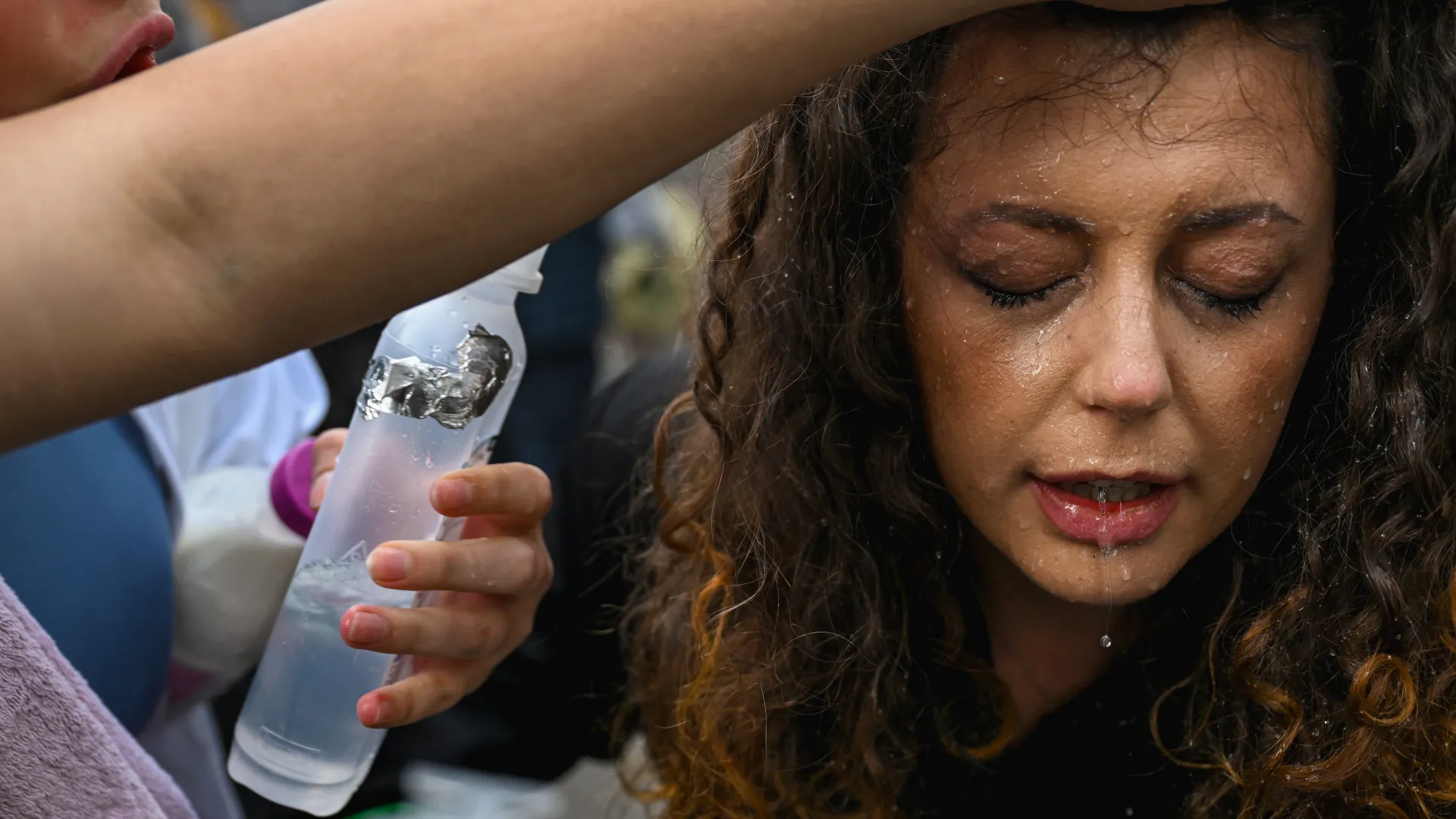
The crisis tipped into open confrontation on Tuesday, October 13. Protesters threw bricks and concrete blocks at the education ministry, and fires broke out in several Tirana buildings. Al Jazeera reported damage to the prime minister's office and to finance and justice ministry buildings, along with bank branches. Deutsche Welle-derived reporting added that a College of Europe building near the prime minister's office was damaged by fire; Rama later posted a video from inside it. By Wednesday the demonstrations had spread to universities in Elbasan and Shkodra, and by Friday Korca was affected, with windows smashed and rubbish bins set alight.
Police responded with water cannon and tear gas. Casualty and arrest figures differ slightly between outlets. Al Jazeera, citing AFP and Reuters, reported that police detained 160 people over violent acts on Thursday evening, while a regional report drawing on Deutsche Welle and Reuters put the three-day total at 152 arrests, 324 people placed under investigation, and 71 injured police officers, with demonstrators also hurt. The difference likely reflects different counting periods, but it underlines that the data remain preliminary. Parliament, according to Democracy Now, cancelled its session during the unrest.
Rama stayed silent for the first two days, then appeared in a video from the fire-damaged building on Thursday. On Friday he escalated his rhetoric, telling Reuters that foreign interests were trying to obstruct Albania's EU accession and accusing the opposition of hiding behind masked demonstrators to push the country backwards. He said he was prepared to discuss rising education costs but would not step down. The government continues to deny the corruption allegations that have dogged senior officials since Rama won a fourth term in elections held in 2025 on a pledge to bring Albania into the EU, possibly by 2028.

The Protesters and Their Demands
The students who spoke to international media describe a movement that has outgrown its original grievances. A 22-year-old economics master's student told Deutsche Welle that a monthly salary of 540 euros is not enough to rent an apartment, even as luxury towers reshape Tirana's skyline. Skerdi Topalli, a 20-year-old journalism student, said protesters want the political class of the past 35 years replaced by new leaders. Their central demand is political, and they say they will not negotiate other concerns, such as tuition, graduate unemployment and university conditions, with Rama directly. Protesters also want electoral and education reforms.
Analysts describe the moment as an accumulation of frustration. Journalist Arlis Alikaj called it the "boiling point" of months of suppressed grievances, noting that young people are demanding systemic change while opposition groups try to capitalise. Albania's economy still lags the EU in wages, productivity, purchasing power and public services, emigration continues to drain the country of young people, and the pace of EU integration has disappointed many even though Albania is among the Western Balkan states furthest along the membership path. Corruption scandals have complicated that path, and analysts frequently describe Albania as a hub for gangs laundering money from drug and weapons trafficking, charges the government rejects in relation to its own officials.
Many students are also wary of the established opposition. Sali Berisha, the veteran leader of the Democratic Party and a former prime minister, has said he supports the protests while denying that he organised the violence. Some students told Deutsche Welle that their frustration extends to the traditional opposition as well as to Rama, which complicates any attempt to channel the movement into conventional electoral politics.
Reactions
Brussels has urged calm, restraint and dialogue while Albania pursues membership, a cautious formula that avoids taking sides but reminds Tirana that its accession talks depend on how it treats dissent and handles corruption. Rama has used that very dependency as an argument, claiming that his resignation would put the EU path at risk. Critics counter that the repression of protest and the unresolved corruption allegations threaten the path more than any change of leadership would.
Regionally, the Albanian unrest is part of a wider pattern of youth-led protest. In France, secondary students have spent weeks blockading schools over teacher shortages, overcrowded classrooms and decaying buildings, and in Argentina thousands of students and university workers marched in Buenos Aires against education cuts by President Javier Milei. Democracy Now reported that the Albanian protesters also want an end to the coastline sale to the Kushner-backed resort, tying the domestic story to American politics. Earlier this month, Rama reportedly told US Democrats not to use Albania as a means of targeting Trump, indicating that he is aware of how the issue resonates in Washington.
Scholars caution against comparing the current wave with Albania's previous student uprising. In December 2018, protests over rising education costs forced Rama to dismiss eight ministers and announce a package called the Pact for the University, although some demands from that period were never met. Sokol Lleshi, a lecturer at the University of New York Tirana, argued that the present movement differs from 2018 and that lasting change would more likely require a broader coalition of social groups, perhaps including defections from the elite, rather than student mobilisation alone. Political analyst Mark Marku, dean at the University of Tirana, warned that Rama's departure and fresh elections would not automatically yield better leadership unless protesters can present a clear programme and a credible alternative.

What's Next
Several paths are plausible. Rama could try to wait out the protests, relying on his parliamentary majority, the exhaustion of demonstrators and the narrative that violence discredits the movement. The fires and injuries to police give him material for that argument, but a heavy-handed crackdown risks feeding the sense that the government is deaf to a younger generation. Alternatively, he could repeat the 2018 playbook by reshuffling ministers and offering concessions on education, although the protesters have said that anything short of his resignation is insufficient.
The European dimension adds pressure in both directions. Brussels wants stability in the Western Balkans and is unlikely to endorse street-driven regime change, yet it has also made clear that environmental compliance, anti-corruption efforts and the right to peaceful assembly are conditions for progress. A prolonged crisis, or evidence of excessive force, could slow the accession process that Rama says he is defending. The unresolved status of the coastal project, including whether the reported suspension holds and what the anti-corruption inquiry finds, will remain a lightning rod.
For now, the immediate questions are whether the protests remain violent, whether they continue to spread beyond Tirana, and whether the government is willing to open real dialogue. The large number of arrests and investigations could either deter participation or radicalise it. Observers should watch for further demonstrations this weekend, any move by parliament to reconvene, statements from EU institutions and member states, and whether opposition parties succeed in aligning with a movement whose members distrust them.
Published By | News Editor