World Politics
Overview
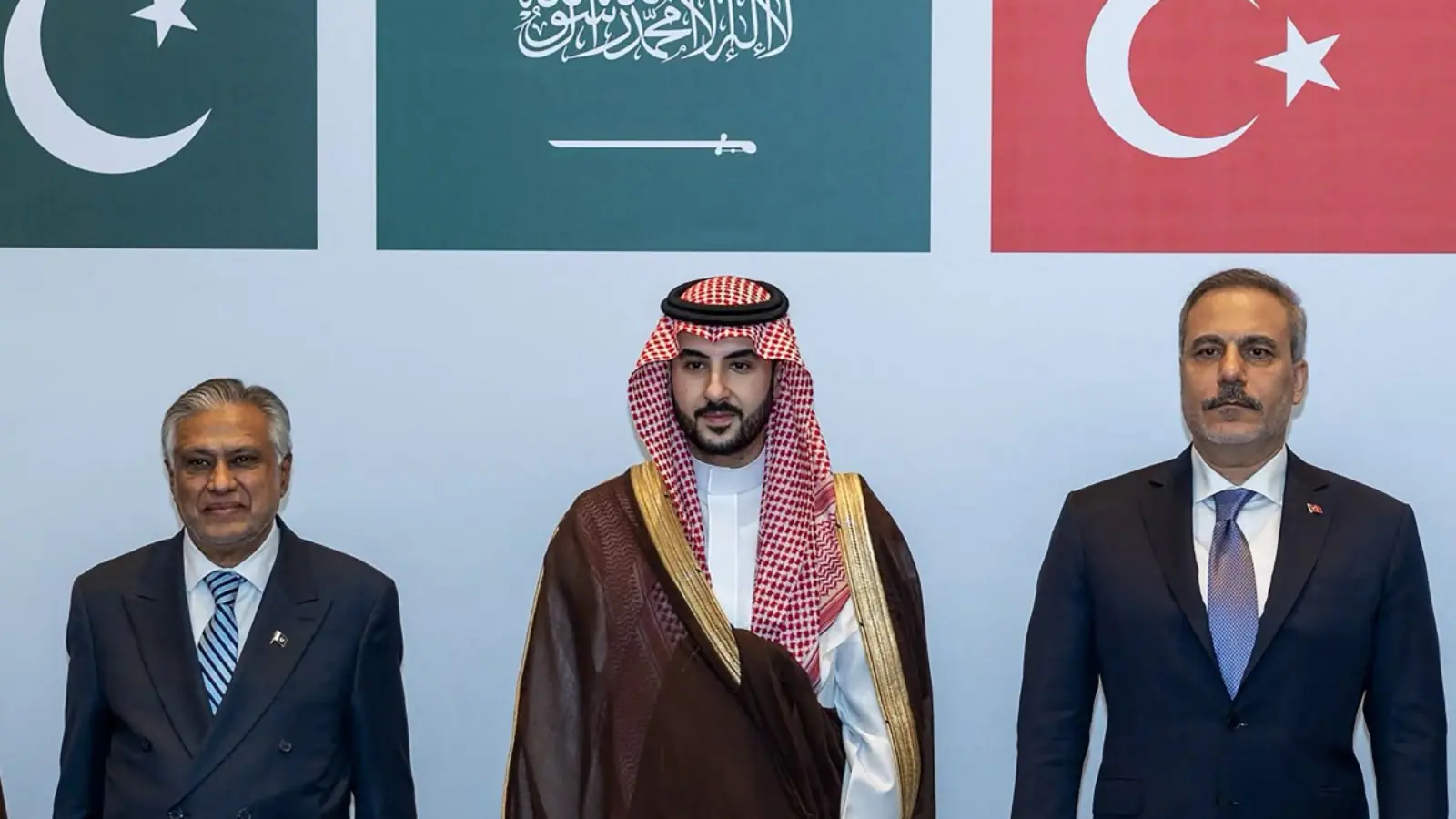
Saudi Arabia, Turkey and Pakistan activated their mutual defense treaty, known as the Mecca (or Makkah) Joint Defence Agreement, at an emergency meeting of defense and foreign ministers in Riyadh on Monday, October 5, 2026. The three governments agreed to "collective deterrence measures" and pledged that Turkey and Pakistan would "provide the agreed military forces and capabilities and ensure their rapid deployment" to the kingdom. It is the first time the pact, signed in August, has been invoked, and it turns a paper alliance into an operational commitment at a moment when Saudi Arabia is under sustained attack from Yemen's Iran-aligned Houthi movement.
The decision marks a significant shift in Middle Eastern security. The alliance links NATO's second-largest army, the Islamic world's only nuclear-armed state and the Gulf's largest economy. How far it goes in practice, and how Iran, Israel and the United States respond, will shape the next phase of a region already convulsed by the seven-month U.S.-Iran war.
Background: From Signing to Activation
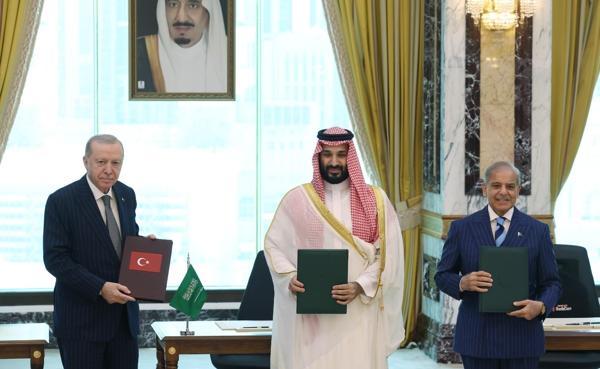
The pact traces back to a Saudi-Pakistani strategic defense arrangement and Turkey's later effort to join it. Wikipedia's entry on the Strategic Mutual Defence Agreement and January reporting by Press TV, which described Turkey as seeking to join the Saudi-Pakistan military pact in a manner mirroring NATO, show the idea had been developing for months. The three states formally signed the Mecca agreement in early August 2026, according to Al Jazeera, which gives the date as August 7. Like NATO's Article 5, the treaty treats an armed attack on any member as an attack on all.
The trigger for activation lies in Yemen. According to Euronews, Saudi Arabia has endured sustained Houthi assaults on cities, oil infrastructure and vessels since Yemen's civil conflict reignited in July 2026. In September the Houthis launched a major offensive that seized significant territory from the internationally recognized government. Euronews also reported that attacks involving Mecca and Medina, Islam's two holiest cities, prompted the emergency session; our earlier coverage of the Saudi-Houthi escalation around Mecca on September 18 describes the build-up to this moment.
Key Developments: The Riyadh Meeting
Saudi Defense Minister Prince Khalid bin Salman said after the meeting: "The committee agreed to activate collective deterrence measures, in response to the attacks." The joint statement, as relayed by Pakistan's Foreign Ministry, said the three countries "reaffirmed their unequivocal rejection of any attack or threat against the kingdom's security" and committed to "practical implementation" of the pact. Notably, the statement avoided naming the Houthis directly.
The timing was stark. Hours before the meeting, Houthi-aligned forces claimed strikes on King Khalid International Airport in Riyadh and on an Aramco refinery. Houthi military spokesperson Brigadier General Yahya Saree said the attacks were retaliation for Saudi military action in Yemen. Saudi officials did not confirm the claimed damage, so the claims remain unverified.
Details are thin. Euronews noted that troop numbers, roles and timelines remain unspecified. The Week reported that Pakistan's defense minister clarified that the Turkish and Pakistani armies are "playing a supportive role" for now, with Saudi forces conducting direct combat operations. That caveat matters: it suggests the immediate effect is deterrence and reinforcement, such as air defense, training and logistics, rather than a ground offensive in Yemen. Al Jazeera cited the alliance's combined strength at roughly 1.4 million active troops, 3,400 military aircraft and 6,000 tanks, a figure that illustrates scale but not what will actually be sent.
On the same day, Yemen's government reported gains of its own. According to a Profile News daily report relaying Reuters, Saudi-backed forces announced they had retaken areas around Bab el-Mandeb and Dhubab and were advancing toward Mokha, with Yemen's defense ministry claiming Mokha had fallen to government forces under heavy Saudi air support. Reuters said it could not independently verify the full extent of the gains, and the Houthis reportedly made concurrent advances near Taiz, which indicates a fluid battlefield.
Reactions and Analysis
Scholar Abdulaziz Alghashian described the moment to Al Jazeera as "a critical juncture in the history of the region," marking the visible implementation of an emerging regional security architecture. For Riyadh, the activation is a way to diversify its security guarantees after years of relying heavily on Washington, and to signal to the Houthis and their Iranian backers that an attack on the kingdom now brings in two other major militaries.
For Turkey, the step deepens an expansion of influence across the Middle East and the Red Sea region that has been under way for years, while placing Ankara, a NATO member, in a treaty that could draw it into conflict with an Iran-aligned group. For Pakistan, which has long-standing ties to Riyadh and a nuclear arsenal, the commitment brings obligations that must be balanced against its own tensions on its western border with Afghanistan, which have been the subject of separate conflict this year.
Reactions from Tehran, Jerusalem and Washington had not been prominent in the sources reviewed, and this report does not attribute positions to them. Iran backs the Houthis, though the extent of its direction of their operations is disputed, and the group's attacks on Saudi targets come amid a wider U.S.-Iran confrontation. A move that puts Turkish and Pakistani forces on Saudi soil will probably be read in Tehran as hostile, even if the stated purpose is defensive.
Risks and Open Questions
The first question is scale. A symbolic deployment of air-defense units or advisers is very different from the stationing of combat brigades, and nothing public yet distinguishes between them. The Pakistani statement's emphasis on a supporting role suggests caution. A second question is command: how the three militaries, with different equipment, doctrines and political masters, will coordinate under a Saudi-led deterrence concept.
A third concerns escalation. If Houthi missiles kill soldiers from Turkey or Pakistan, the pact's logic would pull their governments deeper into a Yemeni war that has already lasted years, with little military resolution. A fourth is domestic politics: publics in both countries have their own economic and security pressures, and the sight of troops dispatched abroad may be contested.
Energy markets are also watching. Profile News reported that Middle East oil exports had returned to pre-war levels of around 18.3 million barrels a day by the end of September, and Saudi Aramco warned in a statement reported by Euronews that global oil inventories are "alarmingly low" and could take two years to rebuild. Attacks on Saudi refineries and airports, even if only claimed, therefore carry global economic weight.
What's Next
In the coming days watch for announcements specifying what forces will move and where, for any Saudi confirmation or denial of the Houthi-claimed strikes on Riyadh's airport and the Aramco refinery, and for the battlefield around Mokha, Bab el-Mandeb and Taiz. Diplomatic channels to the Houthis, including any Omani mediation, will matter if the aim is to deter rather than fight.
The activation also sets a precedent. If the three-power alliance functions, other states may seek to join or to build similar arrangements, further eroding the dominance of Washington-centered security structures in the Gulf. If it falters, with promises of rapid deployment slowed by logistics or politics, it will expose the limits of the new architecture just as it is being tested. For now, the Mecca pact has moved from signature to action, and the region is waiting to see what that action looks like on the ground.
Published By | News Editor