Written By | Health News Agencies
For the first time in history, America has approved a treatment for ataxia-telangiectasia, the savage childhood disease that steals a child's balance, then their immune system, then their life
HEALTH
For thirty-three years, families living with ataxia-telangiectasia have been handed the same brutal sentence at the paediatrician's door: your child has a rare, inherited, progressive neurological disease. There is no cure. There is no approved treatment. Go home and love them.
This week, for the first time, that sentence changed.
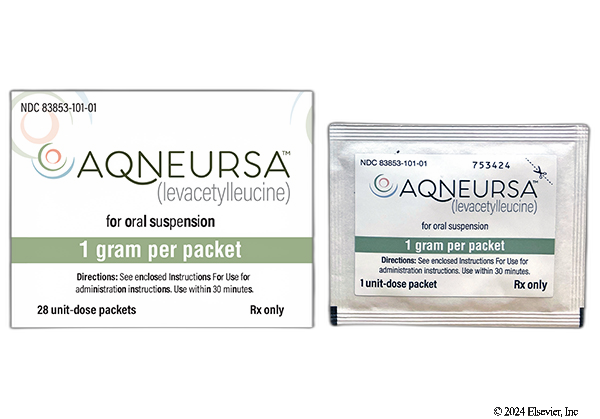
The U.S. Food and Drug Administration has approved Aqneursa — generic name levacetylleucine — as an oral suspension to treat ataxia in adults and children with ataxia-telangiectasia who weigh at least 15 kilograms, roughly 33 pounds. It is the first therapy ever approved anywhere in the United States specifically for the condition doctors and families simply call A-T.
The approval, granted to the Oxford-founded rare-disease company IntraBio Inc., landed on the agency's target decision date after a Priority Review. It carries Orphan Drug designation. And for the few thousand families worldwide who live with A-T, it represents something they have had precious little of: a door that is no longer locked.
A DIAGNOSIS THAT ARRIVES WITH NOTHING
To understand why a modest-sounding improvement on a neurological rating scale is being described as historic, you have to understand what A-T actually does.
Ataxia-telangiectasia is caused by mutations in a single gene, ATM, which sits on chromosome 11. It is autosomal recessive, meaning a child must inherit a faulty copy from both parents — parents who are almost always perfectly healthy and have no idea they are carriers until their toddler starts falling over.
And that is usually how it begins. The first signs typically appear between one and two years of age, just as a child should be finding their feet. Walking becomes unsteady. Balance deteriorates. Speech slurs. Eye movements stop obeying instructions — a phenomenon clinicians call oculomotor apraxia. Drooling follows. The cerebellum, the brain's coordination centre, is quietly being dismantled.
Then come the telangiectasias that give the disease the second half of its name: tiny dilated blood vessels that spider across the whites of the eyes and the skin, red threads that look almost decorative and mean the opposite.
Most children with A-T are wheelchair-dependent between the ages of ten and fifteen. But the neurological decline is only the part you can see. The same broken gene cripples the immune system and leaves the body's DNA repair machinery in tatters, which is why children with A-T develop cancers — particularly leukaemias and lymphomas — at rates that dwarf the general population. Medical texts list the three main causes of death as malignancy, infection and non-specific pulmonary failure. Many patients do not survive far beyond their teens or early twenties, though milder forms exist and some people have lived into their sixth decade.
Estimates of how common A-T is range from roughly one in 40,000 to one in 100,000 live births, with IntraBio citing approximately one in 70,000. In the United States, the A-T Children's Project has long put the number of affected children at around 500.
Five hundred children. It is a number that explains a great deal about why no drug ever arrived.
THE FATHER WHO REFUSED TO ACCEPT IT
In 1993, Brad Margus was a Harvard MBA running a south Florida seafood company that sold shrimp to restaurants, cruise lines and hotels. Then two of his young sons were diagnosed with A-T.
Margus and his wife Vicki did what almost nobody does. They founded a charity — the A-T Children's Project — and went looking for the science that did not exist. Within seven years they had raised $7 million and helped drive the hunt that identified the ATM gene itself, a landmark announced in 1995. The shrimp salesman went on to become a fixture of American biotech, but the disease that started it all stayed stubbornly untreatable.
On the day of the approval, Margus put it plainly.
"This is a historic day for the A-T community and the patients and caregivers who have coped for decades without a treatment approved specifically for A-T," he said in a statement. "With today's FDA decision, those impacted by A-T have a treatment option demonstrating benefit across a range of A-T symptoms, including symptoms affecting daily life for patients and their loved ones."
IntraBio's chief executive Mallory Factor called it "a tremendous milestone for the A-T community and IntraBio," adding that the drug "now offers the potential to make meaningful differences in the lives of thousands of patients and their families who have lacked options to treat the diverse and debilitating array of symptoms caused by A-T."
73 PATIENTS, SIX COUNTRIES, ONE CLEVER TRIAL DESIGN
The evidence behind the approval comes from a phase 3 trial called IB1001-303, registered as NCT06673056 and published in July this year in The Lancet Neurology by Martakis, Bremova-Ertl, Bolton and colleagues.
It was small, because A-T is small. Seventy-three patients with genetically confirmed A-T were enrolled across ten sites in Germany, Slovakia, Spain, Switzerland, the United Kingdom and the United States. Twenty-six were adults and 47 were children. Thirty-eight were female, 35 male. The median age at the start of treatment was 13, with a range stretching from four years old to fifty.
Crucially, the study used a randomised, double-blind, placebo-controlled two-period crossover design. Each participant took the drug for 12 weeks and placebo for 12 weeks, in a randomly assigned order — meaning every patient acted as their own control. In a disease this rare, that design squeezes far more statistical power out of a tiny population than a conventional parallel-group trial ever could. Seventy of the 73 patients, or 96 per cent, completed the study.
WHAT THE NUMBERS ACTUALLY SHOWED
The primary endpoint was the Scale for the Assessment and Rating of Ataxia, or SARA — a standard neurological instrument that scores things like gait, stance, sitting balance and speech. Lower is better.
On levacetylleucine, patients improved by 1.9 points more than they did on placebo (95% confidence interval −2.7 to −1.1; two-sided P less than .001). An earlier readout put the raw figures at −1.92 on drug versus −0.14 on placebo.
The FDA also assessed a modified, functional version of the scale known as fSARA, which narrows the measurement to four domains — gait, sitting, stance and speech disturbance — scored from 0, the best possible neurological status, to 16, the worst. On that measure the mean treatment difference was −0.6 (95% CI −0.9 to −0.2; P less than .001).
Secondary endpoints, including the International Cooperative Ataxia Rating Scale and investigator-rated Clinical Global Impression of Improvement, pointed the same way. There was no evidence that children and adults responded differently. And the benefit was visible within the 12-week treatment window.
It is worth being honest about scale here, because tabloid readers deserve it as much as anybody else. A 1.9-point shift on a 40-point ataxia scale is not a cure. It does not repair the cerebellum, restore the immune system or lower cancer risk. What it appears to do is make a body that is losing coordination slightly more governable — enough, families and investigators report, to show up in the things that make up a day: sitting steadier, speaking more clearly, falling a bit less.
For a disease whose treatment column has read "none" since it was first described, that is the difference between something and nothing.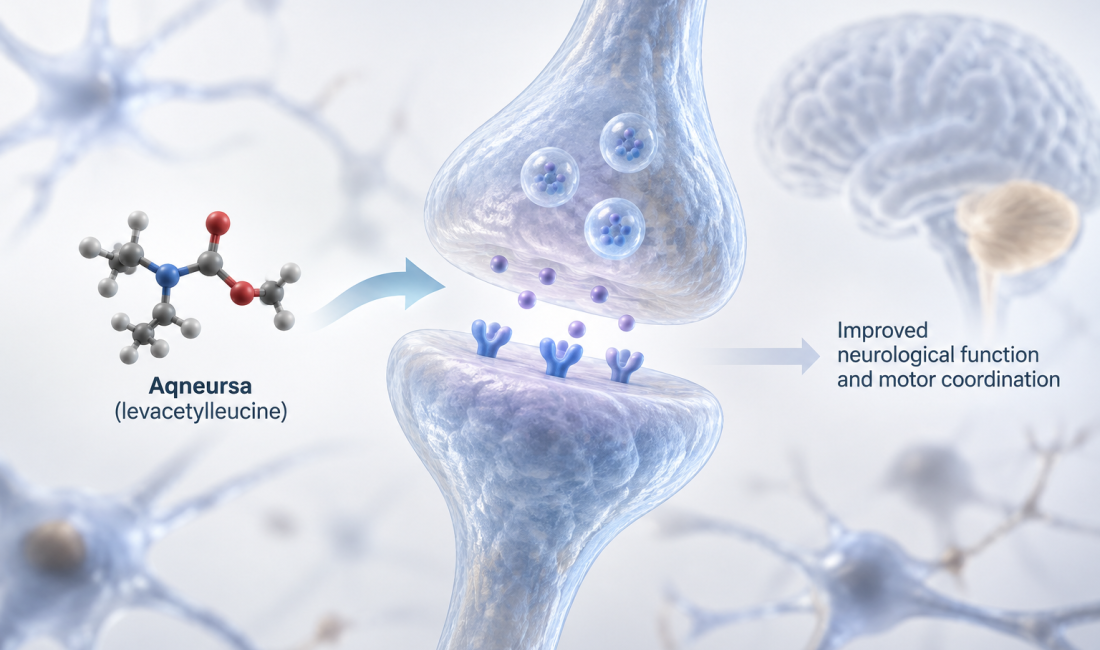
HOW IT IS SUPPOSED TO WORK
Levacetylleucine is not a gene therapy and makes no claim to fix ATM. It is a modified amino acid — the L-enantiomer of N-acetyl-leucine — and its proposed mechanism is metabolic rather than genetic. Preclinical work suggests it helps normalise glucose metabolism and enhance cerebellar activity, correcting metabolic dysfunction and improving lysosomal and mitochondrial function in cells that are struggling.
The drug is not new to the FDA. Aqneursa was first approved in September 2024 for the neurological manifestations of Niemann-Pick disease type C, another devastating rare neurological condition. This week's decision is an expansion of that same product into a second disease.
THE SAFETY LEDGER
By the standards of rare neurological medicine, the safety picture is unusually calm.
There were no treatment-related serious adverse events and no deaths during the trial. No patient discontinued because of a treatment-related side effect. The adverse reactions that turned up in at least 5 per cent of A-T patients and more often than on placebo were fall, skin laceration and urinary tract infection — a trio that arguably says more about living with a balance disorder than about the drug.
The label carries no contraindications, but it does carry a warning for embryo-fetal toxicity based on animal reproduction studies. Prescribers are told to verify pregnancy status before starting treatment and to counsel patients on effective contraception during treatment and for seven days after the final dose.
There are two drug-interaction points that matter. Levacetylleucine should not be taken alongside N-acetyl-DL-leucine or N-acetyl-D-leucine — versions sold and used in some countries — because the D-enantiomer competes for the same monocarboxylate transporter and may blunt the drug's effect. And because levacetylleucine inhibits P-glycoprotein, patients taking P-gp substrate medicines should be monitored more closely for side effects.
THE QUESTION NOBODY WANTS TO ASK FIRST
Approval is not access, and rare-disease drugs are among the most expensive medicines on earth.
IntraBio has not publicly announced an official list price for the A-T indication. In the Niemann-Pick setting, pharmacy pricing databases have listed figures in the region of $14,600 for a pack of 28 granule sachets — a retail reference point rather than a manufacturer's stated annual cost, and one that will depend heavily on dose, weight and insurance.
For families, the practical fight now shifts from "is there a drug?" to "will my plan cover it, and how fast?" Orphan Drug designation brings market exclusivity and tax incentives to the manufacturer; it does not bring a price cap. Expect the coming months to be dominated by prior-authorisation paperwork, specialty-pharmacy logistics and patient-assistance programmes — the unglamorous machinery that decides whether an approval reaches an actual child.
WHAT THIS MEANS FOR YOU
If A-T is not in your family, the honest answer is that this approval will never touch your life directly. But it is worth understanding what it signals, because the pattern is spreading.
First: if you have a child under three whose walking or balance is deteriorating rather than improving, that is not clumsiness and it is not something to "wait and see" on. Progressive loss of coordination in a toddler warrants a paediatric neurology referral. A-T is rare, but it is one of several conditions where early genetic diagnosis changes management — including avoiding certain radiation exposures, which people with A-T tolerate badly because of their broken DNA repair.
Second: carrier status matters. Because A-T is recessive, both parents carry a faulty ATM copy. Carriers themselves are generally healthy, but research has associated ATM carrier status with modestly elevated cancer risk, particularly breast cancer. Families with a confirmed diagnosis should be offered genetic counselling — for siblings, for cousins, for the next generation.
Third, and more broadly: this is what modern rare-disease approval looks like. Seventy-three patients. A crossover design. A repurposed molecule already approved for a different disease. Two decades ago that package would have been laughed out of the room. Today it is how medicine reaches populations too small to support a conventional trial — and there are thousands of such populations waiting.
WHAT COMES NEXT
IntraBio is already running a further phase 3 study, IB1001-304, testing the same drug in CACNA1A-related disorders — a cluster of rare neurological conditions affecting an estimated 30,000 people in the United States and 690,000 worldwide, none of which currently has an approved therapy. The company expects to finish enrolment in October.
Meanwhile the deeper problems of A-T remain untouched. Nothing approved this week addresses the immune deficiency, the cancer risk or the underlying genetic fault. The research pipeline aimed at those — antisense oligonucleotides, gene-editing approaches, ATM-targeted strategies — is still years from a regulator's desk.
But something did change this week, and it changed for a specific reason. It changed because in 1993 a man who sold shrimp for a living refused to accept an empty page, and spent the next three decades filling it.
Five hundred American children now have a treatment option that did not exist on Thursday. In rare disease, that is what a miracle actually looks like: not a cure, not a headline cure anyway, but a locked door that finally opened — and a queue of other diseases behind it, watching to see whether it stays open.



