LONDON, UNITED KINGDOM
For twenty-five summers, the Serpentine Pavilion has been architecture's most closely watched annual dare: a temporary structure in Kensington Gardens, commissioned from a studio that has never had a permanent building in London, given a few months and a modest budget to say something about what architecture is for. Zaha Hadid's 2000 inaugural pavilion set an impossibly high bar for spectacle — a jagged, tent-like form that read as a manifesto. Every summer since, the pavilion has tended to answer that manifesto with more manifesto: swooping canopies, cantilevered follies, structures engineered to look like they shouldn't be able to stand up.
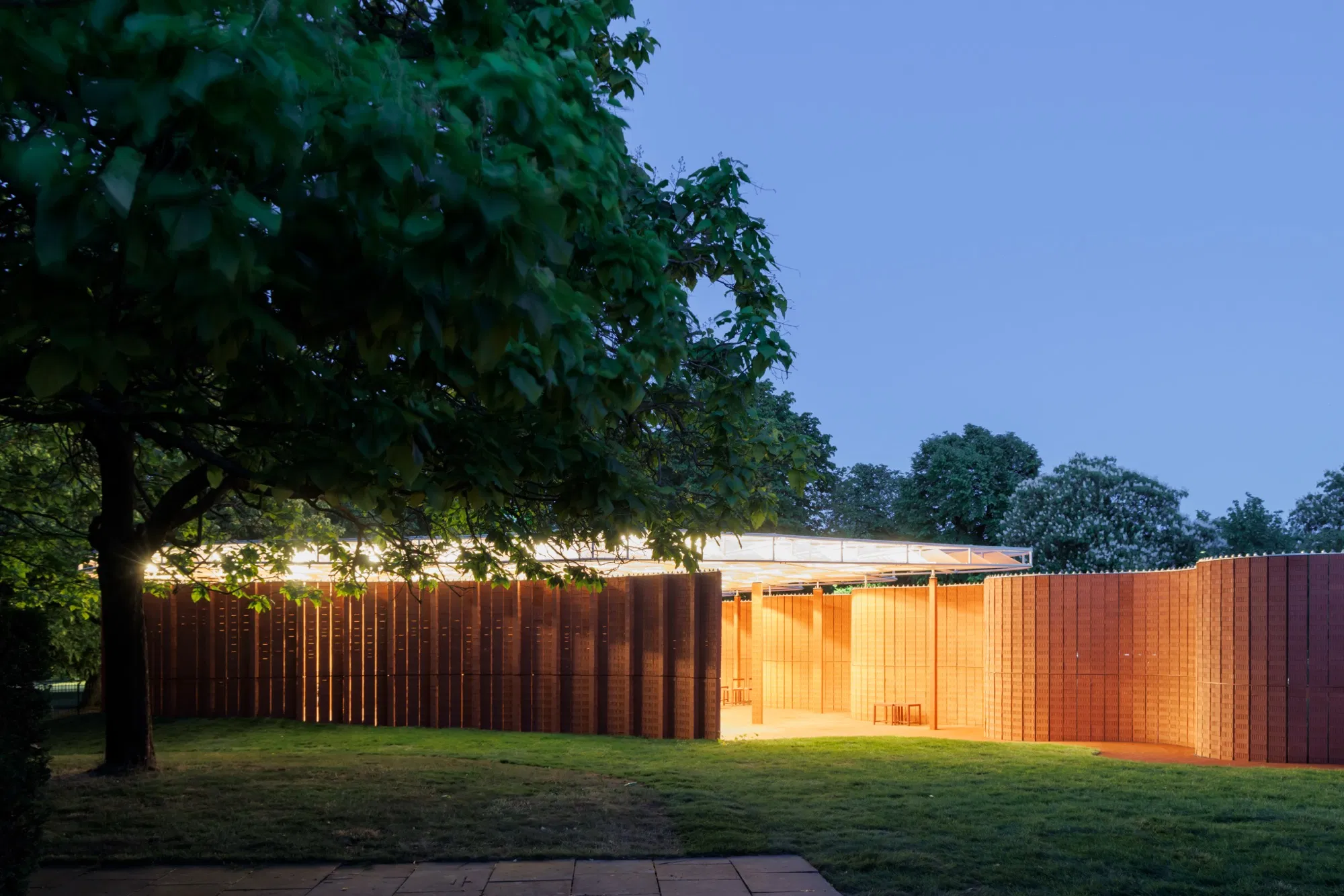
This year's pavilion, unveiled by the Mexico City studio LANZA Atelier and open to the public now through October 25, does something almost defiantly different. It's made of brick. It references a garden wall. And in a design culture that has spent a quarter-century rewarding architectural fireworks, that restraint has become the story.
The Wall That Isn't Straight
LANZA Atelier — founded by architects Isabel Abascal and Alessandro Arienzo — built this year's pavilion, titled "A Serpentine," around the crinkle-crankle wall: a one-brick-thick wall laid in a wave-like, serpentine pattern rather than a straight line. It's a genuinely obscure structural trick, prized in historic English kitchen gardens because its curves let it stand at just a single brick's thickness — using fewer bricks overall than a straight wall would need for the same stability, since the waving form itself provides the lateral bracing a flat wall would otherwise require buttresses for. Despite its strong association with the English country estate, the technique is believed to have originated in ancient Egypt and been introduced to England by Dutch engineers centuries ago — a lineage LANZA Atelier leaned into rather than smoothed over.
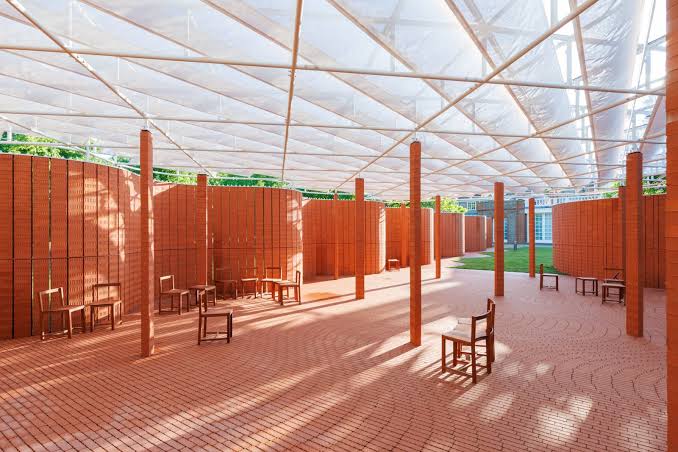
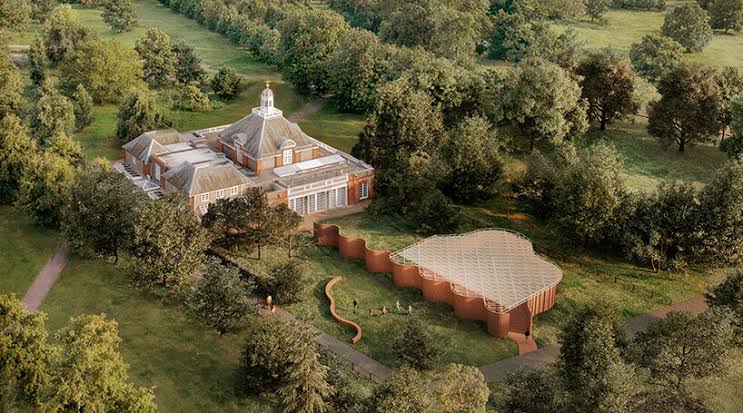
The choice of name and site is almost too neat: a serpentine wall, built for the Serpentine Gallery, in a design borrowing its curve from the very geometry the gallery is named after — itself a reference to the sinuous lake running through Hyde Park and Kensington Gardens nearby. Above the brick walls, a translucent roof rests lightly across a grid of brick columns, a gesture architecture critics have described as "evoking a grove of trees," letting light and air move through the structure and blurring the line between shelter and open garden pavilion. The brick itself was chosen deliberately to put the new structure in conversation with the existing brick façade of the Serpentine South Gallery — a building originally constructed as a tea pavilion, a lineage LANZA's design nods back toward rather than competes with.
"What LANZA has built is unfashionably literal. A serpentine, in a place called Serpentine, made of bricks that match the bricks already there. The pavilion does not invent a vocabulary so much as translate one" — from a review of the finished structure.
Playful, But at What Cost?
Not every response has been unqualified praise. A review published shortly after opening framed the pavilion as a study in tension between the spectacular and the ordinary, noting the studio built something "generous enough to accommodate the scrunched-up napkins and discarded straws of the sticky-handed masses" — a pointed way of saying the pavilion is designed to be used, sat in, and messed up by picnicking families and tourists, rather than simply photographed and admired from a respectful distance. That's arguably the more radical proposition buried inside an otherwise modest-looking building: a rejection of the idea that a Serpentine Pavilion needs to announce its own importance to justify the commission.
LANZA Atelier is, by design, an unlikely name to headline the world's most prestigious annual architecture commission. The Serpentine Pavilion brief specifically seeks out a studio that has not yet completed a permanent, built structure in London — a rule established to give emerging and international practices a rare shot at high-visibility exposure they might otherwise spend a decade waiting for. Abascal and Arienzo's Mexico City-based practice fits that mold precisely: respected within architecture circles for smaller-scale, materially inventive work, but without the kind of London footprint that would typically precede a commission this visible.
A Milestone Year for the Program
The 2026 pavilion arrives as the Serpentine marks the program's 25th anniversary, and the gallery has built additional programming around that milestone — notably a collaboration with the Zaha Hadid Foundation that explicitly reconnects this year's commission back to Hadid's own inaugural 2000 pavilion, the structure that effectively invented the entire genre of temporary, architect-defining summer commissions that cities from New York to Beijing have since tried to replicate. Framing LANZA Atelier's quiet, literal brick wall against Hadid's swooping, era-defining original makes the contrast between the program's first commission and its twenty-fifth impossible to miss — and seems to be precisely the point.
It also raises a genuine question the architecture press has been chewing over since the pavilion opened: has the Serpentine Pavilion, as an institution, quietly outgrown its own need to shock? For its first decade and a half, being selected typically meant being tasked with producing something formally audacious enough to dominate a news cycle — Hadid, Toyo Ito, Rem Koolhaas, Frank Gehry, Zaha Hadid's successors all leaning into structural spectacle as the point. LANZA Atelier's willingness to build something that reads, in the words of one review, as "unfashionably literal," suggests the commission's newer custodians are comfortable rewarding a different kind of ambition — one measured in craft, material research and site-specificity rather than sheer visual audacity.
What This Means for Visitors
For Londoners and tourists alike, "A Serpentine" is free to visit in Kensington Gardens through October 25, alongside the Serpentine Gallery's regular exhibition program, making it one of the more accessible entries into contemporary architecture discourse available anywhere in the city this summer — no ticket, no reservation, just a walk through the park. It's also, per LANZA Atelier's stated intent and the design's built-in tolerance for wear, meant to be sat in, eaten in and generally lived with rather than merely observed, a rare architectural commission explicitly designed to welcome mess.
For the broader design world, the pavilion is worth watching as a bellwether. If LANZA Atelier's low-key, materially grounded approach draws the kind of sustained institutional attention Hadid's spectacle did twenty-five years ago, it may mark a genuine turn in what architecture's most visible annual platform decides to reward next — away from the era of the singular, monumental "starchitect" gesture, and toward something more modest, more local, and arguably more durable.
Published By | Features Editor