MILAN
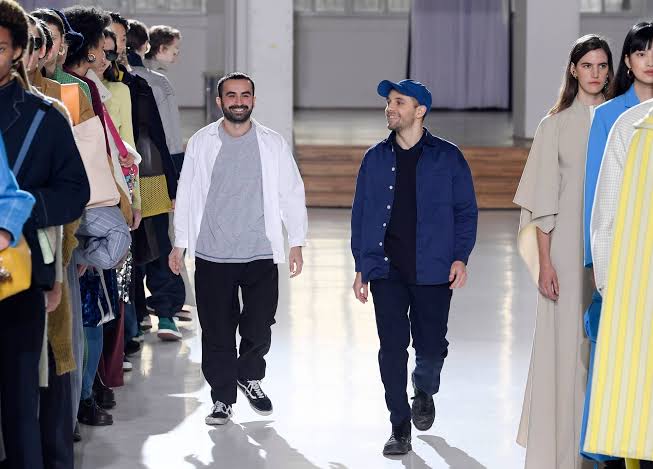
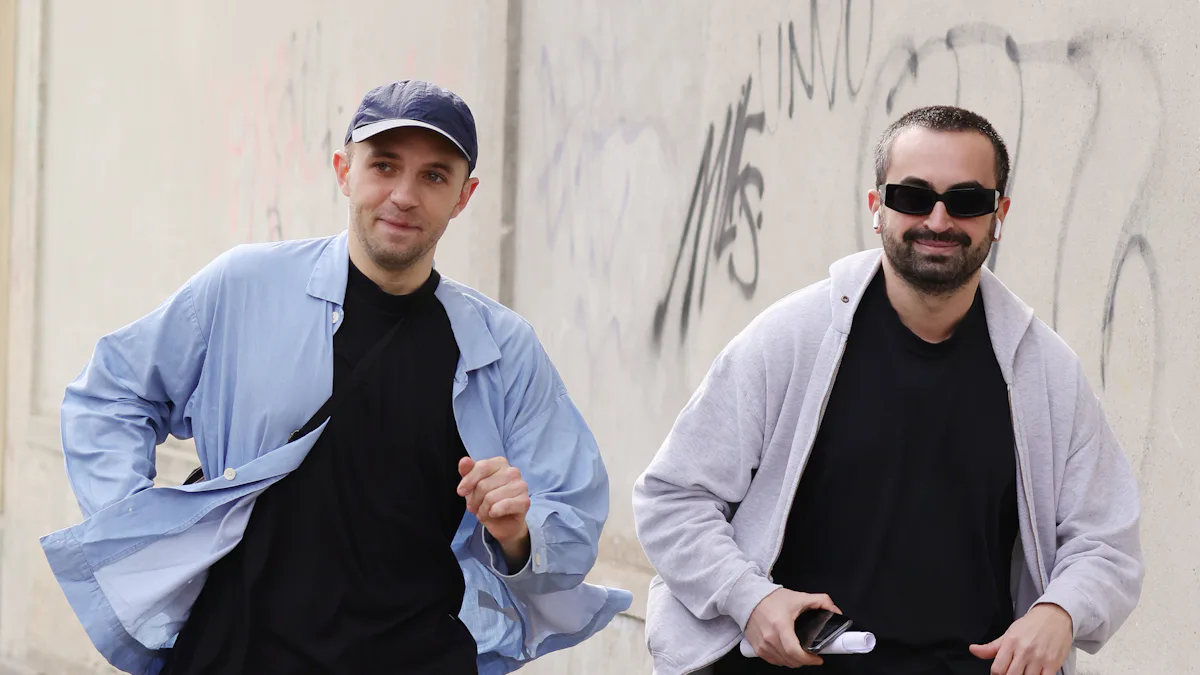
There is a particular kind of fashion job that looks like a coronation and functions like a rescue mission. Loris Messina and Simone Rizzo have just taken one.
In three weeks, on September 25, the pair will present their debut collection as creative directors of Moschino during a Milan Fashion Week that runs September 22 to 28. It will be the most closely watched show on a calendar that Prada is opening — Prada having moved uncharacteristically to the 2 p.m. slot on the first day, September 22, abandoning its traditional Thursday berth. But the Moschino show is the one carrying actual stakes.
Who They Are
Messina and Rizzo are not house-trained luxury executives. They founded Sunnei in 2014 and spent a decade turning it into the most quietly influential independent label in Milan — a brand built on deadpan humor, unbothered proportions, and a refusal to take the industry's rituals entirely seriously. They ran their own shows, their own casting, their own irreverent brand of Milanese cool, and they built a following that skewed young and international at a moment when most Italian houses were struggling to reach either.
Then, last September, they stepped away from Sunnei entirely. The industry spent months speculating about where two founders with that particular skill set would land. The answer, announced in June and effective immediately, was Moschino.
Massimo Ferretti, executive chairman of parent company Aeffe, framed the appointment in the language of continuity rather than rupture. In the process of a brand's evolution, he said, it is essential to know how to harmonize identity and innovation — adding that Messina and Rizzo possess a contemporary creative vision, a deep cultural sensitivity, and the ability to articulate relevant languages.
Read less diplomatically: Aeffe has hired two people who know how to make young people care.
The Job They've Inherited
The scale of the challenge is the story. Moschino has cycled through creative leadership at a rate that would destabilize a far healthier house.
Jeremy Scott, who defined the brand's meme-fluent, maximalist decade, departed in 2023. Davide Renne was named his successor and died just ten days after his appointment, a tragedy that left the house without direction almost before it had one. Adrian Appiolaza, a Buenos Aires-born Central Saint Martins graduate, took the helm in January 2024 and steadied things for two and a half years before departing this summer by mutual agreement, effective immediately.
Messina and Rizzo are, by that count, the fourth creative regime in roughly three years.
The financial picture is no gentler. Moschino, founded by Franco Moschino in 1983 and manufactured by Aeffe from the very beginning, grew revenue from roughly €151.8 million in 2012 to about €273.3 million in 2022 — and has been declining, steeply, since. Aeffe, which acquired full control of the brand in 2021, is now working through a corporate restructuring under Italy's negotiated business-crisis framework. A preliminary, non-binding offer from the Portuguese fund Oxy Capital, leading a consortium, would absorb the group's operating assets and debts.
That is the context in which two designers get one show to change the narrative.
What They Might Actually Do
The obvious risk is that Moschino's identity is so loud that it swallows whoever wears it. The house's DNA — Franco Moschino's original project was fashion satirizing fashion, all trompe l'oeil and safety pins and slogans — invites literal-mindedness. Jeremy Scott turned that instinct up to eleven and got a decade of virality out of it. Appiolaza dialed it back toward the archive and got critical respect but not, evidently, enough commercial lift.
Messina and Rizzo's Sunnei work suggests a third path. Their humor was always dry rather than loud: the joke sat in the cut, the styling, the presentation format, rather than in a handbag shaped like a household object. If they can translate Franco Moschino's original irony into clothes that a thirty-year-old would wear on a Tuesday, they will have solved a problem three predecessors could not.
The commercial question is more brutal than the creative one. A house in restructuring needs volume, and volume in 2026 means accessories, footwear, and entry-price product that moves. Whatever appears on the runway on September 25 will be judged twice — once by critics on aesthetic terms, and once, more quietly, by whoever ends up owning Aeffe's balance sheet.

The Wider Pattern
Moschino's churn is an extreme version of a condition afflicting the entire midmarket of Italian and French fashion. Houses with real heritage but without the scale of the mega-groups have spent three years swapping designers at speed, hoping that a new name will do what a new strategy hasn't. Each change resets the customer's understanding of what a brand is, which is precisely the opposite of what a struggling brand needs.
What makes this appointment interesting is that Aeffe has not reached for a famous name. It has reached for two founders — people who have built something from nothing and understand what it costs. That is a different bet, and a more intelligent one.
What This Means for You
If you shop the brand, expect the aesthetic to shift meaningfully away from the costume-adjacent maximalism of the Scott years and toward something more wearable and more Milanese. If you're watching the industry, September 25 is the single most informative twenty minutes of the Milan schedule — a live test of whether independent-designer instincts can be transplanted into a legacy house under financial pressure.
And if you're a designer with your own label wondering whether to take the big job: watch closely. This is what the big job actually looks like.
The Bottom Line
Franco Moschino built a house on the idea that fashion should laugh at itself. Forty-three years later, two men who built their reputation doing exactly that get three weeks to prove the joke still works — and a considerably shorter runway than anyone would want.
Published By | Features Editor