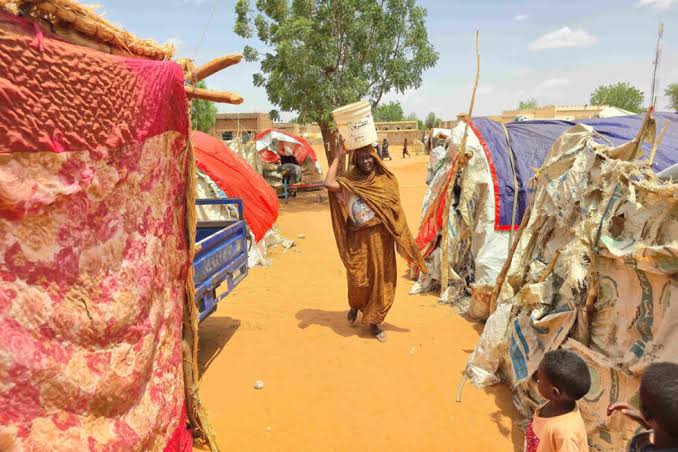
El-Obeid, Sudan
In the Sudanese city of el-Obeid, residents have learned to read the sky. Drones — sometimes as many as 40 at once, according to residents interviewed by NPR — hang over the city of roughly 500,000 people, and no place is safe from them: not homes, not the road to school, not the market, not even funerals. One 25-year-old resident described the calculus of daily life under siege bluntly: "You might get hit and killed by a drone while you're asleep at home, or while on the way to school. You could also get hit by a drone in the market." A local aid worker, who asked not to be named for her safety, told NPR that her uncle was killed by a drone strike while walking to bury a neighbor who had himself just been killed by one.
That grim detail captures why the United Nations is now warning, in unusually stark language, that el-Obeid risks becoming the site of Sudan's next mass atrocity — a fear grounded not in speculation but in recent history. Volker Türk, the UN High Commissioner for Human Rights, issued what he called a "red alert" last month, telling reporters: "This is not a drill. It is a red alert that needs to land on the desks of heads of state and government around the world. Their phones should be running hot in the coming days and weeks, with ideas on how to prevent atrocity crimes in el-Obeid and in other places in Kordofan."
Why El-Obeid, and Why Now
El-Obeid is the capital of North Kordofan state, sitting along a strategic corridor in central Sudan, south of the capital, Khartoum, and along the route toward the western Darfur region. That geography has made it a critical battleground in the civil war that erupted on April 15, 2023, between Sudan's military, led by Gen. Abdel-Fattah al-Burhan, and the paramilitary Rapid Support Forces, led by Burhan's former deputy, Gen. Mohamed Hamdan Dagalo, widely known as Hemedti. Control of el-Obeid would open a more direct corridor toward Khartoum for whichever side holds it, which is why the RSF has thrown extensive resources into besieging and bombarding the city even as Sudan's army has scored recent battlefield gains elsewhere, including retaking a major highway in North Kordofan and other positions in the region last week.
According to data from the International NGO Safety Organisation cited by NPR, North Kordofan recorded the highest number of drone attacks anywhere in Sudan in 2026, with both the army and the RSF deploying the weapons. The RSF's tactics in el-Obeid — attacking water distribution infrastructure to create severe shortages — closely mirror the approach it used before and during its capture of el-Fasher, the capital of North Darfur, in an assault that has become the grim benchmark against which every subsequent siege in Sudan is now measured.

The Shadow of El-Fasher
That comparison is not rhetorical. El-Fasher fell to the RSF in late October 2025 after an 18-month siege, and what followed shocked even a country numbed by more than three years of war. The UN Human Rights Office documented more than 6,000 killings in just the first three days of the RSF's offensive on the city — at least 4,400 people killed within El-Fasher itself and more than 1,600 others killed along the routes civilians used to try to flee. UN investigators later concluded that the violence bore "the hallmarks of genocide," and the UN Office of the High Commissioner for Human Rights formally found that RSF conduct during the capture of El-Fasher amounted to war crimes and possible crimes against humanity, describing "a wave of intense violence... shocking in its scale and brutality."
It is that precedent — a documented case of mass killing, abduction and systematic sexual violence following a long siege and a final assault — that now hangs over el-Obeid. Sudan researcher Eric Reeves told NPR bluntly this week that "there is no likelihood of a military rescue of el-Obeid," despite the Sudanese army's recent gains nearby.
A Deepening Humanitarian Collapse
The consequences of the siege are already visible in el-Obeid's daily life. UN Women's East Africa director, Anna Mutavati, described a "deadly gamble" facing women and girls in the city, who must venture out, often at night in the mistaken belief that darkness offers protection from aerial attack, to collect water from what remains of the city's damaged distribution points. "Under the perception that darkness offers protection from aerial attacks, these women and girls have been harassed, raped and subjected to other forms of sexual violence — all while trying to access water," Mutavati said.
Compounding the crisis, a cholera outbreak is spreading through parts of the city, hitting children hardest. Mohamed Kamal, Plan International's Sudan director, said this week that "cholera is tearing through certain communities in the city, with the outbreak being compounded by incessant rains and recent drone strikes that have crippled critical medical facilities and left thousands without access to urgent treatment and life-saving medications." Kamal warned that children face triple jeopardy in el-Obeid: heightened vulnerability to disease, the risk of recruitment into armed groups, and lasting psychological trauma from the siege.
More than 100,000 displaced people are now sheltering in camps in and around the city, according to NPR's reporting, with satellite imagery reviewed by the outlet showing the rapid growth of one camp between March and early August of this year. Esperanza Santos, Sudan emergency coordinator for Doctors Without Borders, said many of those families "are struggling to meet their basic needs in IDP camps." The World Food Programme, which is distributing food in the city, says aid funding cuts and rising diesel and fertilizer costs — themselves partly a byproduct of broader disruption linked to the war in Iran — are compounding the strain on humanitarian operations. "At a time when needs continue to grow, humanitarian resources are shrinking," Derk Segaar, special Sudan envoy for the International Federation of Red Cross and Red Crescent Societies, told a UN briefing in Geneva this week.

The Toll of a War Without End
El-Obeid's suffering is a single, acute chapter in a war that has already reshaped Sudan and the wider region. Since fighting began in April 2023, at least 59,000 people have been killed, according to the Armed Conflict Location & Event Data Project, a conflict-monitoring group — though ACLED and other researchers caution the true toll is almost certainly far higher given the difficulty of documenting deaths in besieged and inaccessible areas. Nearly 14 million people have been displaced nationwide, with roughly 11 million internally displaced and close to 4 million more having fled into neighboring Chad, Egypt and South Sudan as refugees and asylum seekers. An estimated 33.7 million people — around two-thirds of Sudan's population — are expected to need humanitarian assistance this year, with 21 million facing acute food insecurity, figures that have made Sudan's war, by most humanitarian metrics, the largest crisis of its kind in the world.
International Pressure, Limited Leverage
Pressure on Washington and other capitals to act has been mounting. On Tuesday, a bipartisan group of more than 20 U.S. senators, including Democrats Tim Kaine, Bernie Sanders and Adam Schiff, wrote to Secretary of State Marco Rubio urging concrete steps to prevent mass atrocities in el-Obeid. "While we welcome the State Department's expression of concern about the escalating situation in el-Obeid, words are not enough," the senators wrote, adding that "the encirclement and systematic crippling of resources in el-Obeid increasingly parallels el-Fasher." The letter specifically called on the administration to halt arms sales to the United Arab Emirates, which has faced persistent accusations — which it denies — of supporting the RSF. Reeves, the Sudan researcher, endorsed that demand, telling NPR: "Until the United Arab Emirates is called out and dissuaded from pursuing its grotesquely destructive policy in Sudan, we're going to see this war continue."
Analysis and Outlook
The political stakes of el-Obeid extend well beyond North Kordofan. A repeat of el-Fasher-scale violence would not only mark a second documented case of atrocities meeting the threshold UN investigators have already associated with genocide in this war — it would also crystallize, for governments still debating how forcefully to respond, whether international pressure of the kind applied after el-Fasher's fall (formal war-crimes findings, senatorial letters, UN Security Council briefings) has any deterrent effect at all on the RSF's battlefield conduct. So far, the evidence is not encouraging: el-Fasher's fall came after 18 months of well-documented warning signs, much like the warnings now emerging from el-Obeid.
What happens next will likely hinge on factors largely outside Sudan's borders as much as inside them: whether the U.S. and other governments are willing to impose real costs on the RSF's external backers, whether humanitarian corridors can be negotiated despite the drone threat, and whether Sudan's army can translate its recent territorial gains into an actual relief operation that Reeves and other analysts currently consider unlikely. In the meantime, the residents of el-Obeid continue counting drones in the sky, and international officials continue warning, with increasing urgency, that the world already has all the evidence it needs to know what could happen next — and has yet to prevent it.
Published By | News Editor