BENGALURU
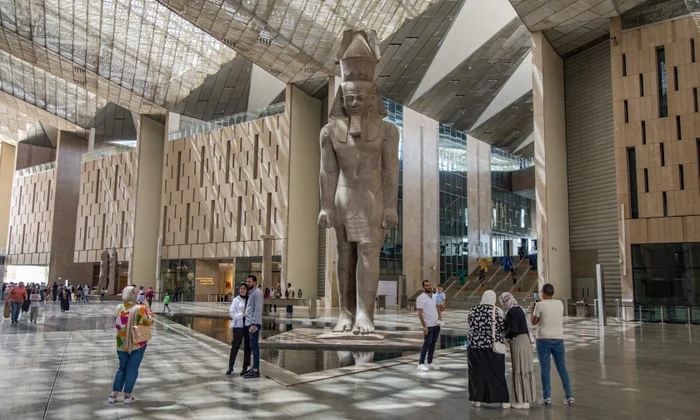
There is a particular kind of irony in hiring the architects of one of the ancient world's grandest monuments to design a museum about start-ups. But that is precisely what has happened in Bengaluru, where officials have confirmed that Heneghan Peng Architects — the Dublin-based studio behind the newly completed Grand Egyptian Museum in Giza — has won the international bid to design the Museum of Innovation, Startup and Technology, or MIST, India's first museum devoted entirely to the country's modern history of entrepreneurship and technology.
The choice is a deliberate statement. Heneghan Peng spent more than three decades bringing the Grand Egyptian Museum from competition-winning sketch to a finished 81,000-square-meter home for over 100,000 pharaonic antiquities, a project so vast in scope and so patient in execution that its 2025 completion was treated as a genuine architectural milestone. Handing that same studio the job of memorializing India's tech boom — an industry defined by speed, disruption and the opposite of multi-decade patience — sets up an unusual creative tension that Bengaluru's planners appear to be embracing rather than avoiding.

A Factory, Not a Monument
Unlike the limestone-clad grandeur of Giza, MIST will live inside a repurposed industrial shed. The museum and its companion institution, a deep-tech incubator called Innoverse, are being built within the former Switchgear Factory Shed at the NGEF campus in Bengaluru's Baiyappanahalli area — the historic home of the New Government Electrical Factory, a state manufacturing enterprise whose steel-framed, sawtooth-roofed industrial architecture is now being preserved rather than demolished. Heneghan Peng is leading the design in collaboration with London-based DROO and Bengaluru's own Cadence Architects, a three-way consortium selected out of six shortlisted teams through a two-stage global quality-and-cost review process that concluded on July 21.
The renderings released alongside the announcement lean into the building's industrial bones rather than disguising them: exposed steel trusses, large operable factory windows, and a soaring, naturally lit central volume that will house the exhibition hall. Crucially, the entire complex sits within a 105-acre urban forest — an almost unheard-of amount of green buffer for a project in one of India's densest, fastest-growing cities, and one that planners are positioning as central to the visitor experience rather than incidental to it.
What India's First Innovation Museum Will Actually Tell
MIST's stated mission is to become the country's first museum "dedicated exclusively to modern India's journey in innovation, technology, and entrepreneurship" — a scope broad enough to cover everything from the early state-run electronics manufacturing that once occupied the very factory shed the museum will inhabit, through to the software services boom that made Bengaluru globally synonymous with the term "Silicon Valley of India," and into the current generation of start-ups the city continues to produce at a rate few global tech hubs can match.
That arc — from state manufacturing to software services to venture-backed start-ups — gives the museum's setting an unusual kind of narrative honesty. Rather than building a gleaming new structure to celebrate disruption, MIST tells that story from inside one of the very institutions disruption eventually displaced. The NGEF factory itself closed years ago as India's economy shifted away from state-run heavy manufacturing, and repurposing its shell to house a museum about the industries that came after is the kind of curatorial decision that usually gets made by an exhibition designer, not a site-selection committee — in this case, the building is already doing curatorial work before a single artifact has been installed.

A $35 Million Bet on Bengaluru's Own Legacy
The project carries a total budget of roughly $35 million and is targeting completion of its first phase, alongside the Innoverse incubator, by 2028 — a comparatively modest price tag and quick timeline next to marquee international museum projects like the Grand Egyptian Museum's decades-long, multi-billion-dollar build. That contrast is likely intentional. Where Giza was built to be a permanent, singular monument to a civilization thousands of years in the past, MIST is explicitly designed around an industry that reinvents itself every few years, meaning the building's flexibility — factory-shed volumes that can be reconfigured as exhibitions and technology change — may matter more than its permanence.
Local architecture critics have noted that the choice also reflects a broader trend across India's fast-growing cities: rather than importing an entirely new architectural language for prestige cultural buildings, planners are increasingly choosing adaptive reuse of the country's own industrial and colonial-era heritage, preserving structures that might otherwise be demolished for redevelopment while giving them new civic purpose.

What This Means for Visitors and the City
For Bengaluru residents, MIST represents something the city — despite its global reputation as a technology capital — has conspicuously lacked: a public institution that formally tells its own origin story. Tech workers who move to the city for jobs at its start-ups and multinational campuses will, by 2028, have a museum that traces the industry back to its roots rather than treating Bengaluru's tech identity as something that simply always existed.
For architecture watchers further afield, MIST is a case study in what happens when a studio famous for a career-defining, decades-long project takes on something built for speed instead of permanence. The Grand Egyptian Museum proved Heneghan Peng could out-wait an entire generation of competitors to see a vision through. Bengaluru will test whether a studio built for patience can also build for an industry that has never once stood still.
Ground has not yet broken. But with a consortium selected, a site secured, and a 2028 target on the books, Bengaluru's own museum of disruption is, fittingly, already disrupting expectations of what a "museum building" project is supposed to look like.
Published By | Features Editor