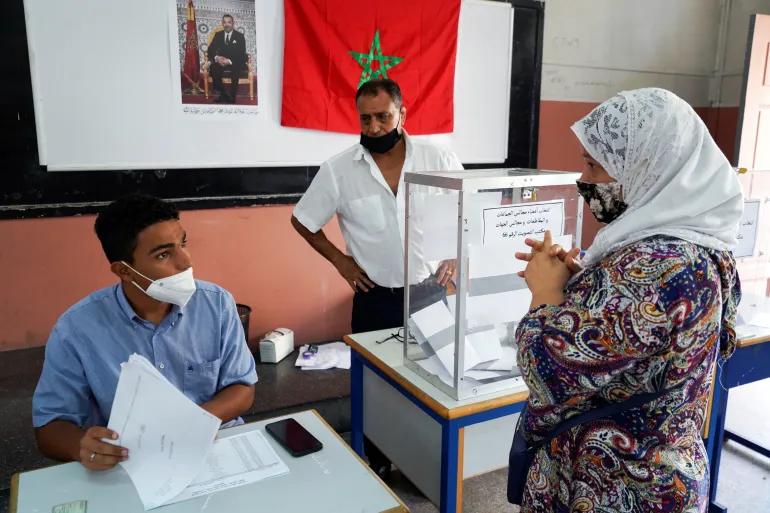
RABAT, Morocco
With four days to go before Moroccans vote in parliamentary elections on September 23, the campaign has settled into an uneasy contest less about which party will govern than about whether a skeptical, disproportionately young electorate will bother to show up at all. A record 1,850 candidate lists and 7,288 candidates from 27 parties are chasing 395 seats in the House of Representatives, but the vote is unfolding barely a year after youth-led "Gen Z 212" protests exposed deep public distrust of the same political institutions now asking for a mandate.
The election matters well beyond Morocco's own parliament. It is the first national test of whether King Mohammed VI's government can convert last autumn's costly concessions to street protesters — sweeping budget increases, promises of tens of thousands of new health and education jobs — into renewed public faith in electoral politics, or whether Morocco's young people conclude, as protesters chanted for weeks last year, that the ballot box changes little in a system where the palace retains ultimate control over defense, foreign affairs, the interior and religious affairs regardless of who wins a parliamentary majority.
From hospital deaths to a national protest movement
The immediate origin of the current political moment traces to September 2025, when eight women died following cesarean sections at a public hospital in Agadir, a failure that came to symbolize the state of Morocco's underfunded public health system and ignited what became known as the Gen Z 212 movement — a leaderless, largely online-organized wave of youth demonstrations named for Morocco's international calling code. The protests' core grievances were not, by most accounts, aimed at the monarchy itself but at the quality of public education and healthcare, corruption, and youth unemployment, particularly among university graduates who found credentials no guarantee of work.
The government's response was substantial on paper. King Mohammed VI called for healthcare and education budgets to rise by 18% for 2026, pushing combined spending toward roughly $15 billion, and the government committed to creating 8,000 new health-sector jobs, 19,000 new education positions, and renovating 90 hospitals. Electoral reforms followed too: campaign-cost subsidies covering up to 75% of expenses for candidates under 35, new requirements that parties include younger founding members, and digital tools intended to ease candidate registration.
A year later, the underlying structural problems the protests identified remain largely unresolved. Hospital governance reforms drafted in 2022 still have not been implemented. Out-of-pocket healthcare costs still consumed an average of 34% of total health spending in 2024, with 91% of insurance reimbursements flowing to private clinics rather than the public system most Moroccans rely on. Youth unemployment among 15-to-24-year-olds stood at 37.3% as of the most recent data cited by regional analysts, even as the government points to a projected 4.4% GDP growth rate for 2026 and Morocco's continued rise as a North African industrial hub anchored by automotive manufacturing, aeronautics, phosphate exports and the Tanger Med port, now among the world's 20 busiest container terminals.

Parties jockeying for a fractured electorate
The governing coalition since 2021 — the National Rally of Independents (RNI), led by Prime Minister Aziz Akhannouch, alongside the Party of Authenticity and Modernity (PAM) and the Istiqlal Party, which together hold 102, 87 and 81 seats respectively — is campaigning on continuity, with Akhannouch's RNI promising to create 1 million jobs and raise the minimum wage to roughly $530 a month. PAM has matched the jobs pledge with its own 1-million-job target attached to a five-year, $37.1 billion program, while Istiqlal has centered its pitch on purchasing power and public services.
The most closely watched storyline, however, is the attempted comeback of the Justice and Development Party (PJD), the Islamist-rooted party that dominated Moroccan governments for a decade before being "crushed" — in the words of analysts covering the race — in the 2021 election, collapsing from 125 seats to just 13. Under party leader Abdelilah Benkirane, the PJD unveiled its 2026 platform on September 8 under the slogan "To Achieve Citizen Dignity," built around education quality, expanded healthcare coverage, decent employment and anti-corruption measures — a deliberate pivot away from 2021, when the party ran largely on defending its own governing record. Benkirane has also gone directly after Akhannouch's record in office, while publicly acknowledging just how difficult a path back to a parliamentary majority remains for a party still working to rebuild trust it lost in government.
Cracks have also appeared inside the governing coalition itself. A leaked audio recording attributed to House Speaker Rachid Talbi Alami, an RNI figure, exposed internal tension over what future role Budget Minister Fouzi Lekjaa might play, prompting Akhannouch to publicly insist the coalition's parties should focus "on winning the election rather than distributing government posts in advance," while Lekjaa dismissed talk of "dividing up the spoils without having hunted them." The episode, days before the official campaign opened, fed precisely the narrative PJD and other opposition parties have sought to advance: that governing arrangements in Morocco are settled among elites well before voters cast a single ballot.

Structural stakes: a monarchy that sets the terms
Whatever the outcome September 23, Morocco's political system ensures the vote's practical consequences will be bounded. King Mohammed VI appoints the prime minister from the party that wins the most seats, but the monarch retains direct control over defense, foreign affairs, the interior ministry and religious affairs — meaning that Morocco's most consequential strategic positions, including its stance on the Western Sahara dispute and its peacekeeping commitments related to Gaza, will remain insulated from whatever government voters choose. Parliament's writ covers budgets, legislation and the administration of schools, hospitals and pricing policy — the very domains at the heart of the Gen Z 212 protesters' grievances, which is precisely why turnout, more than the identity of the winning party, has become the metric analysts are watching most closely.
Registered voters number 15.8 million, but roughly 2.2 million fewer Moroccans are registered to vote than in 2021, and the electorate skews sharply older: voters aged 60 and above make up 29% of the rolls, while those aged 18 to 24 — the demographic most associated with last year's protest movement — account for barely 4%. A March 2026 Afrobarometer survey found only about 33% of young Moroccans expressed trust in parliament, government leaders or political parties, a striking indicator given that this same cohort spent much of the past year in the streets demanding the state address their concerns. The 2021 election drew a turnout of roughly 50.35%; analysts widely agree that a result meaningfully below that level would reopen questions about the legitimacy of Morocco's elected institutions that the government has spent the past year trying to put to rest through spending and reform pledges.
What to watch next
Three things will determine how this election is read once results come in Wednesday night into Thursday. First, turnout itself, and specifically whether young voters who fueled the Gen Z 212 protests translate street-level frustration into ballots, stay home in a gesture of continued distrust, or split the difference by voting for parties like the PJD that are explicitly campaigning on the same grievances that drove last year's demonstrations. Second, whether the PJD can convert Benkirane's aggressive framing of the race into a genuine seat recovery, which would mark a significant reshaping of Morocco's parliamentary landscape even without threatening the monarchy's underlying authority. Third, whether the coalition tensions exposed by the Talbi Alami recording resurface in the horse-trading over a new government once results are final, testing whether Akhannouch's insistence on winning first and dividing power later holds up once an actual majority has to be assembled. However the seats fall, the deeper test — whether Moroccans conclude their political system is responsive to what brought hundreds of thousands into the streets barely a year ago — will likely take considerably longer than a single election night to answer.
Published By | News Editor