Written By | Business Experts
Zimbabwe's recent growth has been unusually strong and unusually uneven.
Economic & Social Transformation
Introduction: A Currency That Finally Held
For most of the past three decades, Zimbabwe has been shorthand for monetary collapse. Hyperinflation in 2008, the abandonment of the local currency in 2009, the return of quasi-dollarisation, and a series of failed currency relaunches left households and firms deeply sceptical of any official promise of stability. Against that history, the numbers now emerging from Harare are striking. According to the World Bank's Macro Poverty Outlook, inflation in the structured-gold-backed currency, the ZiG, fell from roughly 85 percent in April 2025 to 4.1 percent in January 2026, the first single-digit reading since 1997. By August 2026, ZiG annual inflation stood at 2.9 percent, with month-on-month inflation of just 0.1 percent, and the official exchange rate has hovered around ZiG 26 to 27 per US dollar since mid-year.
Yet stability is not the same as transformation. Zimbabwe still carries roughly US$7.4 billion in external arrears that block access to concessional finance, its fiscal position depends on volatile commodity receipts, nearly half the population lives below the international poverty line, and the IMF itself has flagged a shortfall in protected social spending as a significant concern. This article examines how far Zimbabwe's recovery has progressed, what is driving it, and what must happen for macroeconomic calm to become broad-based development.
The Growth Picture: Agriculture and Gold
Zimbabwe's recent growth has been unusually strong and unusually uneven. The World Bank estimates real GDP growth of 7.5 percent in 2025, driven by a rebound in agriculture after the 2024 El Nino drought. Agriculture, which contracted by 18.1 percent in 2024, is estimated to have grown by 22.8 percent in 2025. The IMF's more recent staff assessment, issued after its mission of 7 to 17 September 2026, puts 2025 growth at 8.3 percent, an illustration of how much uncertainty surrounds Zimbabwe's national accounts. Both institutions agree on the direction of travel and on the risk ahead: the World Bank projects growth easing to 4.6 percent in 2026 and about 4.1 to 4.2 percent in 2027 and 2028, while the IMF projects 5 percent in 2026 and a slowdown to 3.5 percent in 2027 because of anticipated El Nino effects.
The dependence on rainfall matters because roughly two-thirds of Zimbabweans depend directly or indirectly on agriculture for their livelihoods. A recovery built on a single good season is reversible, and the forecast dip in 2027 shows that policymakers are already bracing for another climate shock. Climate adaptation, from irrigation and drought-tolerant seed to index insurance, is therefore an economic stabilisation issue, not only an environmental one.
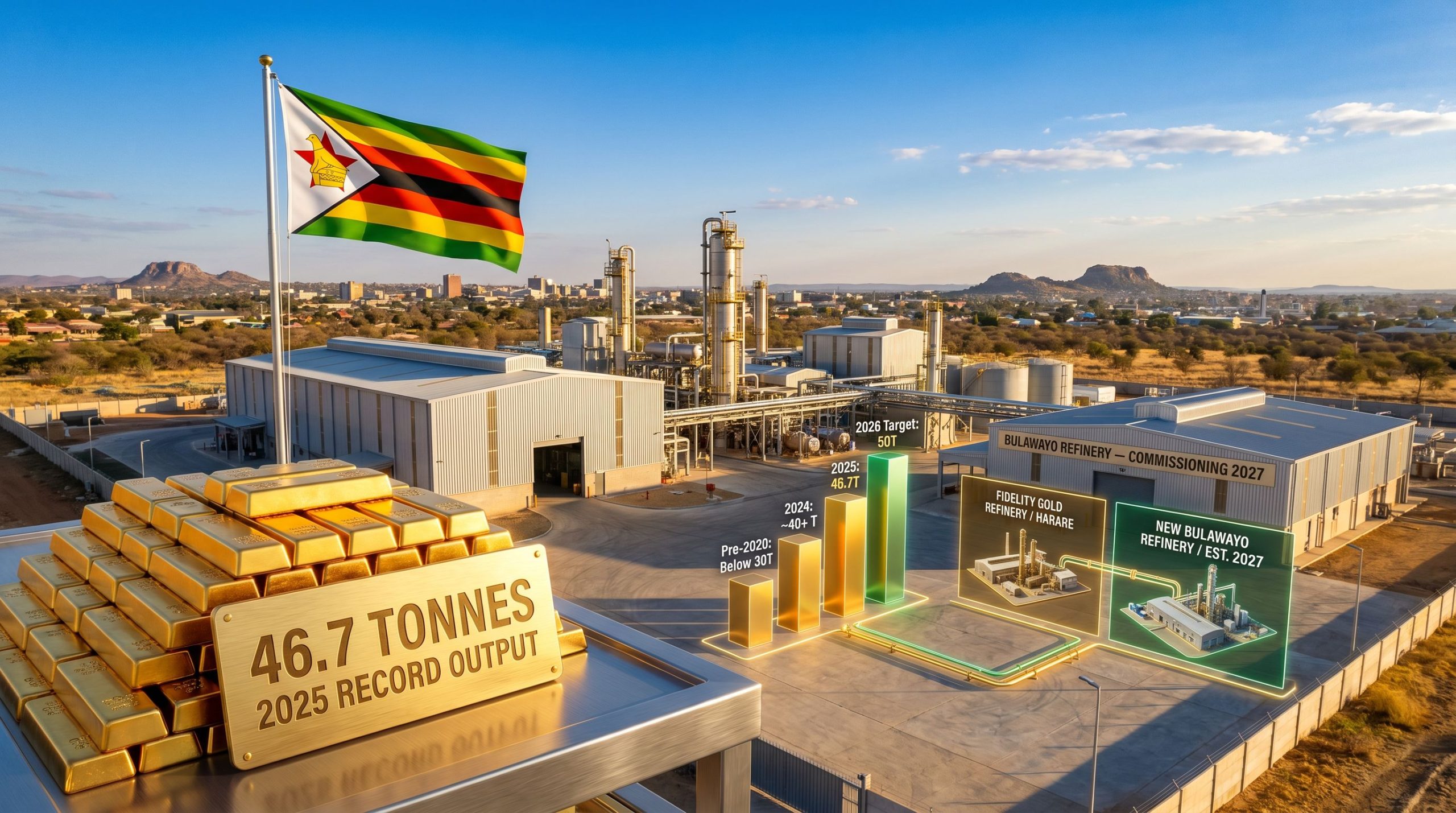
The second engine is mining, and specifically gold. Figures cited by Rio Times reporting on Zimbabwean official data show gold deliveries of 16.59 tonnes in January to May 2026, with H1 2026 gold exports of about US$3.1 billion, and total mining exports of US$6.21 billion in the first half, up 121.3 percent year on year. The government's 2026 gold production target is 55.6 tonnes. Total foreign currency receipts reached US$10.72 billion in the first half, up 47.8 percent. These are large numbers for an economy of roughly US$50 billion, and they have allowed the central bank to build reserves from about US$1.17 billion in January 2026 to more than US$1.5 billion by May.
How Stability Was Engineered
The ZiG's resilience is not an accident of luck. Since its introduction in April 2024 the Reserve Bank of Zimbabwe has pursued tight monetary conditions, high policy rates, and a policy of not financing the budget through money printing. The policy rate was cut from 35 percent to 30 percent on 15 June 2026, a cautious easing that signals confidence without abandoning discipline. Fiscal policy has been equally restrictive. The World Bank estimates the 2025 fiscal deficit at only 0.4 percent of GDP, with revenues rising to 15.2 percent of GDP from 12.9 percent the year before.
Zimbabwe has also used an IMF Staff-Monitored Program (SMP) as an external anchor. An SMP is an informal arrangement that involves no IMF financing and no Executive Board endorsement, but it gives creditors and investors a credible external report card. The first review was completed by IMF management on 27 July 2026, and a staff-level agreement on the second review followed on 18 September 2026. According to the IMF, all quantitative and indicative targets through end-June 2026 were met except protected social spending. Two structural benchmarks were completed, namely the Zimbabwe Social Registry manual and a Treasury Single Account reform strategy, while work advanced on an electronic foreign-exchange trading platform, a strategy for liberalising the foreign-exchange market, a liability-management framework, a second National Anti-Corruption Strategy, and the publication of the Mutapa Investment Fund's financial statements. The IMF also projects a current account surplus for 2026 and 2027.
The Limits of the Recovery: Debt, Arrears and De-dollarisation
The central obstacle is debt. The World Bank puts total public debt at US$23.6 billion, or 45.6 percent of GDP, in 2025, a ratio that would look manageable elsewhere. The problem is composition and status: external arrears of about US$7.4 billion are blocking access to concessional lending from the multilateral development banks, and domestic expenditure arrears add roughly US$1.3 billion, or about 2.6 percent of GDP. The World Bank describes the debt as unsustainable in its present form. Without an arrears clearance and restructuring process, Zimbabwe cannot tap the long-tenor, low-interest financing that would fund roads, power, water and health systems. The IMF has accordingly kept arrears clearance and debt restructuring at the centre of its dialogue with Harare.
Dollarisation is a second constraint. The parallel market rate was reported at around ZiG 32 per dollar in August 2026, a premium of roughly 20.7 percent over the official rate, and one measure of mono-currency readiness stands at only 50.1 percent, indicating that dollar pricing still dominates about half the economy. A currency that citizens do not fully trust is fragile even when the headline inflation rate is low. This is why the IMF and the central bank are working on foreign-exchange market liberalisation and an electronic trading platform: unifying the market and narrowing the premium is a precondition for durable confidence.
Finally, the strength of the mineral boom raises the question of who benefits. Gold and other minerals generate large export receipts but relatively little employment. Fiscal transparency, including the publication of the Mutapa Investment Fund statements, is a step towards ensuring that resource wealth is properly accounted for.
The Social Dimension: Poverty and Protection
The human side of the recovery is slower than the macroeconomic one. The World Bank estimates that 45.2 percent of Zimbabweans lived below the international poverty line of US$3.00 per day in 2025, and 60.5 percent below the lower-middle-income threshold of US$4.20. It projects the international poverty rate falling only to 43.9 percent in 2026. In other words, a year of exceptional growth and single-digit inflation is expected to lift only about one percentage point of the population out of extreme poverty. Low-income households are especially exposed to agricultural swings and to the uncertainty of an economy still partly priced in dollars they do not hold.
This is why the IMF's warning on protected social spending deserves attention. The programme met its fiscal targets, but did so in part by underspending on the priority social areas that cushion poor households. The newly completed Zimbabwe Social Registry manual is a step towards a targeted, data-driven social protection system, but a registry only matters if resources flow through it. Health, education and cash transfers must be protected in the 2027 budget, especially with a projected El Nino year ahead.
What Comes Next
Three priorities stand out. First, a credible arrears clearance path, ideally agreed with creditors and the multilateral banks, would unlock concessional finance and lower the country risk premium. Second, deepening the exchange-rate reforms and rebuilding trust in the ZiG would reduce the need for dollar hoarding and support formal savings and credit. Third, converting mineral windfalls into diversified growth, through agro-processing, energy and skills, would reduce the economy's exposure to rain and commodity prices. Zimbabwe's recent progress shows that discipline can work quickly. Whether it produces lasting transformation depends on whether the gains reach the roughly four in ten Zimbabweans who still live in extreme poverty, and on whether the state can resolve a debt problem that has outlasted several governments.



