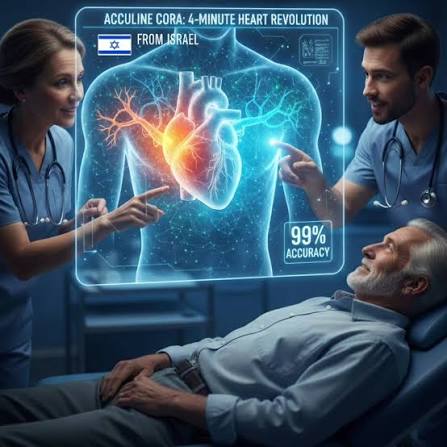
For decades, the only way to truly measure the fluid pressure that signals heart failure meant threading a catheter through a vein and into a patient's heart. This week, federal regulators cleared a briefcase-sized machine that claims to get the same answer using seven chest electrodes and a fingertip clip — and doctors say it could catch heart failure years before a crisis sends someone to the ER.
RESEARCH TRIANGLE PARK, North Carolina
Imagine finding out you're heading toward heart failure not from a hospital bed after a 911 call, but from a four-minute test in your regular doctor's office — no sedation, no catheter threaded through a vein into your heart, no overnight hospital stay, no bill running into the thousands. That's the promise behind a device that just cleared one of its biggest regulatory hurdles yet: the FDA has cleared the CorVista System's new Pulmonary Capillary Wedge Pressure, or PCWP, Add-On, a tool designed to flag the single measurement that has long required the most invasive test in mainstream cardiology.
Pulmonary capillary wedge pressure sounds like a mouthful of medical jargon, and it is — but what it measures is brutally simple and brutally important. It's an estimate of the pressure inside the left side of your heart, the chamber responsible for pumping oxygenated blood out to the rest of your body. When that pressure creeps up, fluid starts backing up into the lungs. That backup is heart failure, and elevated wedge pressure is one of its earliest and most reliable fingerprints — whether the failing heart still pumps at full strength (a version of the disease called HFpEF) or has lost muscle power altogether (HFrEF).
Until now, getting a hard number on that pressure meant right heart catheterization: a thin tube snaked from a vein in the neck, arm, or groin, up through the blood vessels and directly into the heart's chambers to take a live pressure reading. It's the diagnostic gold standard for a reason — it's extremely accurate — but it's also invasive, expensive, requires a specialized lab and team, and carries real, if small, procedural risks including bleeding, infection, and irregular heart rhythms. For a condition that now affects an estimated 6.7 million American adults, and is projected to climb to 8.7 million by 2030, that bottleneck has been a quiet crisis of its own.
A FOUR-MINUTE TEST BUILT ON YOUR HEART'S OWN SIGNALS
The CorVista System sidesteps the catheter entirely. A patient sits still for roughly three and a half minutes while seven electrodes on the chest and back and a photoplethysmography sensor clipped to the index finger — the same kind of light-based sensor used in a pulse oximeter — quietly record the electrical and blood-flow signals the heart is already emitting. That raw signal data is sent to the cloud, where a machine-learning algorithm trained on thousands of prior patients, many of whom also underwent invasive catheterization or echocardiography for comparison, crunches the numbers and spits out a risk read on elevated wedge pressure. Results land in a secure web portal in a matter of minutes, fast enough for a physician to review them before the patient has even left the building.
It's the latest indication cleared for a platform that has been quietly stacking up FDA clearances since 2023, when it first won clearance to help detect coronary artery disease. It picked up clearance for pulmonary hypertension detection in April 2024, on the strength of a Breakthrough Device Designation the FDA had awarded two years earlier — a designation CorVista Health says marked the first major advance in pulmonary hypertension diagnostics in more than 40 years. Heart failure detection, including this new PCWP capability, has been the next frontier the company has been racing toward ever since, and additional indications remain in active development.
"We're very pleased for the opportunity to continue to work closely with the FDA to fulfill our mission to improve the diagnosis and treatment of cardiovascular diseases," said Don Crawford, President and CEO of CorVista Health, discussing the company's ongoing FDA collaboration. The company has framed the PCWP clearance as another step toward a bigger goal: putting hospital-grade cardiac diagnostics into a doctor's office visit instead of a specialty referral that can take weeks to schedule.
A DIAGNOSTIC SYSTEM THAT'S QUIETLY BROKEN
The case CorVista is making isn't subtle: American cardiology has a diagnosis problem, and it's bigger than most patients realize. According to the company's own clinical data, an estimated 69% of heart failure cases are misdiagnosed at the primary care level — meaning the majority of patients showing textbook warning signs like breathlessness, fatigue, and swelling are being sent home with the wrong explanation, or no explanation at all, until the disease has progressed further. In a related statistic that should alarm anyone who's ever brushed off chest tightness as "probably nothing," 41% of heart attack patients turn out to have had undiagnosed coronary artery disease sitting there beforehand, unnoticed.
Those numbers point to a system where patients experiencing vague, easy-to-dismiss symptoms — shortness of breath climbing stairs, unusual tiredness, ankles a little more swollen than usual — get funneled into what CorVista's own materials describe as a "long and fragmented diagnostic journey": a family doctor visit, then a referral to a cardiologist, then a wait for an echocardiogram or stress test, then possibly another wait for a catheterization lab slot, weeks or months after the first symptom appeared. Heart failure specialists have argued for years that survival and quality of life hinge enormously on how early the disease gets caught — patients diagnosed and treated before their first hospitalization tend to fare dramatically better than those who first learn they're sick in an emergency room.
The financial stakes back up the urgency. Heart failure now costs the U.S. health system an estimated $227 billion a year in direct costs, a figure some researchers project could balloon to $858 billion annually by 2050 as the population ages. The disease was a contributing factor in more than 425,000 deaths in a single recent year, accounting for close to half of all U.S. cardiovascular deaths. A test that could plausibly move even a modest fraction of those diagnoses earlier — into a routine primary care visit instead of a hospital bed — represents both a public health opportunity and, frankly, a massive commercial one, which is part of why device makers like CorVista have been racing to build out point-of-care cardiac diagnostics.
WHAT THE EXPERTS ARE WATCHING
Point-of-care, AI-assisted cardiac testing has been one of the fastest-growing corners of health technology over the past two years, and clinicians who study heart failure diagnostics have generally welcomed tools that promise earlier detection — with a consistent caveat. Non-invasive, algorithm-driven tests are typically validated against the invasive gold standard (in this case, right heart catheterization and echocardiography) in controlled clinical studies, and cardiologists tend to stress that a screening flag is not the same as a diagnosis. A positive CorVista reading is designed to indicate the likelihood of elevated wedge pressure and prompt further evaluation, not to replace catheterization outright in patients who need a definitive, quantitative pressure reading before major treatment decisions like advanced heart failure therapies or transplant evaluation.
Still, the clinical logic behind screening tools like this one is straightforward: catheterization will never be practical as a first-line test for the tens of millions of Americans with vague cardiac symptoms walking into primary care offices every year. A fast, cheap, low-risk screen that can tell a doctor which of those patients actually need to be fast-tracked to a specialist — and which don't — has real potential to compress that "long and fragmented diagnostic journey" into something closer to a single visit.
WHAT THIS MEANS FOR YOU
If you or someone in your family has been brushing off breathlessness on stairs, ankles that seem puffier by evening, or a tiredness that doesn't track with how much sleep you're getting, this is the kind of technology that could eventually change how quickly those symptoms get taken seriously. As CorVista and its point-of-care platform roll out more broadly following this clearance, expect it to start showing up first in cardiology practices and larger primary care networks rather than every neighborhood clinic — new medical technology typically reaches early-adopter health systems well before it becomes standard everywhere.
In the meantime, the clearance doesn't change the current advice from heart specialists: don't wait for a new gadget to take persistent cardiac symptoms seriously. Unexplained shortness of breath, swelling in the legs or abdomen, or fatigue that's out of proportion to your activity level are still reasons to see a doctor now, using whatever tools — invasive or not — are already available in your area.
THE BOTTOM LINE
Heart failure is one of the most expensive, most common, and most under-diagnosed conditions in American medicine, quietly contributing to hundreds of thousands of deaths a year while frequently going unrecognized until a crisis forces the issue. The newly cleared CorVista PCWP Add-On won't replace catheterization for patients who need a precise, definitive reading before major treatment decisions — but as a fast, non-invasive screening tool that can be deployed in a routine office visit, it represents the kind of incremental technology shift that cardiologists have wanted for years: catching the disease sooner, in more ordinary settings, before it turns into an emergency.
Published By | Features Editor