World Politics
Background
The modern White House press corps is an odd institution: it has no statutory basis, no charter and no guarantee of anything. Its access rests on custom — on the assumption, held by every administration since Franklin Roosevelt's, that the executive branch tolerates being watched at close range by reporters it did not choose and cannot fire. That assumption has been under sustained pressure since January 2025, and on Friday afternoon it was tested more directly than at any point in the modern era.
The pattern was set early. In February 2025 the White House barred Associated Press journalists from the Oval Office, from Air Force One and from other events too small to accommodate the full press corps, after the wire service declined to adopt the president's preferred name, "Gulf of America," for the Gulf of Mexico in its widely used stylebook. The AP sued on First Amendment grounds. A federal judge ruled in April 2025 that the White House had to restore its access; an appeals court subsequently allowed the administration to keep the AP out of smaller restricted spaces while the litigation proceeds. That case is still open. Alongside it, the administration has pursued or threatened legal action against The New York Times, The Wall Street Journal and the BBC over stories the president objected to; the Times and Journal cases were dismissed, and the BBC has moved for dismissal of its own.
There is an older precedent too. In 2018, during Trump's first term, the White House revoked the press credential of CNN's Jim Acosta after a contentious exchange at a news conference. CNN sued, a federal judge ordered the pass restored, and the administration complied and dropped the matter. The Pentagon has followed a parallel track: new press rules imposed on national security reporters prompted a large number of outlets to surrender their credentials rather than sign. The through-line is the treatment of access as leverage — something granted to outlets that please and withdrawn from those that do not.
Key Developments
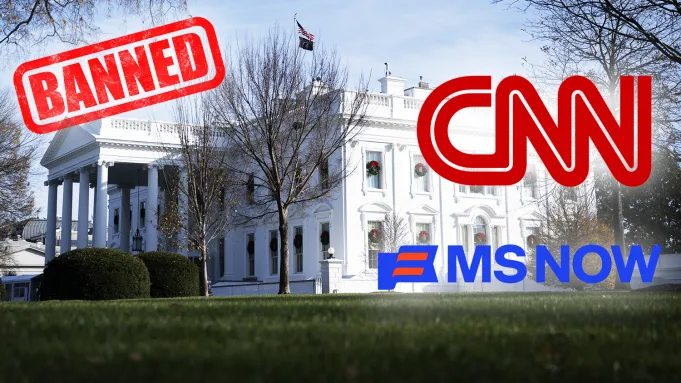
On Friday 18 September, Trump posted on Truth Social: "I am proud to announce that, effective immediately, I am banning Fake News CNN, MSNOW … and Politico … from the White House as a result of their constant 'reporting' FAKE NEWS!" He continued: "Media Outlets shouldn't be able to constantly write or report FICTION and LIES when they're covering the President of the United States, the Trump Administration, or the United States of America. Other Fake News Media Outlets to follow."
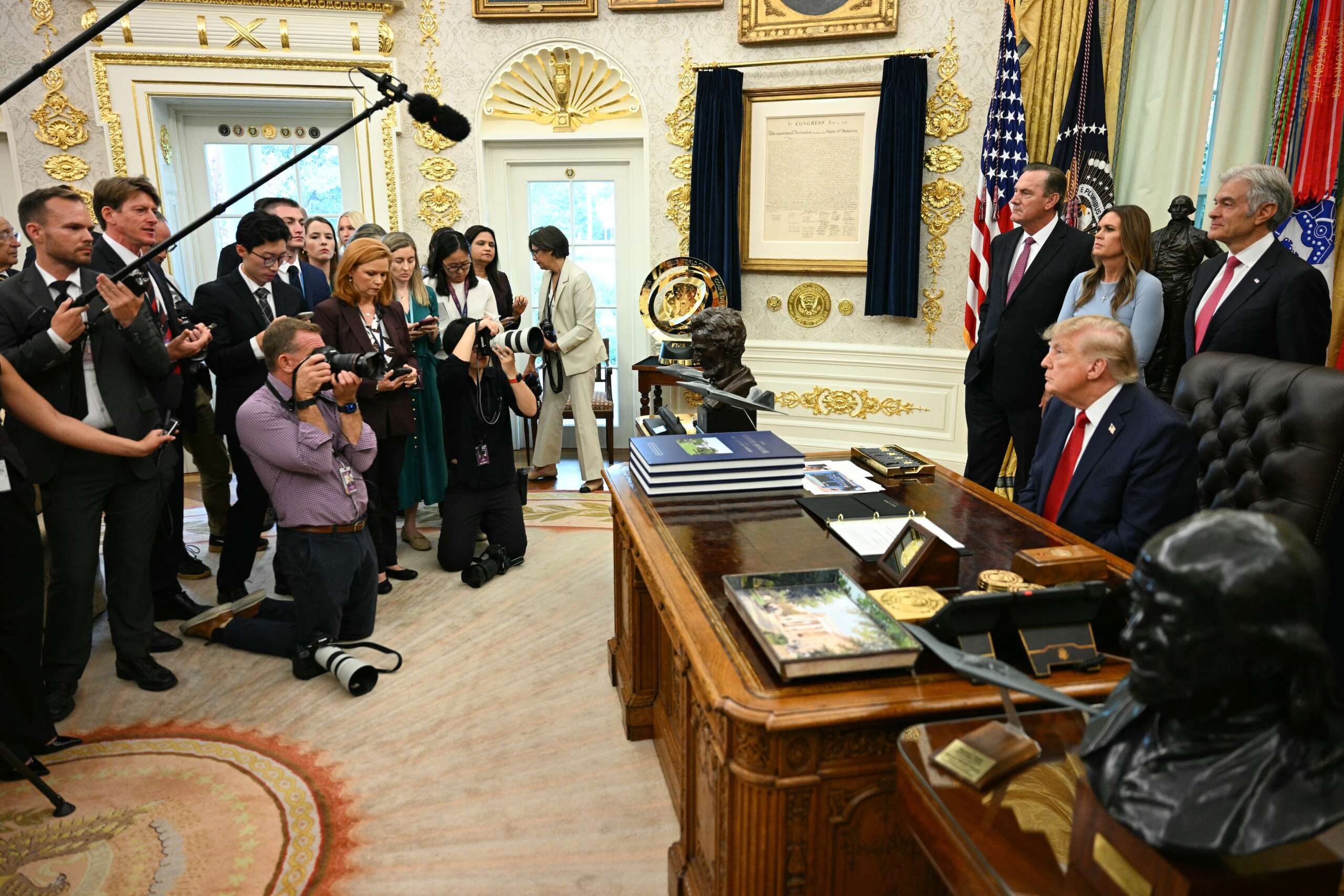
Minutes later he took questions in the Oval Office during a healthcare event, holding up a printout from Breitbart. Asked how the ban squared with his oath to uphold the Constitution, he answered simply: "Because they're fake news. I get so tired of reading and seeing fake news." Asked why now, he said there was no particular reason and no specific story behind it — accounts of the exchange differ slightly, with CBS News rendering the answer as "cumulative stories of the last two years" and TIME as "cumulative stories over the last few years" — before adding, in TIME's account, that the outlets "purposely write negative news, and they do that because they want to try and diminish the Republicans and a Republican administration." Asked whether the point was to intimidate journalists into softening their coverage, he replied: "No, no, no, no. I dislike dishonest press, like you. I think you're terrible." He separately named The New York Times and The Washington Post as "crummy" and possible future targets.
He was also asked whether he expected the ban to survive a court challenge. "I think it's good to point it out whether it survives or doesn't," he said. "I don't think that a court should allow fake news to be written day after day after day." It was an unusually candid acknowledgement that the action's legal durability is secondary to its expressive purpose.
What the announcement conspicuously lacked was any mechanism. The post specified no process for revoking credentials, no effective date beyond "immediately," and no description of what "the White House" covers — the briefing room, the grounds, the travelling pool, or all three. The practical answer on Friday evening was: nothing changed. CNN reporters remained at the White House and continued covering the administration; the president took the regular press pool with him to his golf club in Virginia for a Super PAC dinner before departing for Camp David. The White House, asked for comment, referred reporters to the president's Oval Office remarks.
One structural consequence would be significant if the ban were enforced. CNN is one of the five networks in the television pool that travels with the president and documents his movements and encounters — the mechanism by which independent footage and accounts of presidential activity reach every other outlet, foreign and domestic. Removing CNN from that rotation would not simply punish one company; it would degrade the shared record on which the rest of the press, and the public, depend.
Reactions
The White House Correspondents' Association responded within hours. Its president, Jacqui Heinrich — herself a Fox News correspondent — said the association "stands in defense of our colleagues at CNN, MSNOW, and Politico who are being singled out for doing their jobs," and noted pointedly that "the president said it plainly in the Oval Office, describing his own planned action as a 'ban on the free press.'" She continued: "The Constitution protects the freedom of the press from government interference. That protection does not depend on whether the president likes a news organization's coverage, agrees with its reporting, or approves of the questions its journalists ask." The stakes, she argued, run wider than the newsrooms involved: "It is about the right of the American people to receive a full and independent account of the activities, policies and decisions of whoever occupies the nation's highest office."
CNN said it "stands fully behind our White House team and their fair and accurate reporting," adding that the network has "a right under the U.S. Constitution to do that reporting without hindrance or interference from the government." Politico said it "will continue to fairly report on this White House and future ones," and pledged to "vigorously defend our First Amendment rights against any attempt to restrict them." MS NOW — the cable network that emerged from MSNBC's separation from its former parent — had no immediate comment.
Legal scholars were blunt. Jameel Jaffer, executive director of the Knight First Amendment Institute at Columbia University, called the move unconstitutional. "The First Amendment prohibits the president from punishing journalists because he doesn't like their coverage," he said, "just as it prohibits him from punishing universities because he doesn't like the courses they offer, or from punishing law firms because he doesn't like the clients they represent." He added a second argument aimed at the pool specifically: "If President Trump means to expel these news organizations from the White House press pool, his action is doubly unconstitutional because the press pool is a 'public forum' under the First Amendment, which means the president can't exclude journalists from it on the basis of their viewpoints." The Reporters Committee for Freedom of the Press issued its own condemnation, and leading First Amendment organisations said that any attempt at implementation would be struck down in court.
Not every part of the government disagreed with the president. The Department of Defense said it "fully supports President Trump's decision," with Defense Secretary Pete Hegseth adding that "we are grateful these outlets already chose to self-deport from the Pentagon" — a reference to the credentialing rules that drove many news organisations out of the building rather than sign them. Hegseth spent the same week publicly attacking The Washington Post over its report that more American service members have died in the Iran war than the Pentagon has disclosed, which he called "a complete LIE."
What's Next
The immediate question is whether the administration attempts to operationalise the announcement at all. Nothing in the White House's Friday posture suggested it had prepared to; if credentials are actually pulled, litigation is close to certain, and the AP case gives both sides a reasonably clear map of the terrain. Courts have generally held that once the government opens a forum to the press, it cannot exclude particular journalists on the basis of viewpoint, and that credential revocation requires notice and an opportunity to respond. The counter-argument the administration has advanced — that the president retains discretion over who enters non-public spaces such as the Oval Office and Air Force One — has secured partial, interim success in the AP litigation, which is why the appeals court allowed the narrower exclusions to stand pending resolution.
The second question is political. The announcement lands six weeks before midterm elections in which the president's party is defending narrow majorities, with his approval rating near 39 per cent, an Iran war entering its seventh month and inflation pressures from oil above $100 a barrel. Attacking the press is familiar territory for Trump and reliably popular with his base; whether it registers with anyone else is less clear. What is measurable is the chilling effect on the institutions involved, and the possibility that the threat itself — "other Fake News Media Outlets to follow" — does more work than any enforcement ever could, by inviting every newsroom in Washington to calculate the cost of the next unfavourable story.
For now the ban exists as a sentence on a social media platform, contradicted by the continued presence of the reporters it names. That gap between proclamation and practice has become a recognisable feature of this administration's dealings with the press. It is also, in a system that depends on custom rather than statute, the place where the custom erodes.
Published By | News Editor