Written By |
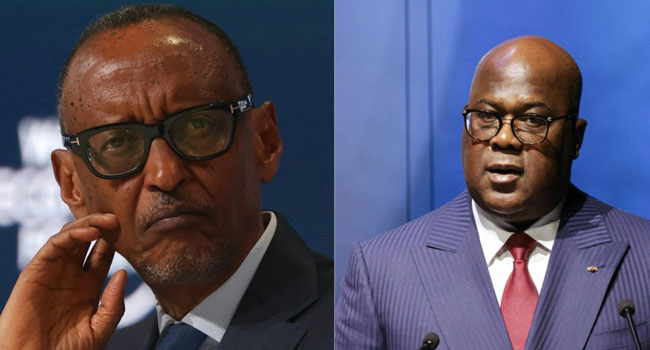
President Félix Tshisekedi said that s peace deal between the DRC and Rwanda aims at ending decades of conflict in eastern Congo paving the way for “a new era of stability
Rich in natural resources, especially lucrative minerals, the vast Democratic Republic of Congo’s (DRC) east has been plagued by deadly violence that has ravaged the region for three decades.
A peace deal between the DRC and Rwanda aimed at ending decades of conflict in eastern Congo paves the way for “a new era of stability,” Congolese President Félix Tshisekedi said on Monday.
Fighting intensified early this year when the Rwanda-backed M23 armed group seized territory, including the key city of Goma in late January and Bukavu several weeks later.
The lightning offensive near Rwanda’s border left thousands dead and deepened a humanitarian crisis for hundreds of thousands of displaced people, according to the DRC government and the United Nations.
After a series of systematically broken truces and ceasefires in recent years, and the failure of several attempts at negotiation between Kinshasa and Kigali, Congolese and Rwandan foreign ministers signed a peace deal in Washington on Friday.
A parallel, Doha-led mediation effort between the DRC government and the M23 is also ongoing.
A representative from Qatar attended Friday’s signing of the agreement, which was described as a significant milestone towards peace by the African Union and the United Nations.
The deal “opens the way to a new era of stability, cooperation, and prosperity for our nation,” Tshisekedi said in a speech broadcast on Monday to mark the 65th anniversary of the DRC’s independence from Belgium.
Won’t ‘Sell Off’ Interests
Tshisekedi is due to meet his Rwandan counterpart, Paul Kagame, in Washington in the coming weeks.
The agreement outlines provisions for the “respect for territorial integrity and halting hostilities” in eastern DRC but these measures have yet to be implemented.
It calls for “a lifting of defensive measures” by Rwanda and the withdrawal of Rwandan soldiers from Congolese territory.
Rwanda has denied directly supporting the M23 but has demanded action against another armed group that it says threatens its security — the Democratic Forces for the Liberation of Rwanda (FDLR), which was established by ethnic Hutus linked to the 1994 genocide of Tutsis in Rwanda.
The agreement calls for the “neutralisation” of the FDLR by Kinshasa.
It also includes economic measures, although few details have been released so far.
In April, the Congolese president discussed a mining agreement with Massad Boulos, a Lebanese-American businessman and father-in-law to Donald Trump’s daughter Tiffany Trump, who was appointed by Tshisekedi as a senior advisor on Africa.
A “regional economic integration framework” aimed at greater transparency in the supply chains of critical minerals is also foreseen under the deal.
Kinshasa will not “sell off any of the DRC’s interests,” government spokesman Patrick Muyaya said on the sidelines of an economic forum in Osaka, Japan, on Saturday.
The DRC is the world’s leading producer of cobalt and has significant deposits of gold and other valuable minerals, including coltan — a metallic ore vital for manufacturing phones and laptops.
“This deal is not just a document; it is a promise of peace for the people affected by the conflict in eastern DRC,” Tshisekedi said.
The text — negotiated through Qatar since before Trump took office — does not explicitly address the territorial gains made by the M23 rebel group. The M23, like the pro-Kinshasa militias it fights, has never officially recognized previous ceasefires. The front line in eastern DRC has remained relatively stable since February. However, clashes continue between M23 fighters and myriad local militias, which employ guerrilla tactics.
Corneille Nangaa, coordinator of the political-military Congo River Alliance — to which the M23 belongs — dismissed the Washington agreement as “limited” and accused Kinshasa of “systematically” undermining the Doha mediation process.